















NASA astronaut shares image of impossible-looking 'hopper' crystal growing on the space station. What is happening?
Astronauts grew a scroll-like crystal aboard the ISS, and its strange shape reveals what happens to ordinary salts once gravity stops running the show.

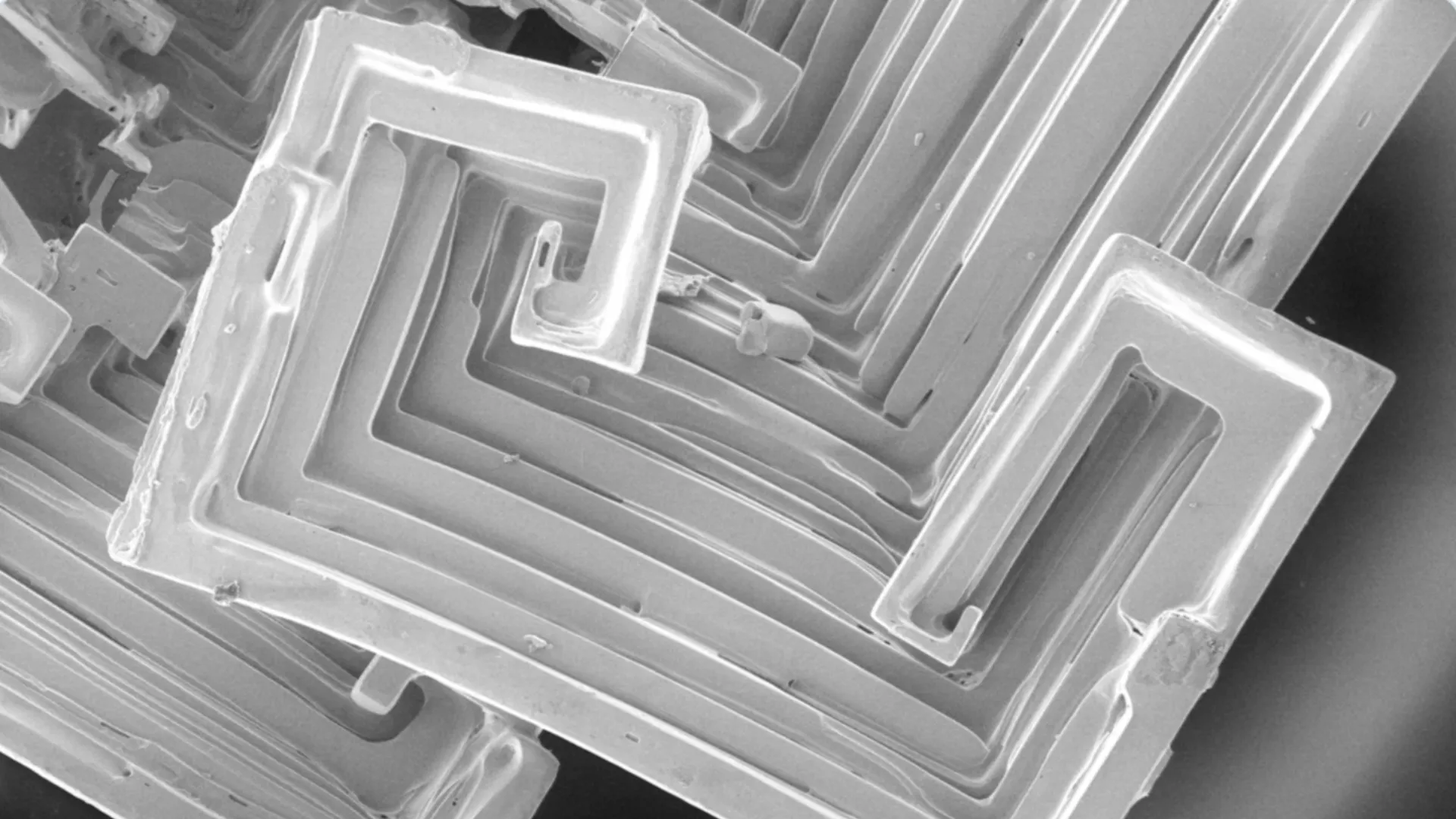
Astronauts have grown a common crystal in space — but this extraterrestrial version is exhibiting a very uncommon behavior. Under a microscope, the crystal looks more like a tiny futuristic sculpture than something that formed naturally. The pyramid-like assembly curls in on itself in stair-stepped layers, seeming almost too orderly to be real. But according to scientists, the striking shape is what happens when gravity stops calling the shots.
The image, shared on July 18 by NASA astronaut Don Pettit, and accompanying video were captured aboard the International Space Station (ISS) and show potassium chloride crystals growing in microgravity — the near-weightless environment experienced in orbit.
Microgravity isn't quite zero gravity; astronauts experience a gravitational pull roughly a million times weaker than on Earth's surface, Anne Wilson, a professor of chemistry and biochemistry at Butler University, told Live Science. That reduction in gravity's tug has profound impacts on the human body, and, as the new image shows, completely changes how liquids and crystals behave as well.
"[Other] forces start to become far more pronounced than gravity forces," Wilson said, pointing to molecular attraction and polarity as two influences that suddenly take over once gravity fades into the background.
Those conditions enable potassium chloride — a common salt used as a sodium substitute in foods and sports drinks — to crystallize in ways that are nearly impossible to reproduce in a terrestrial lab.
On Earth, growing crystals eventually get heavy enough to sag, break or settle at the bottom of their container. But in microgravity, they keep growing outward from wherever they started.
Potassium chloride naturally forms cube-shaped crystals, Wilson said. In microgravity, those crystals grow mainly from their edges and corners instead of across their faces, leaving the center hollow and creating the striking pyramid-like structures seen in the image.
Get the world’s most fascinating discoveries delivered straight to your inbox.
In microgravity, crystals experience "hopper growth," where the outer edges and corners grow at faster rates than the flat faces, creating a step-like appearance. This timelapse records their growth inside a thin water film. Look closely, and you will see the patterns emerge! pic.twitter.com/iSlqJvke1GJune 6, 2026
Scientists call this pattern hopper growth, and it isn't unique to potassium chloride (ordinary table salt forms the same way). As new corners emerge during growth, the crystal can change direction entirely, producing the elegant scrolling pattern visible in the new image.
RELATED STORIES
- 'Extreme' crystal that formed in 1945 nuclear bomb test is unlike anything scientists have seen
- Science history: Chemists discover buckyballs — the most perfect molecules in existence — Nov. 14, 1985
- Only 1% of chemicals in the universe have been discovered. Here's how scientists are hunting for the rest.
While the crystal is visually stunning, the science behind it could prove just as valuable. Materials grown without gravity's interference often form with fewer defects, giving researchers a rare look at what a truly "ideal" structure looks like. This insight could help refine manufacturing processes for semiconductors and other advanced materials back on Earth.
For Wilson, images like this serve another purpose: inspiring curiosity.
"I love seeing videos of how things behave in space," she said. "Who would think that something as simple as potassium chloride could still be super cool?"
ISS astronauts spend a significant amount of their time conducting science experiments that would be near-impossible on Earth. Recently, astronauts used the space station’s newly upgraded Cold Atom Laboratory to create and study an elusive fifth state of matter called the Bose-Einstein condensate. And last year, researchers demonstrated how moss spores exposed to space for nine months on the outside of the ISS continued to grow after being returned to Earth.

Olivia Maule is a science journalist whose beats include space, biotechnology and the environment. She holds a B.A. in biology and a B.S. in anthropology from the University of Florida and completed a master's degree in science communication at U.C. Santa Cruz. A 2025 AAAS Mass Media Fellow, she wrote stories and produced videos during a summer at El Nuevo Día, Puerto Rico's largest newspaper, and has written for Eos, Mongabay, Science magazine and Stanford Report. Olivia is a native Spanish and English speaker.
You must confirm your public display name before commenting
Please logout and then login again, you will then be prompted to enter your display name.