













Eerie green fireball detected hours before smashing into Lake Ontario in the dead of night
A renegade meteor flared in Earth’s atmosphere in the wee hours of Nov. 19, creating a bright green fireball in the sky over the eastern US and Canada.

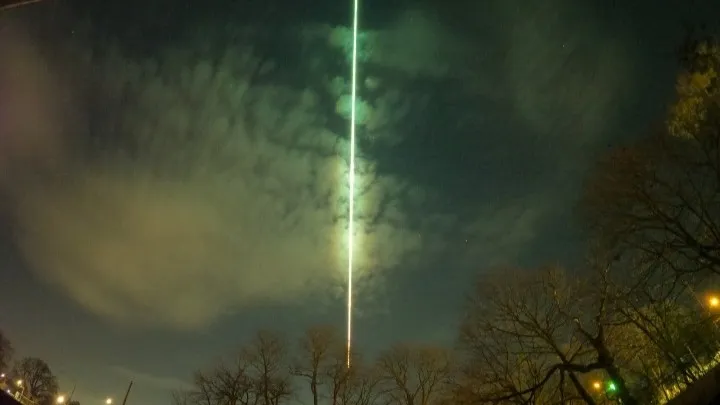
At half past 3:00 a.m. (EST) on Nov. 19, a bright green fireball streaked through the sky over the northeastern United States and southeastern Canada. Witnesses reported seeing a helicopter-like object cruising silently through the air before lighting up huge swathes of the night like an enormous lightning bolt. After about 10 seconds, it was gone.
This fireball was a small meteor, detected by astronomers just three hours before it tumbled through Earth's atmosphere, caught fire and broke up into hundreds of pieces. Most of those pieces likely smacked straight into Lake Ontario, though some small chunks may have impacted land on the lake's southern shore, according to NASA.
Seven observatories around the world watched the meteor make its early morning death dive, and at least 59 people in New York, Maryland, Pennsylvania and the nearby province of Ontario, Canada reported seeing the fireball on the International Meteor Organization's meteor-watching database.
One witness — Dereck Bowen of Brantford, Ontario (a town located about 60 miles, or 97 kilometers, west of the New York border) — managed to capture the fireball's descent with a GoPro camera set to automatically record the sky at night. A spectacular 30-second exposure of the sky shows the moment the meteor soared overhead, with the rock's bright green trail plunging down toward the Earth and lighting up the clouds around it.
Another camera set up outside the nearby CN Tower — a 1,815-foot-tall (553 meters) communications tower in Toronto — also captured the meteor's bright passage across the sky.
Well, here's a BEAUTIFUL view of the bolide from the camera that looks up at the Tower... pic.twitter.com/cxl1lrVeM8November 19, 2022
Fireballs are exceptionally bright meteors that typically originate from asteroids or pieces of comets that orbit the sun, according to NASA.
Get the world’s most fascinating discoveries delivered straight to your inbox.
Related stories
The Nov. 19 fireball — now officially named 2022 WJ1 — was likely a small asteroid measuring no more than 3.2 feet (1 m) in diameter. When space rocks like these enter Earth's atmosphere, they heat up and slow down from the intense friction, producing a visible wake of fiery light behind them. Depending on a meteor's composition, it may also glow green as it tumbles to its doom.
Fireballs are generally considered to be harmless, as most of their pieces burn up in the atmosphere before impacting Earth. However, there may be some rare exceptions. On Nov. 5, a man in California claimed that a fireball set his house on fire after it appeared in the sky moments earlier. Experts from the California Department of Forestry and Fire Protection are still investigating the cause of the blaze.

Brandon is the space / physics editor at Live Science. With more than 20 years of editorial experience, his writing has appeared in The Washington Post, Reader's Digest, CBS.com, the Richard Dawkins Foundation website and other outlets. He holds a bachelor's degree in creative writing from the University of Arizona, with minors in journalism and media arts. His interests include black holes, asteroids and comets, and the search for extraterrestrial life.