













New Way to Kill Viruses: Shake Them to Death

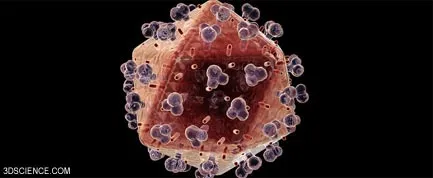
Scientists may one day be able to destroy viruses in the same way that opera singers presumably shatter wine glasses. New research mathematically determined the frequencies at which simple viruses could be shaken to death.
"The capsid of a virus is something like the shell of a turtle," said physicist Otto Sankey of Arizona State University. "If the shell can be compromised [by mechanical vibrations], the virus can be inactivated."
Recent experimental evidence has shown that laser pulses tuned to the right frequency can kill certain viruses. However, locating these so-called resonant frequencies is a bit of trial and error.
"Experiments must just try a wide variety of conditions and hope that conditions are found that can lead to success," Sankey told LiveScience.
To expedite this search, Sankey and his student Eric Dykeman have developed a way to calculate the vibrational motion of every atom in a virus shell. From this, they can determine the lowest resonant frequencies.
As an example of their technique, the team modeled the satellite tobacco necrosis virus and found this small virus resonates strongly around 60 Gigahertz (where one Gigahertz is a billion cycles per second), as reported in the Jan. 14 issue of Physical Review Letters.
A virus' death knell
Get the world’s most fascinating discoveries delivered straight to your inbox.
All objects have resonant frequencies at which they naturally oscillate. Pluck a guitar string and it will vibrate at a resonant frequency.
But resonating can get out of control. A famous example is the Tacoma Narrows Bridge, which warped and finally collapsed in 1940 due to a wind that rocked the bridge back and forth at one of its resonant frequencies.
Viruses are susceptible to the same kind of mechanical excitation. An experimental group led by K. T. Tsen from Arizona State University have recently shown that pulses of laser light can induce destructive vibrations in virus shells.
"The idea is that the time that the pulse is on is about a quarter of a period of a vibration," Sankey said. "Like pushing a child on a swing from rest, one impulsive push gets the virus shaking."
It is difficult to calculate what sort of push will kill a virus, since there can be millions of atoms in its shell structure. A direct computation of each atom's movements would take several hundred thousand Gigabytes of computer memory, Sankey explained. He and Dykeman have found a method to calculate the resonant frequencies with much less memory.
In practice
The team plans to use their technique to study other, more complicated viruses. However, it is still a long way from using this to neutralize the viruses in infected people.
One challenge is that laser light cannot penetrate the skin very deeply. But Sankey imagines that a patient might be hooked up to a dialysis-like machine that cycles blood through a tube where it can be hit with a laser. Or perhaps, ultrasound can be used instead of lasers.
These treatments would presumably be safer for patients than many antiviral drugs that can have terrible side-effects. Normal cells should not be affected by the virus-killing lasers or sound waves because they have resonant frequencies much lower than those of viruses, Sankey said.
Moreover, it is unlikely that viruses will develop resistance to mechanical shaking, as they do to drugs.
"This is such a new field, and there are so few experiments, that the science has not yet had sufficient time to prove itself," Sankey said. "We remain hopeful but remain skeptical at the same time."
- Video: Learn About a New Flu Fighter
- Inside Look: How Viruses Invade Us
- Top 10 Mysterious Diseases
