













Crows Hold Grudges in Humanlike Fashion

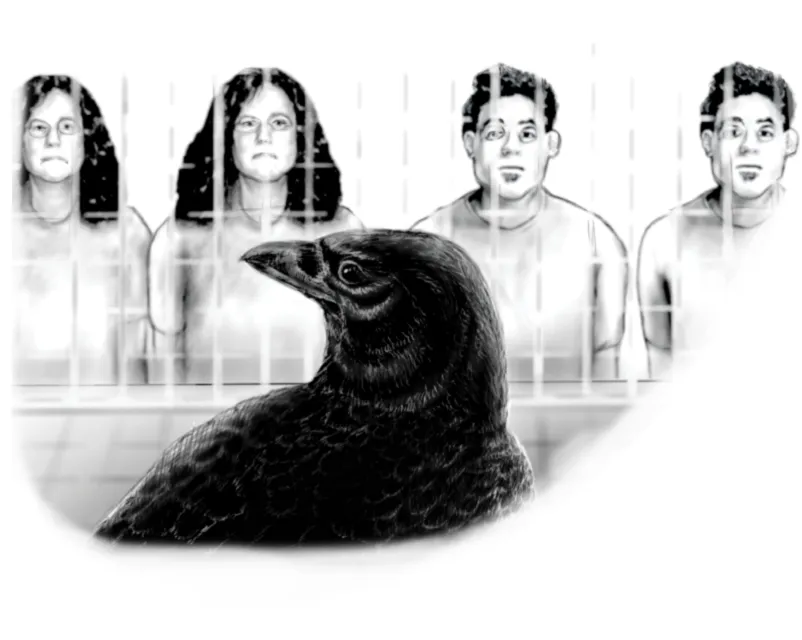
Crows don't forget a face — and they hold grudges, too.
Researchers in Seattle revealed last year that captured crows remember the face of their abductor. Even though years had passed since they saw the threatening face, the crows in the experiment would taunt their captor and dive-bomb him, suggesting the birds held tightly to a negative association.
Now the researchers' follow-up study shows that the birds' brains light up much like the human mind when they see a face they know.
"The regions of the crow brain that work together are not unlike those that work together in mammals, including humans," lead researcher John Marzluff, of the University of Washington, said in a statement from the school. "These regions were suspected to work in birds but not documented until now."
In the study, 12 male adult crows were captured by researchers who were all wearing one type of mask, referred to in the study as the threatening face. Then during four weeks of captivity, the birds were fed by people wearing a different mask. Though both disguises had neutral expressions, this mask was referred to ask the caring face.
To see what was going on in the birds' brains when they saw both faces, the researchers injected a glucose fluid into the bodies of fully alert crows. The crows were then put in the presence of someone wearing either the threatening or caring mask for about 15 minutes before the birds were sedated and given a brain scan. [Pretty Bird: Images of a Clever Parrot]
The fluid revealed which parts of their brains were most active around a certain mask-wearer. Marzluff said it appears the smart birds have a region of their brain that is analogous to the amygdala of mammals.
Get the world’s most fascinating discoveries delivered straight to your inbox.
"The amygdala is the region of the vertebrate brain where negative associations are stored as memories," he said in the statement. "Previous work primarily concerned its function in mammals, while our work shows that a similar system is at work in birds."
The study, detailed this week in the Proceedings of the National Academy of Sciences, suggests that caretakers might be able to reduce the stress of captive animals by treating them well and consistently.
"By feeding and caring for birds in captivity their brain activity suggests that the birds view their keepers as valued social partners, rather than animals that must be feared," Marzluff said.
He added that the findings might even be used to make better behaved crows, suggesting that the birds could be manipulated to associate eating a rare species with a negative experience to train them to avoid a particular prey.
Follow LiveScience on Twitter @livescience. We're also on Facebook & Google+.
