Like a motorcycle windshield splattering bugs on the highway, Earth's atmosphere is constantly deflecting tiny bits of extraterrestrial rock, dust and other space garbage that get in the way of our planet's 67,000-mph (107,000 km/h) joyride. Occasionally, that debris breaks through — as it did 66 million years ago, when an asteroid the size of Manhattan crashed into the Gulf of Mexico and killed the dinosaurs.
That impact was singularly catastrophic. But, according to a new study published today (Jan. 17) in the journal Science, that smashup was also just one episode in an ongoing spike of gargantuan asteroid impacts bombarding our neck of the solar system. After studying 1 billion years of asteroid craters on the Earth and moon, the study's authors found that the rate of huge asteroid impacts on Earth has nearly tripled in the past 290 million years — and nobody's sure why. [When Space Attacks: 6 Craziest Meteor Impacts]
"It's perhaps fair to say it was a date with destiny for the dinosaurs," study co-author Thomas Gernon, associate professor of Earth science at the University of Southampton in the U.K., said in a statement. "Their downfall was somewhat inevitable given the surge of large space rocks colliding with Earth."
Latest Videos From
Reading the scars
In the past, researchers have attempted to estimate the hit rate of asteroids on Earth by dating the rocks at large impact craters around the world. The trouble is it's hard to find craters older than about 300 million years, so geologists suspect that geologic processes like erosion and plate tectonics periodically scrub the world's oldest craters out of existence. This potential erasure of old craters is known as "preservation bias," and it makes accurately calculating Earth's asteroid impact rate a challenge.
To get around this bias, Gernon and his colleagues from the United States and Canada looked to the moon.
Earth's natural satellite (which itself may have resulted from a huge space-rock collision 4.5 billion years ago) is the planet's closest cosmic companion and faces roughly the same proportion of asteroid hits over time, the researchers wrote. And because the moon is not subject to forces like plate tectonics, its oldest craters are thought to remain on full view.
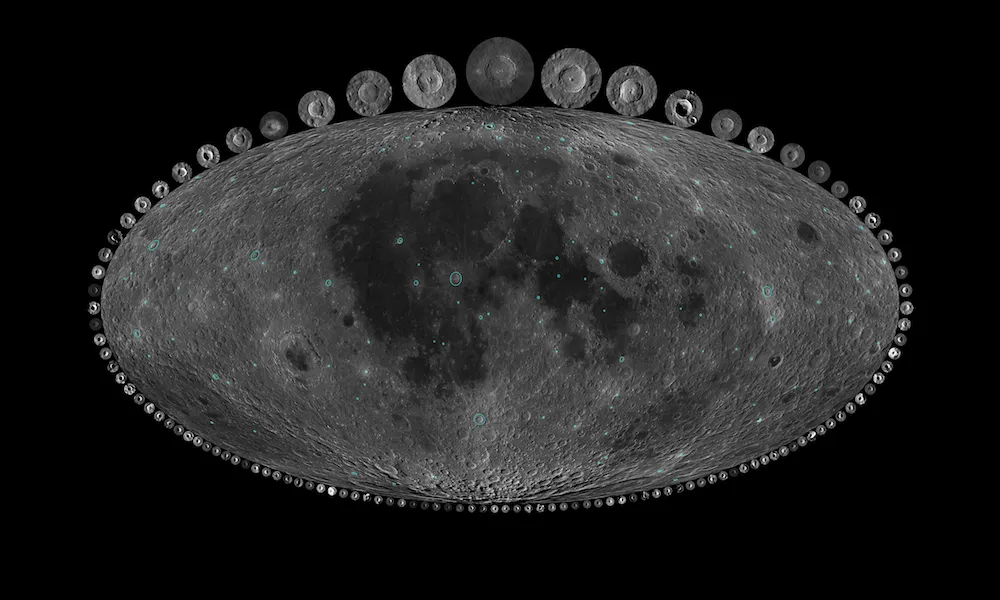
In their new study, the researchers picked 111 large lunar craters (those with a diameter larger than 6.2 miles, or 10 kilometers) that were less than 1 billion years old. To estimate the ages of these lunar scars, the researchers turned to NASA's Lunar Reconnaissance Orbiter (LRO), which has been taking infrared images of the moon since 2009.
These images helped the researchers see how heat radiates off of the moon's surface. They saw that larger rocks (the kind kicked up by big asteroid impacts) absorbed more radiation during the day and tended to release more heat than comes from fine lunar soil, which has been pummeled into dust over millions of years of tiny micrometeorite impacts. (Unlike Earth, the moon has no effective atmosphere to protect it from these constant, tiny strikes.) [Crash! 10 Biggest Impact Craters on Earth]
Because it takes so long for big rocks to break down into dust, the researchers concluded that craters surrounded by larger, hotter boulders probably resulted from more-recent asteroid impacts than did craters carpeted with pulverized dust. With this in mind, the team was able to calculate the approximate ages of their chosen lunar craters, without leaving their Earthly laboratories.
A billion-year bombardment
The team found that, much like Earth, the moon has far more craters that formed in the last 290 million years than those that formed in the previous 700 million years. Indeed, around 300 million years ago, the rate of asteroids pummeling the Earth and moon seems to have increased threefold.
"This means that the Earth has fewer older craters on its most stable regions not because of erosion but because the impact rate was lower prior to 290 million years ago," study co-author William Bottke, an asteroid expert at the Southwest Research Institute in Boulder, Colorado, said in the statement.
Why did the rate of asteroid impacts pick up so drastically about 300 million years ago? It's hard to say, but the researchers suggested that it could be the result of a huge asteroid-on-asteroid impact in the asteroid belt between Mars and Jupiter around that time. If two big enough rocks hit each other fast enough, it could have led to a cascading series of collisions that lasted hundreds of millions of years.
Fortunately, scientists today are (mostly) pretty good at noticing when a large extraterrestrial object is coming our way. In June 2018, NASA announced a five-point plan detailing how the U.S. government plans to detect and, if necessary, clean up after large, Earth-bound objects that could breach the planet's atmosphere. Of the more than 8,000 large asteroids near Earth that NASA knows about, none pose a threat within the next century, an agency spokesperson said.
That's comforting news for now. But if humans should last nearly as long as the dinosaurs did (about 200 million years), we may yet have our own date with destiny in store.
Originally published on Live Science.
The 5 Strangest Meteorites in History
Fallen Stars: A Gallery of Famous Meteorites
10 Things You Didn't Know About the Moon

 Live Science Plus