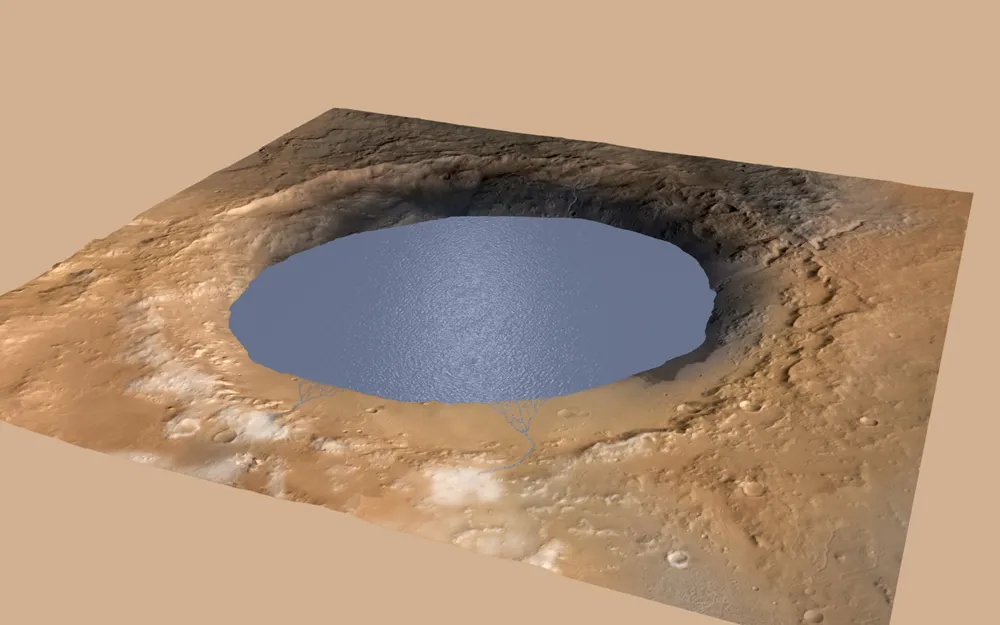
A giant crater on Mars may have been able to support microbial life for millions of years in the ancient past because it was once a huge lake of water, new results from NASA's Curiosity rover suggest.
Curiosity found evidence for the crater lake on Mars in the 96-mile-wide (154 kilometers) Gale Crater, which the rover has been exploring since its August 2012 touchdown. Today, Gale Crater is a dry, stark landscape, but in the ancient past, runoff from the crater rim created a lake in which deposited sediments gradually built up Mount Sharp, a mountain that rises about 3.4 miles (5.5 km) high from the crater's center, mission scientists added.
"This lake was large enough it could have lasted millions of years — sufficient time for life to get started and thrive, sufficient time for lake sediments to build up and form Mount Sharp," Michael Meyer, Mars Exploration Program lead scientist at NASA Headquarters in Washington, said during a press conference today (Dec. 8). [Ancient Mars Could Have Supported Life: Photos]
The origin and evolution of Mount Sharp have puzzled mission scientists since before Curiosity's November 2011 launch. But the rover's recent observations at and near the mountain's base have brought the picture into much clearer focus, researchers said.
At multiple locations, Curiosity noticed beds of sandstone sloping toward Mount Sharp. On Earth, such "inclined beds" are seen at deltas where rivers once emptied into lakes, said Curiosity science team member Sanjeev Gupta of Imperial College London. And that's likely what created the features on Mars, he added.
"These are likely to be quite small, maybe a couple of meters water depth — so very, very small deltas, but certainly clear evidence that we're building out, likely, into a standing body of water," Gupta said.
NASA's Curiosity Mars rover, looking toward the west, viewed inclined strata at "Zabriskie Plateau," northeast of the "Pahrump Hills" outcrop at the base of Mount Sharp. Image released Dec. 8, 2014.
(Image credit: NASA/JPL-Caltech/MSSS)
The deposits were observed at multiple elevations, suggesting that they were laid down in multiple cycles, he added.
Sign up for the Live Science daily newsletter now
Get the world’s most fascinating discoveries delivered straight to your inbox.
Curiosity also spotted rocks with rhythmic, millimeter-scale banding at an outcrop at Mount Sharp's base called Pahrump Hills — something the robot had not seen before on Mars. Here on Earth, such finely banded rocks form when sediment rains down softly, so they're strong evidence for standing water, said Curiosity project scientist John Grotzinger, of the California Institute of Technology in Pasadena.
Also at Pahrump Hills, Curiosity saw crystals in a rock that appear to be salts left behind after the evaporation of water, Grotzinger added.
"We don't imagine that this environment was just a single lake that stood for millions of years, but rather a system of alluvial fans, deltas and lakes and dry deserts that alternated for millions, if not tens of millions, of years as a connected system," Grotzinger said.
The lake, when it existed, was probably not particularly deep, Gupta said. (While depths at the delta locations are just a few meters or so, it's difficult to estimate the depth of the overall lake.)
Further, the southward inclination of the deposits is tough to explain if Mount Sharp had been present when they were laid down, reseachers said: Water should have flowed downhill, to the north, off Mount Sharp in these locations.
"The resolution of the paradox is to acknowledge that the layers represent a time when water was flowing from the crater rim toward the crater interior, and it filled up a series of stacks, and then subsequently those stacks of layers were eroded" to form Mount Sharp, Grotzinger said.
So, sediment suspended in runoff water probably filled in much of Gale Crater over thousands or millions of years. Wind then carved away much of this material, leaving behind the enormous mound known as Mount Sharp, researchers said.
Curiosity rover spotted an example of a thin-laminated, evenly stratified rock type that occurs in the "Pahrump Hills" outcrop at the base of Mount Sharp on Mars. Image released Dec. 8, 2014.
(Image credit: NASA/JPL-Caltech/MSSS)
A warmer, wetter Mars
Mars must have been a very different place about 3.5 billion years ago than it is today to support the Gale Crater lake, said Curiosity deputy project scientist Ashwin Vasavada, of NASA's Jet Propulsion Laboratory in Pasadena: It had to have been warmer, wetter and with a much thicker atmosphere.
But climate models have a hard time explaining how such conditions could have persisted for long stretches on ancient Mars, Vasavada said. So perhaps a rethink is required.
"Maybe what we see can be explained as a result of shorter-lived warm and wet climates, created either by volcanism, orbital changes [or] large asteorid impacts, all of which were active at the time Mount Sharp was forming," Vasavada said. "Each event may have created warm and wet conditions for hundreds or maybe thousands of years, perhaps enough to fill Gale Crater with one more layer of sediment."
The Curiosity rover reached Mount Sharp's base in September of this year after a 14-month trek. The rover spent its first year on Mars near its landing site, where it found strong evidence for an ancient lake-and-stream system that could possibly have supported microbial life long ago. The latest results strengthen and extend those original conclusions.
NASA's Curiosity rover the centerpiece of NASA's $2.5 billion Mars Science Laboratory (MSL) mission is slated to land on Mars Aug. 5. How much do you know about Curiosity and its mission?
A 'Curiosity' Quiz: How Well Do You Know NASA's Next Mars Rover?
Michael was a science writer for the Idaho National Laboratory and has been an intern at Wired.com, The Salinas Californian newspaper, and the SLAC National Accelerator Laboratory. He has also worked as a herpetologist and wildlife biologist. He has a Ph.D. in evolutionary biology from the University of Sydney, Australia, a bachelor's degree from the University of Arizona, and a graduate certificate in science writing from the University of California, Santa Cruz.