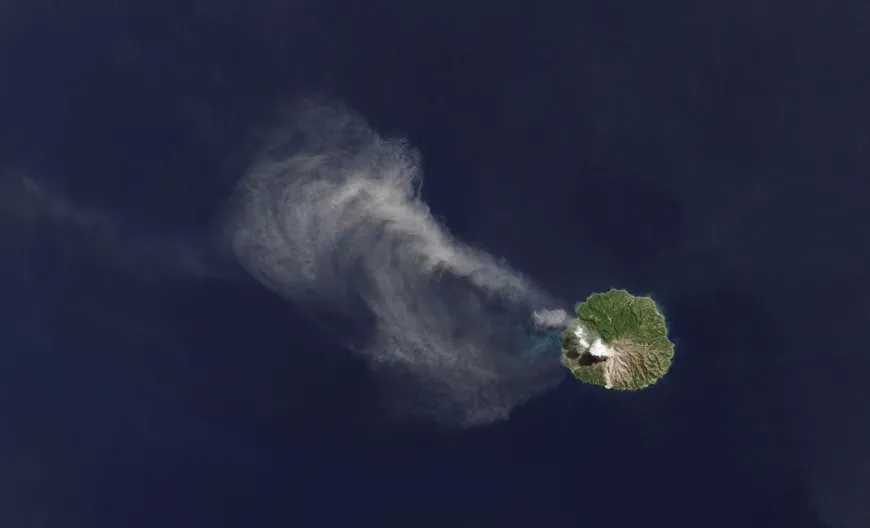
Volcano's Heat, Eruption Seen from Space
Get the world’s most fascinating discoveries delivered straight to your inbox.
You are now subscribed
Your newsletter sign-up was successful
Want to add more newsletters?
Delivered Daily
Daily Newsletter
Sign up for the latest discoveries, groundbreaking research and fascinating breakthroughs that impact you and the wider world direct to your inbox.
Once a week
Life's Little Mysteries
Feed your curiosity with an exclusive mystery every week, solved with science and delivered direct to your inbox before it's seen anywhere else.
Once a week
How It Works
Sign up to our free science & technology newsletter for your weekly fix of fascinating articles, quick quizzes, amazing images, and more
Delivered daily
Space.com Newsletter
Breaking space news, the latest updates on rocket launches, skywatching events and more!
Once a month
Watch This Space
Sign up to our monthly entertainment newsletter to keep up with all our coverage of the latest sci-fi and space movies, tv shows, games and books.
Once a week
Night Sky This Week
Discover this week's must-see night sky events, moon phases, and stunning astrophotos. Sign up for our skywatching newsletter and explore the universe with us!
Join the club
Get full access to premium articles, exclusive features and a growing list of member rewards.
As the saying goes: Where there's smoke, there's fire. That's certainly the case for Indonesia's Paluweh volcano. When the Landsat Data Continuity Mission satellite flew over Paluweh on April 29, it captured images of the smoke from the eruption and an infrared picture of fiery, molten lava at the apex of the volcano. Lava has been spewing from the island in recent months, according to NASA.
The image shows off the satellite's ability to distinguish the contrast between hot and cold, capturing "the boundaries between the hot volcanic activity and the cooler volcanic ash without the signal from the hot spot bleeding over into pixels [showing] the cooler surrounding areas," NASA reported. Older instruments couldn't do this as well — just as the sight of a flashlight distorts the eyes' ability to see darkness, hot objects can distort instruments' ability to see cooler ones nearby. But that's not the case with this new instrument, which was designed to get past previous limitations.
"We can image the white, representing the very hot lava, and right next to it we image the gray and black from the cooler surrounding ash," said NASA researcher Betsy Forsbackain in the statement. "It's exciting that we're imaging such diverse thermal activity so well."
The satellite can detect shifts in temperature in the atmosphere or surface as small 0.18 degreesFahrenheit (0.1 degrees Celsius), meaning it should help give scientists a more accurate measure of Earth's temperature, according to NASA.
Email Douglas Main or follow him @Douglas_Main. Follow us @OAPlanet, Facebook or Google+. Original article on LiveScience's OurAmazingPlanet.
Get the world’s most fascinating discoveries delivered straight to your inbox.