













The planet may become too hot for rice to be cultivated in many areas it currently exists
A new study finds that climate change is creating environments where humans have never successfully cultivated rice before.

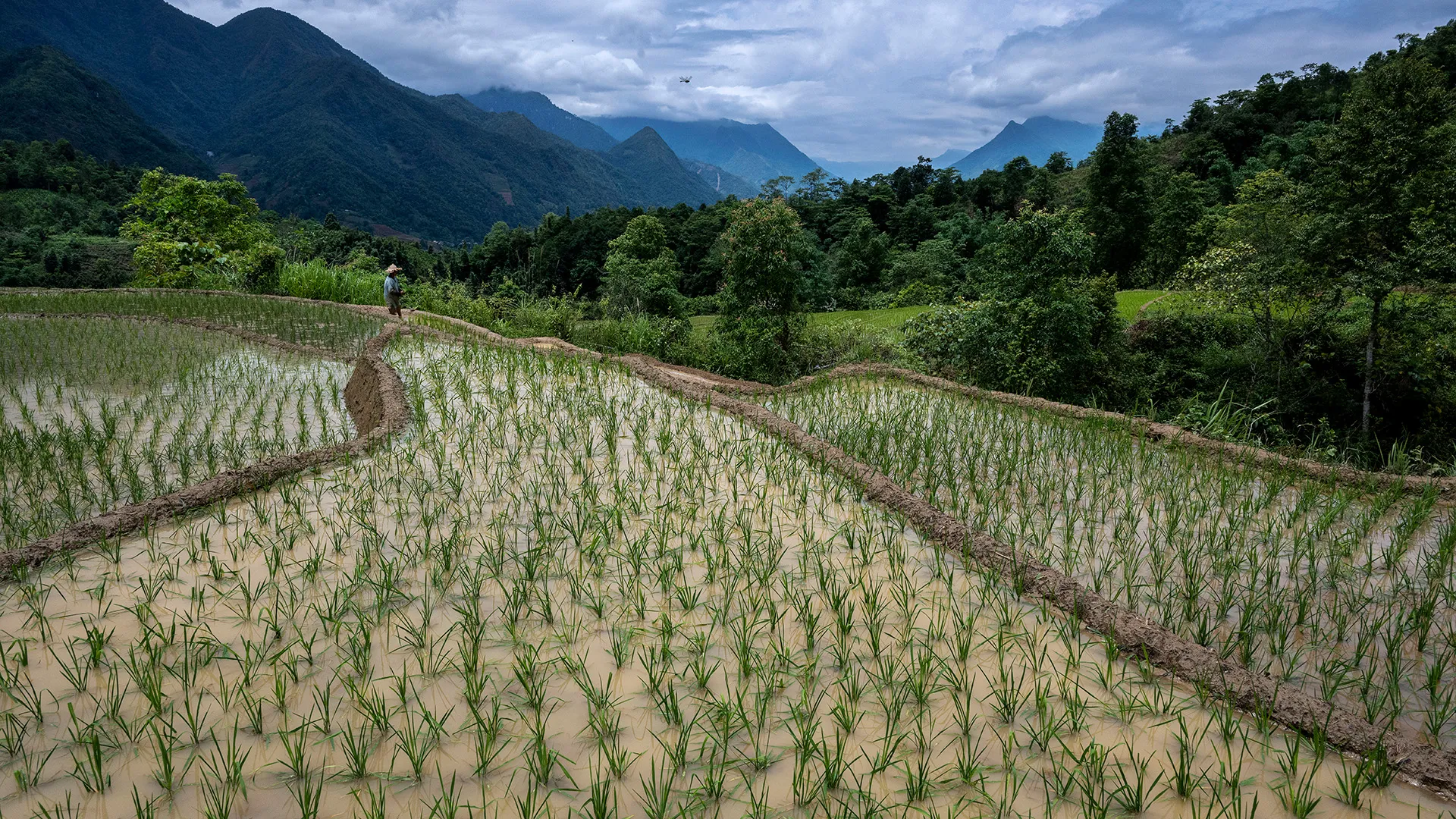
Climate change is pushing rice-growing regions into temperatures beyond those at which rice has been cultivated in the past 9,000 years of human history, new research finds.
Research suggests that warming is proceeding 5,000 times faster than rice has ever evolved.
This means rice may be reaching its "thermal limit," the point at which it can't easily adapt to rising temperatures. Although people can breed more heat-resistant strains or move rice cultivation into new regions, future warming is likely to cause serious disruption for the billion people who depend on rice cultivation for their livelihoods, said study first author Nicolas Gauthier, an anthropologist and geographer at the Florida Museum of Natural History.
"We don't want to downweight the flexibility of human adaptation," he told Live Science. "But we also want to acknowledge that these adaptations have already occurred, and in some cases, we might be closer to the limits of what we can reasonably adapt to in that time frame."
Rice is a staple crop for over half of the world's population, and 90% of cultivation occurs in Asia. Some rice-growing regions are already being hit by severe warming, which is affecting rice yields, according to the World Economic Forum.
Although rice is a heat-loving crop, rice photosynthesis shuts down at around 104 degrees Fahrenheit (40 degrees Celsius), and too much heat can also affect pollen viability and grain growth. Rice is also a water-intensive crop, so shifts in the wet and dry seasons are a problem, as is sea-level rise because low-lying paddies may become inundated with salt water, which can kill the crop.
Gauthier and his colleagues gathered data on past climate from archaeological sites where scientists have found evidence of rice cultivation over nearly a millennium. They found that rice has often expanded into cooler regions as humans have bred cold-tolerant plants and adjusted their agricultural practices. But, he added, the upper temperature limit has stayed the same since the beginning of rice cultivation about 9,000 years ago.
Get the world’s most fascinating discoveries delivered straight to your inbox.
Related stories
In the history of rice farming, cultivation has remained limited to places where the mean annual temperature is below 82.4 F (28 C) and the maximum temperature in the warm season stays below 91.4 F (33 C), on average, the researchers reported in the journal Communications Earth & Environment.
Climate change might warm regions where it is currently too cool to grow rice, enabling a geographical shift in cultivation, Gauthier said, but there will be challenges. Rice paddies have been built up over centuries, and it's not easy to "just pick up and move," he said. And the disruption in rice cultivation will have major economic and food security impacts, he said.
"You could keep global rice production the same" by moving cultivation around, he said. "But that's not fixing the problem for people who live in South Asia who are relying on rice for their consumption."
Editor's Note: The headline of this story was changed at 10:45 a.m. EDT on May 23 to better reflect the current study's findings.
Gauthier, N., Alam, O., Purugganan, M. D., & Guedes, J. D. (2026). Projected warming will exceed the long-term thermal limits of rice cultivation. Communications Earth & Environment, 7(1). https://doi.org/10.1038/s43247-025-03108-0

Stephanie Pappas is a contributing writer for Live Science, covering topics ranging from geoscience to archaeology to the human brain and behavior. She was previously a senior writer for Live Science but is now a freelancer based in Denver, Colorado, and regularly contributes to Scientific American and The Monitor, the monthly magazine of the American Psychological Association. Stephanie received a bachelor's degree in psychology from the University of South Carolina and a graduate certificate in science communication from the University of California, Santa Cruz.
You must confirm your public display name before commenting
Please logout and then login again, you will then be prompted to enter your display name.