The rate of global warming has accelerated at a higher level since 2015 than in any decade since records began in 1880, according to a new study that removes the background "noise" of natural fluctuations. However, not everyone agrees with the paper's findings.
In the study, published Friday (March 6) in the journal Geophysical Research Letters, researchers used statistical evidence to demonstrate accelerated warming in the past decade, which they say is the first time that scientists have identified the "statistically significant acceleration of global warming" since 2015.
"The warming trend nearly doubled after 2014," study co-author Stefan Rahmstorf, head of Earth system analysis at the Potsdam Institute for Climate Impact Research in Germany, told Live Science in an email. "The acceleration of the global warming rate means we will cross the 1.5°C [2.7 degrees Fahrenheit] limit earlier," he said, adding that they were surprised by the drastic surge.
Between 1970 and 2015, the average warming rate was pegged at just under 0.2 degrees Celsius (0.36 F) per decade. But over the last 10 years, the researchers found that the estimated warming rate was 0.35 C (0.63 F) per decade. There has also been a consistent upward trend in the global mean surface temperature, according to the study.
Researchers generally attest that the magnitude and rate of warming over the past 150 years have surpassed the magnitude and rate of changes experienced over the past 24,000 years, which includes the end of the last ice age.
But it's tricky to tease out how much of this accelerated warming is due to human-made greenhouse gas emissions and how much can be attributed to natural influences on the climate, such as El Niño. Rahmstorf and his co-author Grant Foster, a retired climate analyst, wanted to remove these natural fluctuations to better understand the warming trend.
"The key was to reduce the 'noise' in the data, i.e. to remove the effect of natural variability, to get a better signal-to-noise ratio," Rahmstorf said, explaining that this gives the signal increased visibility.
Sign up for the Live Science daily newsletter now
Get the world’s most fascinating discoveries delivered straight to your inbox.
Rahmstorf and Grant used five established global temperature datasets, including those from NASA; the National Oceanic and Atmospheric Administration; and Berkeley Earth. Then, they removed three environmental factors that drive warming — the El Niño-Southern Oscillation cycle, volcanic eruptions and solar variations — and tested the datasets for acceleration in warming since 1970.
The findings showed an acceleration of global warming, they said. Finally, they estimated warming rates by developing a model that looked at changes every decade since 1895.
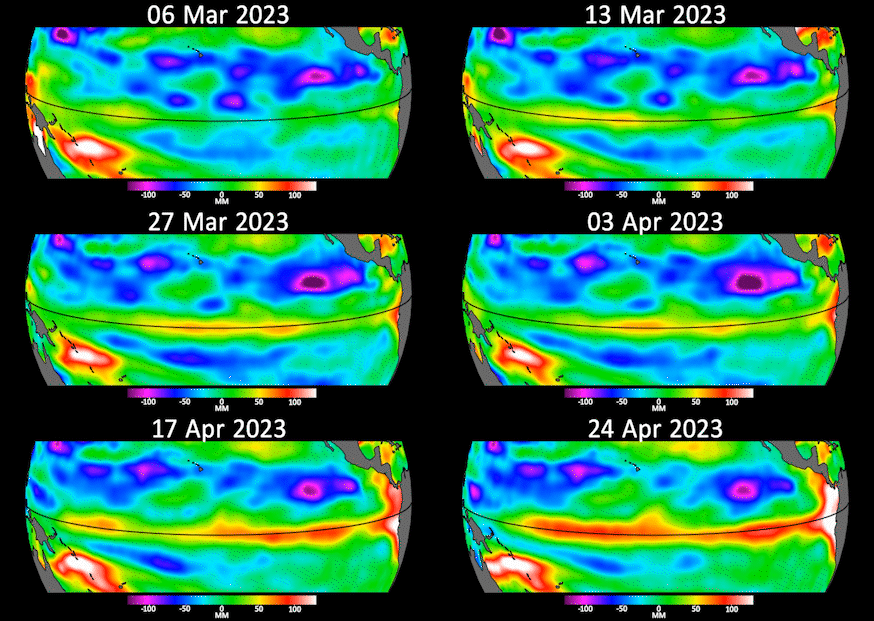
A gif showing the warmer water associated with El Nino forming at the equator of the Pacific Ocean and off the coast of South America.
(Image credit: NASA/JPL-Caltech)
The results showed a "statistically significant acceleration of global warming since about the year 2015," they wrote in the study. In a statement, Rahmstorf said the certainty rate was 98% and was consistent across datasets and analysis methods.
If the current rate of warming continues, he added, this paper and previous research has shown that we will pass 1.5 C (2.7 F) warming by 2030.
Disagreement in the field
But not all researchers are convinced by Rahmstorf and Grant's findings. Their methods for removing these variables from their analysis are imperfect and may leave residual effects, Zeke Hausfather, a research scientist at Berkeley Earth, told Live Science. He argued in a paper published last year that anthropogenic or human activities are increasing the Earth's surface temperature. This has further been linked to faster sea level rise and land precipitation change.
"There is widespread agreement that there has been a detectable acceleration in warming in recent years," he said. "But it remains unclear how much of the additional warming over the past decade in particular is a forced response [or] an unforced variability."
Robert Lund, a statistician at the University of California, Santa Cruz, also agrees there is solid evidence that the Earth is warming, but was less sure if we're experiencing an accelerated warming rate. Lund, who applies the laws of probability to climate change models, was among the authors of the 2024 paper that argued that a recent surge in the rate of global warming was not yet detectable. Despite the hot years of 2023 and 2024, he told Live Science, we need to urge caution while claiming that the Earth is suddenly getting warmer. "There is no statistical evidence of that," he said.
Lund found issues with various aspects in the analysis, such as including factors like El Niño. He said that one would also have to account for the uncertainties caused by them, since models cannot yet capture the intricate atmosphere-ocean interactions. However, the authors did not do this, he noted.
While Lund and Hausfather are cautious of the warming trend, they agree that we are inching closer to surpassing the thresholds established in the Paris Agreement, which aims to hold the rate of global warming to 2 C above preindustrial levels and pursue efforts to limit the increase to 1.5 C above preindustrial levels.
The Earth seems to already be on the track for this, as a recent Emissions Gap Report found that the planet will speed past the 1.5 C threshold in the next decade. This could double the share of people being exposed to extreme heat, Live Science reported last November.
For Rahmstorf, this study also serves as a warning. "We need to become a lot faster in replacing fossil fuels like coal, oil and gas and leaving them behind altogether," he said.
Article Sources
Foster, G., & Rahmstorf, S. (2026). Global Warming Has Accelerated Significantly. Geophysical Research Letters. https://doi.org/10.1029/2025GL118804
Pragathi Ravi is a science journalist writing at the intersection of science, society and nature in India and the US. Her work has appeared in Grist, Inside Climate News, the Christian Science Monitor, and The Xylom, among others. She is based in New York.
You must confirm your public display name before commenting
Please logout and then login again, you will then be prompted to enter your display name.