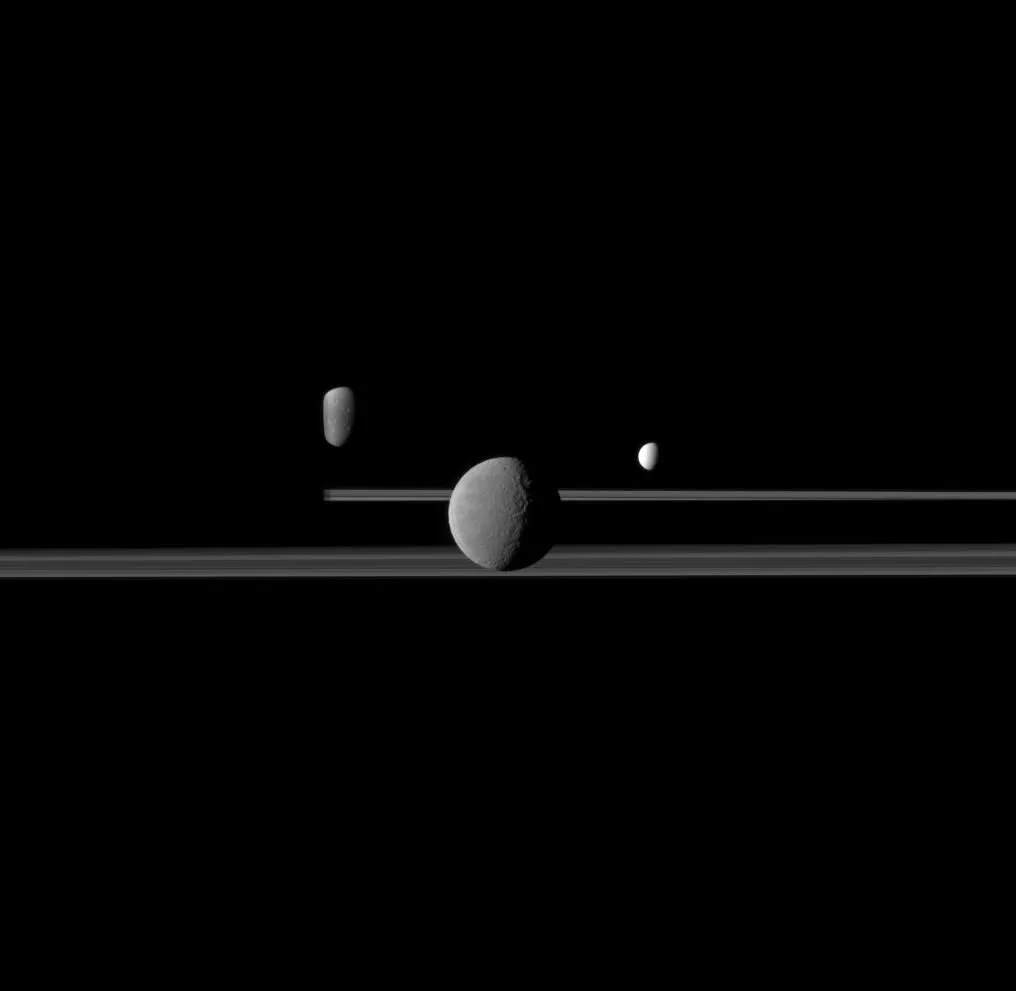
The Cassini spacecraft observes three of Saturn's moons set against the darkened night side of the planet. Saturn is present on the left this image but is too dark to see. Rhea (1,528 kilometers, or 949 miles across) is closest to Cassini here and appears largest at the center of the image. Enceladus (504 kilometers, or 313 miles across) is to the right of Rhea. Dione (1,123 kilometers, or 698 miles across) is to the left of Rhea, partly obscured by Saturn. Image taken April 25, 2011.
The dazzling rings of Saturn and its moons are likely more than 4 billion years old — the cosmic remnants of the solar system's birth, scientists say.
The finding comes after a new study of observations from NASA's Cassini spacecraft orbiting Saturn, which suggests that the planet's rings and moons formed at the same time as the rest of the solar system's planetary bodies soon after the sun sparked into life. Since Saturn's rings and moons formed from the same planetary nebula of gas and dust around the early sun that led to the solar system's other planets, they are a time capsule of sorts for astronomers, the researchers said.
These two global images of Iapetus show the extreme brightness dichotomy on the surface of this peculiar Saturnian moon. The left-hand panel shows the moon's leading hemisphere and the right-hand panel shows the moon's trailing side. Image published Dec. 10, 2009.
(Image credit: NASA/JPL/Space Science Institute)
"Studying the Saturnian system helps us understand the chemical and physical evolution of our entire solar system," Cassini scientist Gianrico Filacchione, of Italy's National Institute for Astrophysics in Rome, said in a statement. "We know now that understanding this evolution requires not just studying a single moon or ring, but piecing together the relationships intertwining these bodies."
Filacchione and his colleagues analyzed data from Cassini's visual and infrared mapping spectrometer, or VIMS, to understand the distribution of water ice and colors across Saturn's rings and moons. Different colors in the rings and moons provide evidence of non-water organic materials, while water ice is a vital clue into the timeline that led to the formation of the Saturnian system, the researchers said. [See photos of Saturn's spectacular rings up close]
Observations from VIMS showed that there is too much water ice in the Saturn system to have been dumped there by comets or other more recent means, leading the researchers to conclude that the water ice must have formed around the time the solar system did.
The researchers also discovered that the surfaces of Saturn's moons typically get redder the farther away they orbit the huge planet. Some of these outer moons, like Hyperion and Iapetus, may have been coated with reddish dust shed by Phoebe, a small, retrograde moon believed to have originated in the Kuiper Belt, the researchers said.
Meanwhile, parts of the planet's main ring system may have been painted with a more subtle reddish hue by meteoroids slamming into the Saturnian system. That red may be a sign of oxidized iron (rust) or polycyclic aromatic hydrocarbons, compounds that could give rise to more complex molecules, the researchers said.
Sign up for the Live Science daily newsletter now
Get the world’s most fascinating discoveries delivered straight to your inbox.
The scientists were surprised to observe reddish tones on the potato-shaped moon Prometheus, which orbits in an area where moons are generally more whitish in color. The finding hints that Saturn's rings may have given rise to some of the planet's moons.
"Scientists had been wondering whether ring particles could have stuck together to form moons — since the dominant
The effects of the small moon Prometheus loom large on two of Saturn's rings in this image taken a short time before Saturn's August 2009 equinox. A long, thin shadow cast by the moon stretches across the A ring on the right. The gravity of potato-shaped Prometheus (86 kilometers, or 53 miles across) periodically creates streamer-channels in the F ring, and the moon's handiwork can seen be on the left of the image. Image released Jan. 28, 2010.
(Image credit: NASA/JPL/Space Science Institute)
The theory was that the rings basically came from satellites being broken up," study researcher Bonnie Buratti, a VIMS team member based at NASA's Jet Propulsion Laboratory, Pasadena, Calif., said in a statement. "The coloring gives us some solid proof that it can work the other way around, too."
The research is detailed in the March 26 edition of the Astrophysical Journal.
NASA's Cassini spacecraft launched toward Saturn in 1997 and arrived in orbit around the ringed planet in 2004. The spacecraft completed its primary mission in 2008 and is currently in the midst of its second extended mission, which runs through 2017.
Space.com is the premier source of space exploration, innovation and astronomy news, chronicling (and celebrating) humanity's ongoing expansion across the final frontier. We transport our visitors across the solar system and beyond through accessible, comprehensive coverage of the latest news and discoveries. For us, exploring space is as much about the journey as it is the destination.