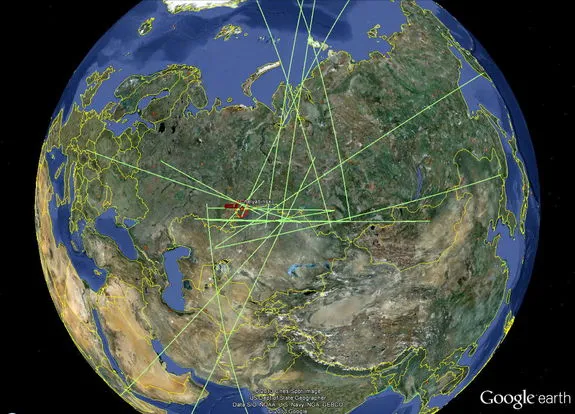
Seventeen infrasound stations in the Comprehensive Nuclear-Test-Ban Treaty Organization's network detected the infrasonic waves from the meteor that broke-up over Russia’s Ural mountains on Feb. 15, 2013.
On Feb. 15, a rocky meteor the size of a bus, but much heavier, exploded over the Ural Mountains near Chelyabinsk, Russia, in what many scientists and lawmakers have billed as a wake-up call to the threat to Earth posed by near-Earth asteroids.
The potential threat of asteroids took center stage today (March 19) during a hearing by the U.S. House of Representatives Committee on Science, Space, and Technology, which is expected to be the first in a series of congressional discussions on the subject. During the hearing, Congressman Lamar Smith (R-Texas) — the committee's chairman — quizzed Gen. William Shelton, chief of the U.S. Air Force Space Command, about the military's ability to detect the Feb. 15 Chelyabinsk meteor, as well as differentiate between incoming meteors and incoming ballistic missiles.
At first there was some confusion over what object and event was being discussed. Once Smith had clarified that he was interested in the Chelyabinsk meteor — and not asteroid 2012 DA14, which also flew past Earth later in the day on Feb. 15 — the interchange went like this:
Chairman Smith: Even with satellites? Even with everything else?
Gen. Shelton: We were aware of the event when it occurred.
Sign up for the Live Science daily newsletter now
Get the world’s most fascinating discoveries delivered straight to your inbox.
Chairman Smith: And not before?
Gen. Shelton: And not before.
Chairman Smith: I just have to ask you how, then, are we going to be aware of incoming missiles if we couldn't detect the meteor exploding over Russia?
Gen. Shelton: We did detect it. We were aware of the event.
Chairman Smith: But at the time of the event?
Gen. Shelton: Yes sir.
Chairman Smith: Not before.
Gen. Shelton: Yes sir. And we would have to take that into a different forum to talk in more detail.
Since the "different forum" to which Gen. Shelton referred is undoubtedly behind Top Secret doors, we will likely not know his answer. But we can do the math:
According to NASA scientists, the Chelyabinsk meteor (also known as a "superbolide") slammed into Earth's atmosphere at more than 18 kilometers per second. That is about 40,264 mph, or 64,800 km/h. [Russian Meteor Explosion in Photos]
Hard data on incoming intercontinental ballistic missiles (ICBMs) is sketchy – for obvious reasons. But simple physics tells us that an ICBM will travel no faster than about 8 km/sec — about 17,896 mph (28,800 km/h) — much less than half the meteor's velocity. The missile, however, will only reach that maximum speed during the "terminal phase" of its trajectory, as it’s coming “downhill” but before its warheads are slowed by the atmosphere’s drag. For most of its journey it will be flying much more slowly.
An ICBM gradually builds velocity during its boost phase. It will be most easily detectable during the latter portion of the boost phase when it's engines are still firing and the missile has risen above the horizon, where its infrared signature can be "seen" against the cooler sky and where radar bounces are unobstructed
Another factor is the glare of the sun. The Chelyabinsk superbolide likely came from the inner part of the Main Belt of asteroids between Mars and Jupiter. Striking our atmosphere soon after local sunrise, the Chelyabinsk impactor's trajectory brought it to Earth from a direction very close to the line-of sight between any potential observers on the ground and the sun's light.
Quoting a common expression, the object would have appeared to "come out of the sun" in a straight line from its apparent origin. It would have been invisible to telescopes, even had they been pointed precisely towards it.
A ballistic missile, on the other hand, will originate on Earth and fly on a much more curved trajectory to a target elsewhere on Earth. There would be many more angles at which it could be detected.
A meteor seen flying over Russia on Feb. 15 at 3:20: 26 UTC impacted Chelyabinsk. Preliminary information is that this object was unrelated to asteroid 2012 DA14, which made a safe pass by Earth on the same day.
(Image credit: Google Earth, NASA/JPL-Caltech)
We know that the meteor's detonation was detected from above by satellite. We can hope — but not know for sure — that the Chelyabinsk meteor was immediately recognized by the world's space-faring superpowers as an isolated natural event, rather than the start of a nuclear exchange.
We may never know what Gen. Shelton and other United States military leaders would report to Congress in closed-door meetings. And we may never know what capabilities the world's militaries actually have for such detections.
What we can say is that asteroids and meteors appear to be an equal opportunity threat to all nations, a point made repeatedly during today’s hearing by NASA Administrator Charles Bolden, Jr. and others.
Bolden told lawmakers during the hearing that congressional budget cuts have hindered NASA's work to identify 90 percent of potentially dangerous near-Earth asteroids that are about 459 feet (140 meters) across. Similar cuts have challenged the agency's projects to develop countermeasures to deflect incoming asteroids, Bolden said.
"The answer to you is, 'if it's coming in three weeks, pray,'" Bolden said. "The reason I can't do anything in the next three weeks is because for decades we have put it off."
This story was provided by SPACE.com, sister site to Live Science. Dave Brody has been a writer and video producer at SPACE.com since January 2000. He produced and hosted the Comet Hunters/Asteroid Seekers, Wheels on Mars, Danger Solar Storm, Atlas of the Sky DVD titles and others. Follow Dave on Twitter @DavidSkyBrody. Follow us @Spacedotcom, Facebook and Google+. Original article on SPACE.com.