














New Rover Could Seek Evidence of Ancient Mars Life Just Below Surface: Study

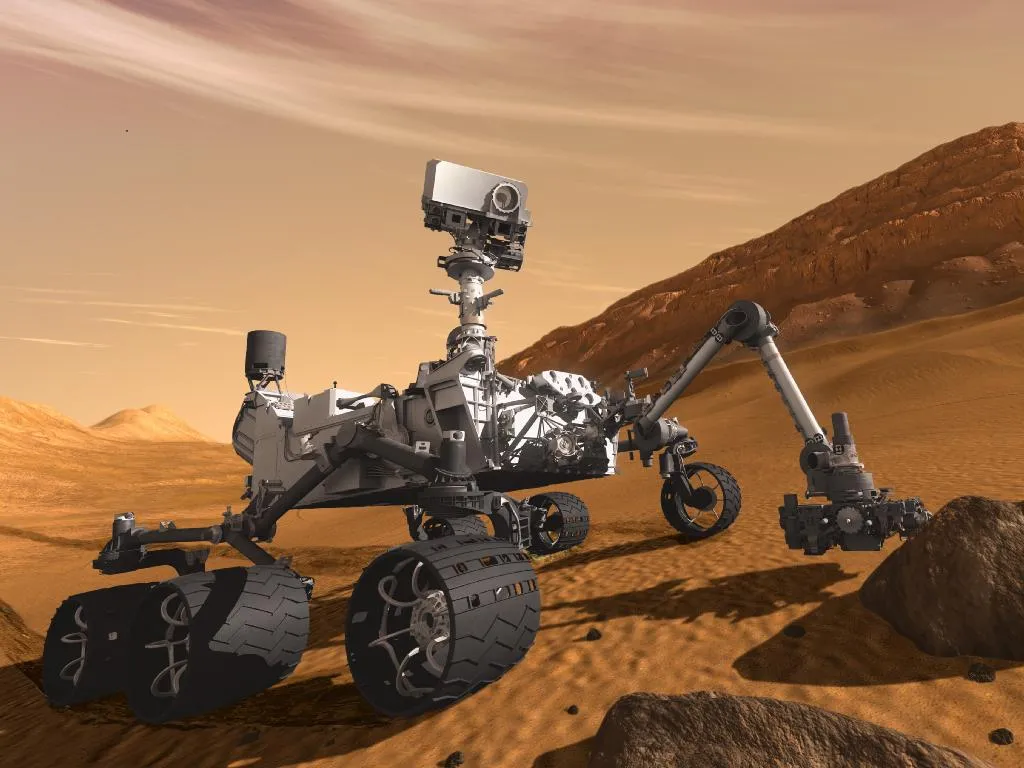
Evidence of ancient life on Mars, if any such evidence exists, might be detectable at shallower depths below the planet's surface than has been thought, a new study says – which would improve the chances that NASA's newest Mars rover, scheduled to touch down on the Red Planet next month, finds it.
The research indicates that simple organic molecules, such as a single molecule of formaldehyde, could exist a mere 2 to 4 inches (5 to 10 centimeters) beneath the Martian surface. While the radiation level at these depths is still intense, simple building blocks of life (and, in the case of young craters, perhaps even complex building blocks) could survive, the researchers said.
The study, which suggests ideal locations and depths to search for organic molecules, could act as a road map for the Curiosity rover, which is due to land on Mars the night of Aug. 5.
Once on the surface, Curiosity, carrying out NASA's Mars Science Laboratory mission, is expected to dig, drill and investigate rocks for signs that Mars is, or ever was, inhabited.
"Right now the challenge is that past Martian landers haven't seen any organic material whatsoever," study lead author Alexander Pavlov, of NASA's Goddard Space Flight Center in Greenbelt, Md., said in a statement. "We know that organic molecules have to be there, but we can't find any of them in the soil."
The researchers report that the chances of finding organic molecules roughly 0.8 inches (2 centimeters) below the surface are close to zero. The top layer of the Martian surface has absorbed so much cosmic radiation over the past billion years that all organic material is likely to have been destroyed, the scientists said. Past rovers on Mars collected and analyzed only loose soil from the topmost layer of the Martian surface. [7 Biggest Mars Mysteries]
Yet only inches deeper — within reach of Curiosity — simple organic molecules could still exist, the researchers said.
Get the world’s most fascinating discoveries delivered straight to your inbox.
Even if Curiosity detected these molecules, the discovery wouldn't necessarily mean ancient life existed on Mars. Simple organic molecules could have originated from other sources, such as meteors and interplanetary dust particles, the researchers said.
Complex organic molecules, such as those made up of 10 or more carbon atoms, would be more reliable indicators of past life on the planet, since they could closely resemble building blocks of life as we know it. These structures, however, would be much harder to find, and they would have been more vulnerable to the radiation that mercilessly bombards the Red Planet.
The new study offers suggestions for where Curiosity could begin its search.
Previous studies focused on the maximum depth that cosmic radiation can reach, Pavlov said, since organic molecules below that point – approximately 5 feet (1.5 meters) – conceivably could survive unharmed for billions of years. But drilling to that depth using existing rover technology would be impractical.
In the new research, the scientists examined a range of more-attainable depths and modeled the accumulation of cosmic ray radiation and its effects on organic molecules. To reach their results, researchers looked at soil and rock composition on Mars, changes in the planet's atmospheric density over time, and the various energy levels of cosmic rays.
The scientists found that "fresh" craters — ones no more than 10 million years old — are optimal sites for Curiosity to investigate, since radiation levels in these young surface features may have lower radiation levels near the surface. If so, more complex molecules, such as amino acids, could remain intact, the researchers said.
"When you have a chance to drill, don't waste it on perfectly preserved" landscapes, Pavlov said. "You want to go to fresh craters because there's probably a better chance to detect complex organic molecules. Let nature work for you."
Curiosity is scheduled to land in the 3.5-billion-year-old Gale crater. Pavlov and his colleagues hope the results of their study will help mission managers decide where to drill once the $2.5 billion rover touches down.
Detailed results of the study will appear in the July 7 issue of the journal Geophysical Research Letters.
This story was provided by SPACE.com, a sister site to LiveScience. Follow SPACE.com on Twitter @Spacedotcom. We're also on Facebook and Google+.
