














City-Size Neutron Stars Collide, Unleash Radio Shockwaves

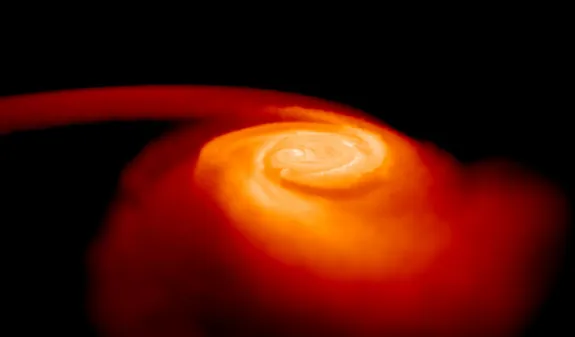
When two city-size neutron stars collide, new research shows that the resulting shockwave emits radio signals that can help astronomers to verify elusive gravity waves.
Superdense neutron stars form when a supernova collapses in on itself to the point where its protons and electrons merge to form neutrons. The resulting stars contain a mass equivalent to our sun, but packed into an ultra-small space about 12 miles (nearly 20 kilometers) across; a teaspoon of the material can weigh up to 6 billion tons.
When two of these bulky stars collide, the explosion releases an enormous amount of energy. New simulations show that particles could rush away at anywhere from one-tenth to half the speed of light.
"The explosion accelerates electrons to a very high energy," Tsvi Piran, of the Hebrew University in Israel, told SPACE.com. "The electrons produce mostly radio emissions, which creates a quasi-spherical blast wave." [Photo and video of neutron star crash simulations]
The fact that the blast wave encircles the core means that astronomers should be able to view it no matter how the stellar pair was oriented.
"Binary collisions are very rare," Piran said. "But they are very important because they are the best sources of gravitational radiation."
Tiny ripples in the universe
Get the world’s most fascinating discoveries delivered straight to your inbox.
As part of his theory of general relativity, Albert Einstein predicted the existence of gravity waves in 1916. The presence of high mass objects causes space-time to warp in a way that we see as gravity. [6 Weird Facts About Gravity]
But when large masses, such as two dense neutron stars, move suddenly, their motion can also cause a shift in space-time. Sensitive telescopes such as LIGO in Louisiana and LOFAR in the Netherlands, both under construction, will be able to detect the minute changes caused by these waves.
The work done by Piran and his collaborator, Ehud Nakar of Tel Aviv University in Israel, will help the astronomers using these telescopes.
Their research is detailed online in the Sept. 28 edition of the journal Nature.
Piran explains that it can be difficult to identify gravitational waves, but that a follow-up signal, such as those produced by the mergers of neutron stars, can provide the necessary confirmation.
The gravity waves from such an explosion reach the Earth first, but are soon followed by the radio flares.
At the same time, their research can help astronomers determine the frequency of these explosions. The rarer they are, the deeper new instruments will need to search.
Present estimates differ by a factor of a thousand. Piran's work should help astronomers to refine that number, he said.
Finding an example
Binary neutron explosions can be challenging to identify. For one thing, they are short-lived. The material shooting out from the center is visible for only a few months, an eye blink on an astronomical calendar. [The Strangest Things in Space]
They also bear a strong resemblance to radio supernovas — stars whose explosive deaths dominate the radio spectrum rather than the visible spectrum.
But the pair thinks they have found one example.
In 2007, a separate team of astronomers led by Jeffrey Bower of the University of California - Berkeley reviewed existing data in search of radio transient objects.
"Transient objects are events which appeared once when astronomers looked at the sky. Then they looked a few months later and there was nothing there," Piran explained.
Bower's team published information on ten objects, each of which could be a number of objects or events.
Reviewing that information, Piran believes that one of the objects, RT 19870422, could be the explosive results of colliding neutron stars.
"The properties of it resemble what we expect from these kinds of flares," he said.
But the problem with transient objects is implicit in their definition — they are only seen once. As such, they are difficult to study.
Piran notes that it is possible that RT 19870422 could be a radio supernova. However, if so, it was an unusually strong one, ten times stronger than any radio supernova yet seen, leaving him to feel relatively confident that the strong signal came from the death of a pair of compact stars.
Now the challenge is to identify other, similar remnants. But one never knows when such explosions will occur.
"We just have to wait for the next one," Piran said.
This story was provided by SPACE.com, sister site to LiveScience. Follow SPACE.com for the latest in space science and exploration news on Twitter @Spacedotcom and on Facebook.

Nola Taylor Tillman is a contributing writer for Live Science and Space.com. She loves all things space and astronomy-related, and enjoys the opportunity to learn more. She has a Bachelor’s degree in English and Astrophysics from Agnes Scott college and served as an intern at Sky & Telescope magazine. In her free time, she homeschools her four children.