













What Is dark energy?
Dark energy is the name physicists have given to the mysterious thing driving the universe's accelerated expansion. It may be a force or a form of energy, and one piece of evidence suggests it is hidden inside black holes.

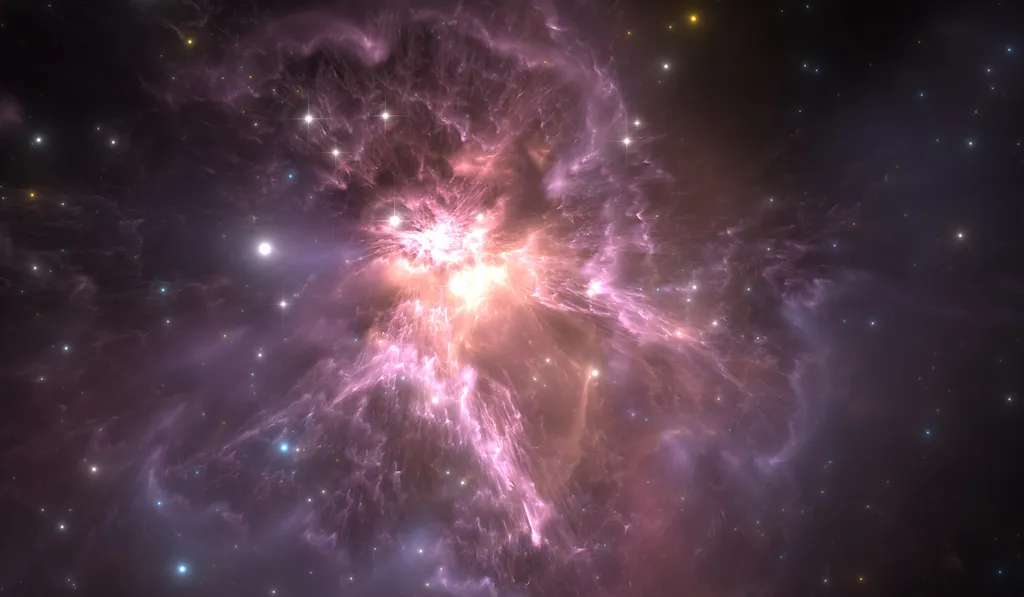
Dark energy is an enigmatic phenomenon that acts in opposition to gravity and is responsible for accelerating the expansion of the universe. Though dark energy constitutes up to three-fourths of the mass-energy of the cosmos, its underlying nature has eluded physicists for decades. Dark energy has no real connections to dark matter, beyond sharing the word dark, which just means that scientists don't really know what these things are.
In 2023, scientists said they detected evidence that dark energy could be explained by a type of energy stored inside black holes. If true, the finding would mean our current models of the universe would not new forces or fields beyond Einstein's conception of gravity in order to explain dark energy. However, followup findings would need to confirm the findings before it can be widely accepted by physicists as an explanation for dark energy.
Who discovered dark energy?
The realization that the universe is expanding can be traced back to the American astronomer Edwin Hubble, who in 1929 noticed that the farther a galaxy is from the Earth, the faster it is moving away from us, according to the Hubble Space Telescope website. This doesn't mean that our planet is the center of the universe, but rather that everything in space is moving away from everything else at a constant rate.
Nearly 60 years after Hubble's revelation, scientists made another startling discovery. Researchers had long been trying to precisely measure cosmic distances by looking at the light of faraway stars. In the late 1990s, after examining distant supernovas, two independent teams found that the stellar explosions' light is dimmer than expected. This indicates that the universe is not only expanding, but also accelerating in its expansion.
That finding has given physicists cause to scratch their heads ever since then, also earning its discoverers the Nobel Prize in physics in 2011.
What does dark energy do?
Though researchers don't entirely understand dark energy, they have used their knowledge of the phenomenon to construct models of the universe that explain everything from the Big Bang to the modern-day large-scale structure of galaxies. Some of these models predict that dark energy will rip apart everything in existence billions of years from now.
The leading explanations of dark energy suggests that it is a type of pent-up energy inherent in the fabric of space-time. "This simple model works very well practically, and it is a straightforward addition to the cosmological model without having to modify the law of gravity," Baojiu Li, a mathematical physicist at Durham University in the United Kingdom, previously told Live Science. But the idea comes with one major problem: Physicists predict that the value of the vacuum's energy should be 120 orders of magnitude higher than what cosmologists observe in measurements, Li said.
Get the world’s most fascinating discoveries delivered straight to your inbox.
In February 2023, scientists used measurements from ancient and dormant black holes to show that these cosmic behemoths are growing faster than predicted. The findings suggest black holes contain a type of vacuum energy inherent in the fabric of space-time that can explain the universe's expansion, all within the framework of Einstein's theory of relativity. If the finding holds up, it would mean no new physics would be needed to explain dark energy. They published their findings in two papers in The Astrophysical Journal and The Astrophysical Journal Letters.
An alternative idea posits that dark energy is an additional fundamental force, joining the four already known (gravity, electromagnetism, and the strong and weak nuclear forces). But this conjecture doesn't explain why humans don't notice this extra force in our day-to-day lives. So, theorists have also built creative models suggesting that this mysterious force is hidden in some way.
The measured value of dark energy is currently the subject of an intense debate between rival factions in physics. Some researchers have measured dark energy's power using the cosmic microwave background, a dim echo of the Big Bang, and produced one estimate.
But other astronomers, who measure dark energy's strength using the light of distant cosmic objects, have produced a different value, and nobody has yet been able to explain the discrepancy. Some experts have suggested that dark energy's power varies over time, though proponents of that idea have yet to convince a majority of their peers of this explanation.
Additional resources:
- Read more about dark energy from Swinburne University in Australia.
- Here's the definition of dark energy and dark matter, from NASA Science.
- Watch "Big Mysteries: Dark Energy," from Fermilab.

Adam Mann is a freelance journalist with over a decade of experience, specializing in astronomy and physics stories. He has a bachelor's degree in astrophysics from UC Berkeley. His work has appeared in the New Yorker, New York Times, National Geographic, Wall Street Journal, Wired, Nature, Science, and many other places. He lives in Oakland, California, where he enjoys riding his bike.