















Robotic Bird Designed to Spy on Humans
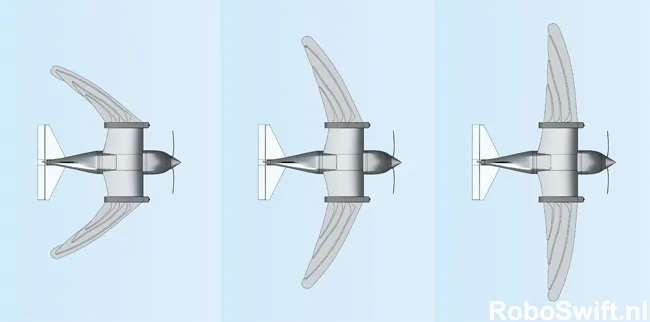
A shape-shifting, robotic bird that can sweep through the skies without a peep has all the right stuff for ground surveillance and even spying on its real-life inspiration—the common swift.
Engineering students presented their design of the so-called RoboSwift at an annual Design Synthesis symposium at the Delft University of Technology in The Netherlands. The robotic bird measures 20 inches (51 centimeters) from wingtip to wingtip and weighs less than three ounces (80 grams).
The team expects to build the micro airplane in the coming months and fly it in January 2008. They hope to enter three RoboSwifts in the First American-Asian Micro Air Vehicle competition in India in March 2008.
RoboSwift's design is revealed in a new video.
Avian aviators
The team, from Delft and the Department of Experimental Zoology of Wageningen University in The Netherlands, based the design on recent findings on the common swift’s flight features, as detailed in an April issue of the journal Nature.
During its lifetime, a common swift can fly up to five times the distance to the moon and back, or more than 2 million miles (more than 3 million kilometers). The Nature study found the common swift is able to endure the distance by constantly morphing its wings in response to the prevailing flight conditions.
Get the world’s most fascinating discoveries delivered straight to your inbox.
By folding its feathers over one another and sweeping them back and forth, the bird changes its wing shape and the surface area exposed to the elements. The feathery adjustments boost flight efficiency and maneuverability.
Flight crew
Much research has focused on the flight of birds such as the common swift, ranging from figuring out what makes them such fantastic aviators to how humans can replicate the traits.
The new robot has “unprecedented” features, the researchers say. It relies on only four “feathers” for morphing ability. To steer, it sweeps one wing back more than the other, creating a difference in lift force on the wings so that the craft can roll or make sharp turns in the air.
Like real birds, the robot can adjust both the wing shape and surface area continuously throughout flight. Onboard lithium-polymer batteries power an electromotor that drives a propeller, allowing RoboSwift to follow a group of real birds for 20 minutes or perform ground surveillance for an hour. The RoboSwift's propeller can also fold back to reduce air drag.
RoboSwift carries three onboard micro cameras, with two mounted on the wing and one in the belly pointing downward. A display mounted to the robo-plane’s head will beam the images to the ground where pilots can get a bird’s-eye view.
The wings of civilian aircraft are constructed to fly in a fixed position, making the planes much less efficient and agile than the common bird. A few military aircraft, such as the F-14 Tomcat and the English-German Tornado, are equipped with “swing wings,” which can sweep back and forth (extending out for a glide and tucking into the body to speed up). But the wings can’t adjust their shape, or morph, to significantly reduce surface area.
- Video: How RoboSwift Works
- Image Gallery: See Sonic Booms
- Image Gallery: Cutting-Edge Robots
Jeanna Bryner is managing editor of Scientific American. Previously she was editor in chief of Live Science and, prior to that, an editor at Scholastic's Science World magazine. Bryner has an English degree from Salisbury University, a master's degree in biogeochemistry and environmental sciences from the University of Maryland and a graduate science journalism degree from New York University. She has worked as a biologist in Florida, where she monitored wetlands and did field surveys for endangered species, including the gorgeous Florida Scrub Jay. She also received an ocean sciences journalism fellowship from the Woods Hole Oceanographic Institution. She is a firm believer that science is for everyone and that just about everything can be viewed through the lens of science.