













Crystals With Pleats Reveal Order and Disorder

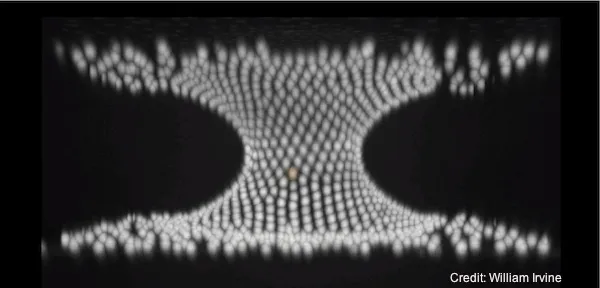
It turns out seamstresses aren't the only ones who use pleats to gather a flat fabric around a curved surface. Crystals can form pleats too, a recent study found.
Getting a flat layer to form around something curved isn't easy: Imagine trying to cover a beach ball with wrapping paper. Using a layer of miniscule plastic particles mixed with oil, researchers found that a single layer of particles would naturally organize itself into pleat-like structures to cover a curved surface (in this case, a water droplet) without wrinkling.
The scientists call their method an "experimental playground" that could help researchers understand the physics of curved surfaces. An understanding of how to smoothly coat curves is important in nano-engineering, study researcher William Irvine of the University of Chicago told LiveScience. For example, if you want to design nano-scale spheres that link up into complex shapes, Irvine explained, you have to coat the spheres with "directional glue."
"Suppose you had a bunch of spheres and you wanted to glue them together," Irvine explained. "If you use something where if whenever any two surfaces touch, they glue together, you would either get a big mess or something that looks very tightly packed, like oranges in the supermarket."
But if you wanted to use spheres to form a diamond shape, Irvine said, you'd need a directional bond, or one that prefers a specific orientation.
"Taking a structure that is that small and putting directional bonds on it is very hard, unless you have a mechanism that spontaneously creates them," Irvine said.
Enter the crystal pleats. It doesn't matter what material you use or what kind of surface you're coating, Irvine said, a single layer of particles naturally wants to organize to cover it. This could have happened in many ways, Irvine said, like the arrangement of hexagons or pentagons seen on soccer balls (and viruses). But the crystals formed by the researchers' particles didn't take that route. Instead, they lined up with little defects in their arrangement. Looking closer, the researchers realized the defects worked much like an opened-up pleat.
Get the world’s most fascinating discoveries delivered straight to your inbox.
"Imagine a pleated skirt with a plaid pattern," Irvine said. "If you looked at what happened to one of the lines from the rectangles around the pleat, you'd see that when you opened the pleat up, the lines would diverge. They would no longer stay parallel to each other… [That's] exactly what we see here."
Irvine and his colleagues are now tinkering with their pleat playground, squeezing in extra particles to see how the system responds. More generally, Irvine is interested in the hidden order that curved surfaces might reveal.
"If you think of something which has any order in it whatsoever, then if you put it on a curved surface, that order will be upset," he said. "What if I take something that looks disordered? … Can we find hidden order in a structure which apparently looks disordered by putting it on a structure where the surfaces are curved?"
You can follow LiveScience Senior Writer Stephanie Pappas on Twitter @sipappas.

Stephanie Pappas is a contributing writer for Live Science, covering topics ranging from geoscience to archaeology to the human brain and behavior. She was previously a senior writer for Live Science but is now a freelancer based in Denver, Colorado, and regularly contributes to Scientific American and The Monitor, the monthly magazine of the American Psychological Association. Stephanie received a bachelor's degree in psychology from the University of South Carolina and a graduate certificate in science communication from the University of California, Santa Cruz.