













Einstein’s ‘Spooky Physics’ Gets More Entangled

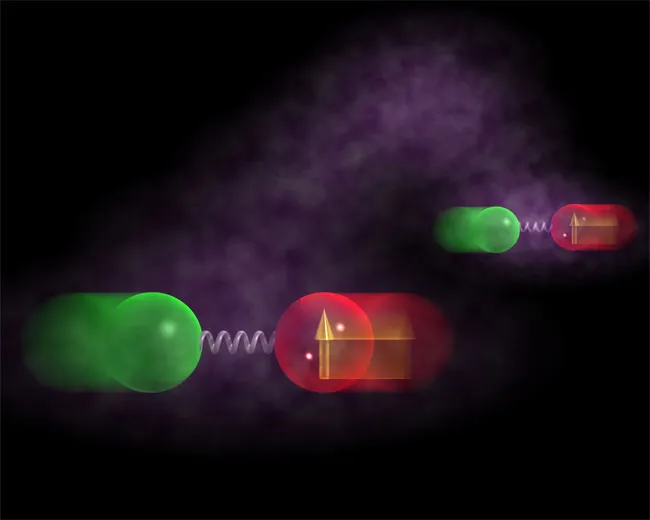
Quantum entanglement is just spooky — even Einstein thought so. As if particles (as in particle physics) have telepathic empathy.
The theory of quantum mechanics predicts that two or more particles can become "entangled" so that even after they are separated in space, when an action is performed on one particle, the other particle responds immediately. Scientists still don't know how the particles send these instantaneous messages to each other, but somehow, once they are entwined, they retain a fundamental connection.
This bizarre idea riled Einstein so much he called it "spooky action at a distance."
A new study found that this eerie quantum link can apply even to situations that resemble the larger, everyday world. Scientists entangled two pairs of vibrating particles separated in space, so that when one pair was forced to change its movement, the other pair did as well.
"We've entangled something that has never been entangled before, and it's the kind of physical, oscillating system you see in the classical world, just much smaller," said John Jost, a physics graduate student at the University of Colorado at Boulder, and a guest researcher at the National Institute of Standards and Technology. Jost and team describe their findings in the June 4 issue of the journal Nature.
Previous experiments have entangled the internal properties of particles, such as spin states, but this is the first time scientists have entangled the particles' pattern of motion.
The breakthrough could help researchers build quantum computers, which could theoretically make calculations much faster than existing technology.
Get the world’s most fascinating discoveries delivered straight to your inbox.
"Apart from adding another toy to the quantum mechanic’s playground, this is an important tool for further developments in quantum-state engineering," wrote physicist Rainer Blatt of the Austrian Academy of Sciences in a separate essay in the June 4 issue of Nature. Blatt was not involved in the new study.
To achieve this feat of entanglement, Jost and colleagues set up two pairs of ions (atoms with one electron removed, so that they have a positive charge). Each pair included one beryllium and one magnesium ion, vibrating back and forth toward and away from each other as if they were connected by an invisible spring.
Using electric fields and lasers, the researchers herded the ions into separate pairs and then entangled their motion. Then they separated the pairs by 240 micrometers (millionths of a meter), which is actually quite a span for an atom. Even at this distance, when the researchers changed the motion of one pair — stopped or started the vibrations — the other responded immediately, stopping or starting in kind.
The experiment proved that this kind of everyday springy motion is entangle-able, and blurred the boundary between the quantum world and the regular macroscopic world we live in, where normal objects don't behave like that.
As for why this entanglement, or any entanglement, is possible, physicists aren't so sure.
"It’s a very difficult question," Jost told LiveScience. "I would just have to say that it stems from the laws and rules of quantum mechanics. There are a lot of people trying to understand what it means."
