















Greatest Mysteries: What Causes Mass Extinctions?

Editor's Note: We asked several scientists from various fields what they thought were the greatest mysteries today, and then we added a few that were on our minds, too. This article is one of 15 in LiveScience's "Greatest Mysteries" series running each weekday.
They are known ominously as the Big Five—the five greatest mass extinctions over the past 500 million years, each of which is thought to have annihilated anywhere from 50 to 95 percent of all species on the planet.
Many unsolved mysteries remain regarding these disasters, perhaps the greatest of which is what caused each of them. But research is uncovering how these extinction events dictated the fate of life on this planet—for instance, determining which animals first crawled onto land and which ruled the oceans.
The main suspects behind these catastrophes seem to come either from above, in the form of deadly asteroids or comets, or from below, in the form of extraordinarily massive volcanism. Occasionally, however, unexpected culprits arise—for instance, otherwise innocuous forests.
The K-T extinction
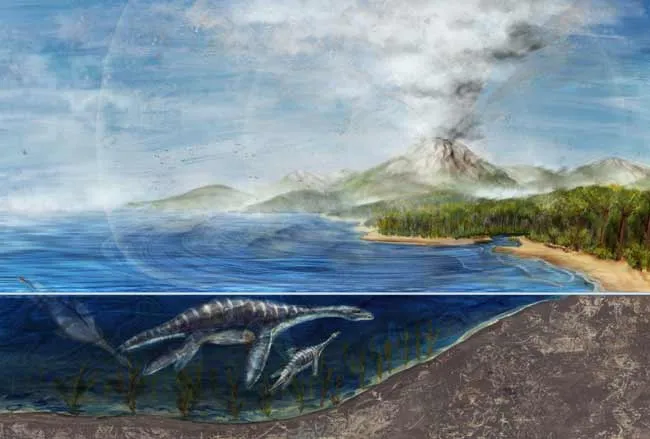
The most recent of the Big Five is the most familiar one—the cataclysm that ended the Age of Dinosaurs. The end-Cretaceous or Cretaceous-Tertiary extinction event, otherwise known as K-T, killed off all dinosaurs save birds roughly 65 million years ago, as well as roughly half of all species on the planet, including pterosaurs.
Not only did mammals sweep across the planet after K-T, but sharks expanded across the seas, explained American Museum of Natural History vertebrate paleontologist Jack Conrad.
Get the world’s most fascinating discoveries delivered straight to your inbox.
"Throughout the Age of Dinosaurs, you always had these large reptile carnivores dominating the water, such as ichthyosaurs, mosasaurs and plesiosaurs," Conrad explained. "Only after they die do you see big sharks becoming really prevalent. You probably wouldn't have seen orcas or blue whales either had reptile dominance of the seas not gone by the wayside."
Although research suggests the planet was on the verge of environmental upheaval before the K-T extinction event, the straw that broke the dinosaur's back is widely thought to have been an impact with an asteroid or comet. Still, a number of researchers contend evidence commonly linked with such an impact, such as the metal iridium, which is rare on the Earth's crust, could also be caused by the massive volcanic eruptions at the Deccan Flats in India, another popular contender for the dinosaur-killing catastrophe.
The Triassic-Jurassic extinction
The end-Triassic, or Triassic-Jurassic extinction event about 200 million years ago is thought by many to possibly have set dinosaurs on the path to their 135-million-year domination of much of life on Earth. It also ended life for roughly half of all species.
Until this disaster, mammal-like creatures known as therapsids were actually more numerous than the ancestors of the dinosaurs, known as archosaurs.
"The dinosaurs definitely survived better than the early proto-mammals did, and the extinction event might have entirely tipped it in their favor," said Rutgers University paleobiologist George McGhee.
Of the Big Five, the Triassic-Jurassic extinction has the fewest number of scientists currently researching it, "although that's changing right now," said Columbia University paleoecologist Paul Olsen. Its cause remains under great debate, with the best contender so far being the massive volcanic eruptions at the "Central Atlantic magmatic province," a region that encompassed a staggering 4.2 million square miles (11 million square kilometers), an area larger than Canada. Another main possibility could be an astronomical impact, Olsen said, although as with the K-T event, the evidence for both types of catastrophe can get maddeningly blurry.
The Permian-Triassic extinction
The largest of the Big Five was the end-Permian or Permian-Triassic extinction event roughly 250 million years ago, which eliminated as much as 95 percent of the planet's species.
Before this extinction, marine animals were mostly filter feeders stuck in place on the seafloor, such as crinoids or "sea lilies." Afterward, the seas became far more complex with mobile creatures such as snails, urchins and crabs.
The most likely final trigger for the end-Permian was again massive volcanism, this time at the Siberian Traps, which spewed as much as 2.7 million square miles (7 million square kilometers) of lava out, an area nearly as large as Australia.
Recent evidence suggests, however, that the end-Permian may have been long in the making.
The late Devonian extinctions
The late Devonian extinction events were actually two sharp pulses of death about 360 million years ago, each just 100,000 to 300,000 years apart.
Each pulse was accompanied by a massive drop in temperature, with the steaming seas of the Devonian—surface temperatures of which were about 93 degrees F (34 degrees C)—dropping to about 78 degrees F (26 degrees C), "and marine organisms would not have liked that at all," McGhee said. As to what caused these cold snaps, the ever-popular suspects are ash and dust kicked up by either astronomical impacts or massive volcanism.
At that time, plants had made it onto land, as had spiders, scorpions and similar creatures. Right before the extinction events, the first proto-amphibians made it onto shore. However, the invasion of the so-called elpistostegalians—distant relatives of the coelacanth—"got wiped out by these extinction events," McGhee explained. "It wasn't until at least another 10 million years later that we got footprints from vertebrates on land again, this time from the ichthyostegalians, the proto-amphibians we're all descended from. Who knows how the world might have been different."
The Ordovician-Silurian extinctions
The earliest of the Big Five, the end-Ordovician or Ordovician-Silurian extinction events some 444 million years ago, are reckoned by many to be the second largest.
These also consisted of a pair of die-offs, apparently involving massive glaciation and a resulting fall in sea levels. The cause of this glaciation remains a mystery, but one idea was that land plants actually caused it, pulling so much carbon dioxide out of the atmosphere that global cooling resulted, McGhee explained.
Curiously, even though the end-Ordovician led to a huge loss of life, in a way it actually had very little impact on the persistence of lineages. Although the four other Big Five extinction events led to huge changes in which animals rose to prominence, the same animals that dominated before the end-Ordovician dominated afterward.
Otherwise, "one neat thing about mass extinction events is that they're often reset buttons, where you change what dominates the globe," Conrad said. "You open the door to things like us to live."
