













New Architecture Inspired By Living Cells

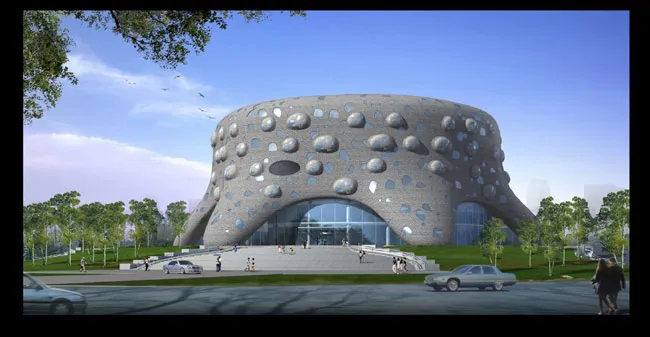
You don't need the Magic School Bus to head into a walled cell; you just need a plane ticket to the Far East where the first cell-shaped building will soon be erected.
The building, designed to resemble a cell from the outside, includes forms inspired by molecular biology on the inside. It will be home to the Institute for Nanobiomedical Technology and Membrane Biology in Chengdu, China.
Photos: Exterior | Interior | Garden
The design comes from a collaboration of individuals from different disciplines initiated by Sloan Kulper, a former Massachusetts Institute of Technology architectural student who once took a biology class.
The instructor for that class, Shuguang Zhang, associate director of the Center for Biomedical Engineering at MIT, frequently discussed similarities between architecture and structures in biology.
"Nature has produced abundant magnificent, intricate and fine molecular and cellular structures through billions of years of molecular selection and evolution," Zhang said.
It was such discussions that sparked Kulper's interest in the shape of the smallest structural unit of living things.
Get the world’s most fascinating discoveries delivered straight to your inbox.
"When I took Shuguang's course, I was thrilled to learn that structural biologists had developed such an amazing language for describing new and complex forms," Kulper said. "Also, structural biology is basically concerned with the sort of geometries that architects and designers often work with, though on a completely different scale."
About a year a later, when Kulper was offered an opportunity to serve as a founding advisor of a new biological research facility in China, he teamed up with Zhang and another MIT graduate, Audrey Roy, currently a software engineer at Sharpcast, Inc. to develop the concepts for a building with a biology theme.
The pioneering design for the cell-shaped building was inspired by "elegantly folded protein structures and their simple and beautiful structural motifs," According to Zhang.
The three worked with a group of Chinese architects to develop sketches and models while simultaneously studying cellular structures that had formal similarities to the spaces being designed, Kulper said. "We worked with images of proteins, membranes and organelles alongside photos and textbook images of glazing systems and cantilevers."
The $12 million, six-story-tall building will sport bay windows all around the surface of the building similar to proteins in a cell membrane, which stick out of the surface like little potatoes.
The institute will also have a crystal-shaped lecture hall with a crystal diffraction pattern on the ceiling. Biologists crystallize proteins and pass X-rays through them to observe the scattering patterns in order to study the shape of a protein.
"The building is very interesting. I have always wondered what it would be like working within the cell," Institute Professor Phillip Sharp said after viewing the renderings of the building.
