















Harnessing Microbes to Clean Water and Create Energy
This ScienceLives article was provided to LiveScience in partnership with the National Science Foundation.
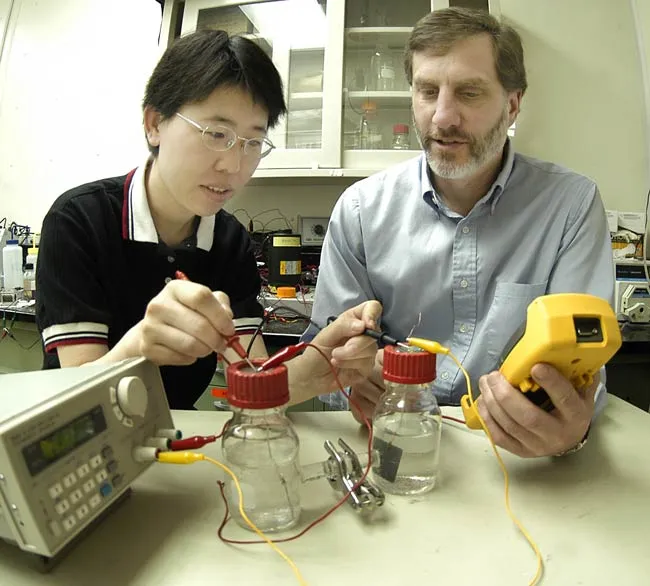
In our world where many people lack access to potable water and sanitation, Bruce Logan and his team are developing energy sustainable technologies to clean water and make electrical energy for water treatment. Their research includes exploring how to develop microbial fuel cells (MFCs) that can tackle both challenges. The researchers have proven that almost any biodegradable material can be used to produce power, for instance, they can produce electricity from domestic wastewater, as well as wastewater generated by animals, farms, food processing and industry. Currently, the lab is working to utilize this technology on larger scales. In past research, Logan and his team developed a modified MFC system that produces hydrogen gas while cleaning wastewater, attaining record high hydrogen yields. This technology can use even the most common microorganisms to produce hydrogen and other fuels such as methane. See a video of Logan in his lab from the new series Green Revolution, an animation of his earlier work, and press releases on his electricity generation work, hydrogen work and the microbes’ record-breaking productivity, and read his answers to the ScienceLives 10 Questions below.
Name: Bruce E. Logan Age: 52 Institution: Penn State University Field of Study: Environmental Engineering and Bioenergy Production
What inspired you to choose this field of study? I spent my summers either on the Great South Bay in New York (on Long Island) or hiking and camping in the mountains in Harriman State Park in New York. I realized that both water and the environment needed to be kept incorporated into my life. That led me initially to choose environmental engineering. Later on, I realized that how we produce energy will be the single greatest challenge to taking care of our environment. We can produce energy many ways, but many of them could be disastrous to our environment.
What is the best piece of advice you ever received? Find something to work on that you enjoy doing and that gives you personal satisfaction. I knew an accountant who chose his job because he knew it would provide a good and solid income. He said after 20 years he hated it. If you are going to spend 40 hours (or more) of your life a week on something, make sure it is interesting and challenging.
What was your first scientific experiment as a child? I had chemistry sets when I was young, but never found them to be much fun. I suppose I was more interested in things going “boom” than an actual chemistry experiment. Later on, I discovered how chemistry could be used to understand water pollution. I used Hack kits to monitor water quality of lakes and rivers in my home town.
What is your favorite thing about being a researcher? I have the freedom to work on almost anything I want. Several times during my career I have moved from one area into new areas, each time finding new things to discover and study. Early on I was doing computational modeling, but felt I needed more direct, hands-on work. That let me to topics as diverse as studying particles in water in order to understand how carbon can sink and be sequestered on the ocean floor, developing new techniques of bioremediation to get rid of chemicals in the environment, studying biofouling and bacterial transport in groundwater systems, and most recently, discovering new methods of bioenergy production. In short, being a researcher is fun and it allows me to choose to work on what I think is important.
Get the world’s most fascinating discoveries delivered straight to your inbox.
What is the most important characteristic a researcher must demonstrate in order to be an effective researcher? Being a researcher takes two of three things: hard work, intelligence and creativity. You only need two of these to succeed. Being smart is not enough. There are a lot of intelligent people that can do great work but lack the drive or creativity to succeed. It is what you do with your intellectual firepower that matters most. You don’t need to be the smartest person in the room, but through hard work and being creative you can achieve great things as a researcher.
What are the societal benefits of your research? I work on systems that address water and energy, two topics of great importance to everyone in the world. We all need clear water and sanitation, but 1 billion people lack sufficient access to potable water, and 2 billion lack adequate sanitation. We cannot address the health needs of our global population without these two things. We could meet the water needs if we had unlimited energy, but we don’t. That is why I work on finding methods to make our water infrastructure energy sustainable.
Who has had the most influence on your thinking as a researcher? Alice Alldredge at the University of California, Santa Barbara. She taught me to hone my observational skills and how to pick research topics that mattered.
What about your field or being a researcher do you think would surprise people the most? Most people today are familiar with my work in environmental engineering, in particular, bioenergy production. Most people are surprised when I tell them that my highest cited paper is still a paper published in a journal called Deep Sea Research.
If you could only rescue one thing from your burning office or lab, what would it be? My hard drive from my computer. Paper is convenient, but all my work is backed up on a computer drive now.
What music do you play most often in your lab or car? I walk a little over a mile to work, so I don’t drive for my commute. I try to vary my music I play on my iPhone based upon my mood. I go primarily for ’60s and ’70s music like America, Don Maclean, Genesis, Yes, Crosby Stills Nash (and Young), to a little more modern music like Switchfoot and Maroon 5, but I’m happy to listen to Opera or comedy by Jim Gaffigan as well. Whatever strikes my mood.
Editor's Note: This research was supported by the National Science Foundation (NSF), the federal agency charged with funding basic research and education across all fields of science and engineering. Any opinions, findings, and conclusions or recommendations expressed in this material are those of the author and do not necessarily reflect the views of the National Science Foundation. See the ScienceLives archive.