













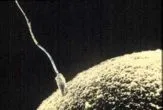
Scientists have long wondered why organisms bother with sexual reproduction. It makes a whole lot more sense to just have a bunch of females that can clone themselves, which is how asexual reproduction works.
Turns out sex might have evolved as a way to concentrate lots of harmful mutations into individual organisms so they could be easily weeded out by natural selection, a new computer model suggests.
The classic explanation for the onset of whoopee, about 1 billion years ago, is that it provides a way for organisms to swap and shuffle genes and to create offspring with new gene combinations that might survive if the environment suddenly changes.
But some scientists think this isn't enough of a justification to outweigh the many costs of getting together to make little ones. Just ask any single person—sexual organisms have to spend valuable time and resources finding and attracting mates.
If all organisms were like starfishes and cacti, which just drop pieces of themselves when they want to multiply, reproduction would be a whole lot simpler. There would be no need for elaborate peacock feathers or bird songs; stags wouldn't need antlers; elephant bulls wouldn't have to produce stinky cologne and guys probably wouldn't spend so much money on dates.
Natural cleansing
The new work could help test a hypothesis first proposed nearly 20 years ago, stating that sex evolved as a way to purge harmful mutations from a population. According to this view, the random shuffling of genes through sex will sometimes have the effect of concentrating many harmful mutations into single individuals.
Get the world’s most fascinating discoveries delivered straight to your inbox.
These individuals will be less healthy than their peers, and therefore more likely to be weeded out by natural selection, the thinking goes.
This hypothesis, called the "mutational deterministic hypothesis," is controversial though, because it assumes that single mutations by themselves are only slightly harmful, while a combination of many mutations together is much more damaging. Scientists call this phenomenon "negative epistasis."
If negative epistasis were true, it would provide a powerful explanation for why sex has managed to persist for so long despite its numerous costs. But the phenomenon has yet to be widely demonstrated in nature and scientists have yet to figure out how such a thing evolved in the first place.
A new computer model by Ricardo Azevedo of the University of Houston and colleagues provides a possible answer to this last question. According to their model, detailed in the March 2 issue of the journal Nature, negative epistasis is a natural byproduct of sex itself.
Digital critters
The researchers created digital organisms that reproduced through sex in the same manner as real organisms. And like a regular organism, the virtual one developed a natural buffer to resist change by mutations. This ability, called "genetic robustness," is thought to be one of the main benefits of sex.
By shuffling genes, sex allows a population to spread its mutations across many individuals within a group. The mutations become diluted and can be effectively dealt with by an individual's genetic repair system.
But the researchers found that the protection only works when the digital organisms were facing a few mutations at a time. When assaulted by many at once, their repair systems became overwhelmed and the organisms died. Azevedo think this happens in real life, too.
"Most organisms are never forced to adapt to being resistant to many mutations at once," he told LiveScience. "They're adapting to being resistant to one or maybe two mutations, but not to ten at the same time."
The researchers think that the combination of genetic robustness through sex and the limited ability of organisms to deal with mutations leads to the natural development of negative epistasis.
"Most mutations are actually harmful, so anything that helps populations get rid of their harmful mutations is going to be important," Azevedo said. "The more interesting side of evolution is all the beneficial mutations that leads to complex structures, but the dirty work of evolution is to get rid of bad mutations, and that's where sex seems to play a role."
- The Most Popular Myths in Science
- The Origin of Sex: Cosmic Solution to Ancient Mystery
- Survival Skills: Why Sex is Good