













Older Elephants Smell Sexier
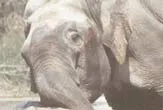
When male Asian elephants enter their annual period of heightened sexual activity and aggression, they broadcast their availability to the ladies by pumping out a pungent mix of pheromones.
But older males have the upper hand on their younger, less experienced competition, producing a more attractive mix of scents, a new study shows.
This mating period is called musth (pronounced "must").
Researchers analyzed more than 100 secretion samples from six males and found that this pheromone, called frontalin, exists in two mirror-image molecular forms designated as "plus" and "minus."
When teenage males start producing frontalin, they produce mostly the plus version. As they age, though, they begin secreting more of the minus pheromone, which smells bitter and acrid to humans. With maturity comes a mixture of the two forms. By the time they reach their mid 20's, adult Asian elephants have perfected a 1:1 mixture.
"There isn't any compound that smells exactly like it," Elizabeth Rasmussen of Oregon Health and Sciences University told LiveScience. "I certainly wouldn't call it pleasant."
But female pachyderms love it.
Get the world’s most fascinating discoveries delivered straight to your inbox.
Strong reactions
To determine what frontalin mixture created the perfect scent, Rasmussen and her colleagues prepared samples for the approval of females elephants in different reproductive stages, from not reproductively active to ovulating and pregnant.
Sniffing and approaching the sample indicated attraction; erect ears and backpedaling showed repulsion.
Some females urinated on the spot, but that reaction can be read either way, Rasmussen said.
Ovulating females were attracted to the 1:1 mixture, but non-reproductive and pregnant females weren't interested. And none of them were impressed by the immature samples.
The researchers also offered a whiff of the "perfect scent" to young and old males, who expressed their distaste by blasting air from their trunks, trumpeting, and roaring. However, samples of immature males generally piqued the males' interest, particularly the younger ones.
"The young elephant is curious in this secretion, and to learn about it he will come up and sniff it," Rasmussen said. "The more experience the young elephant gets in smelling an older bull, the better he'll get at producing his own scent."
The length of musth increases, along with the concentration of frontalin, as males mature, the researchers report. The fittest males produce the strongest, most attractive pheromone mix for the longest period, which improves their status among potential suitors.
Saving elephants
The finding could prove important in developing better conservation techniques and preventing crop-raiding, particularly of rice in Asia, by crafty elephants.
"They know enough to wait until the rice is ripe, until it's been gathered in bundles by humans, and then they go in and quickly crop raid," Rasmussen said. "They make off with bundles of rice."
In Africa, farmers fend off crop-raiding elephants with chili peppers, but repulsive musth-related scents might be a stronger approach.
"We probably won't be able to use pheromones alone," Rasmussen said. "But the more you understand about how elephants use olfaction and how specific signals and pheromones influence elephants, the more humans can figure out good, elephant-friendly methods to control behavior we don't want."
The research is detailed in the Dec. 22 issue of the journal Nature.
- The Sexy, Healthy Scent of a Man
- The Ticklish Trick of Inseminating an Elephant
- Gay Men Respond Differently to Pheromones
- Elephant Mimics Truck Sounds