














Fragmented Forests Could be Boon to Snakes, Bad for Birds

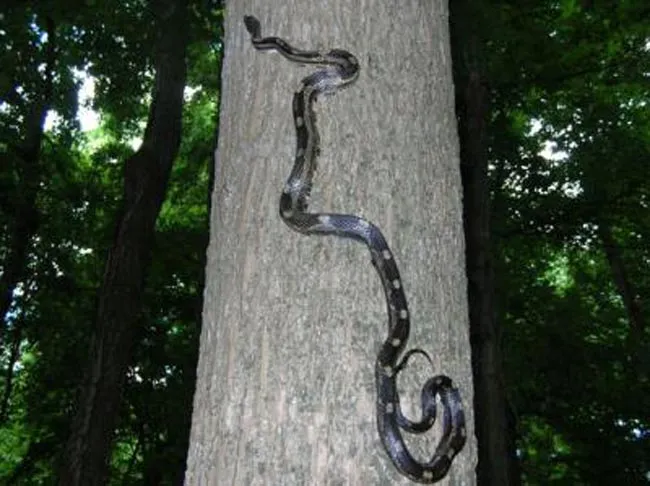
Clearing forests is generally bad news for many native animal species, including rat snakes, but a new study has found that rat snakes that manage to survive in fragmented forests do quite well — much to the detriment of the birds they prey on.
Researchers found that rat snakes are frequent predators of birds' nests in fragmented forests in southern Illinois, and they suggest that forest fragmentation will create a boom in rat snakes, and boost the rates of snake attacks on birds' nests.
Previous work found that rat snakes living in fragmented forests are responsible for between 50 to 70 percent of bird-nest predation.
Rat snakes living in fragmented forests — created by development such as urban sprawl or agriculture — are dwelling in their dream environment. These snakes like to hang out around forest edges, which fragmented forests have more of, because it's easier for them to regulate their body temperatures.
Snakes loiter near forest edges, regardless of whether the edge is natural or manmade, and they have a knack for slithering up trees and robbing bird nests, said behavioral ecologist Patrick Weatherhead of the University of Illinois in Champaign.
"Snakes really like that interface between the open and closed habitat, whether it's an edge where the forest opens onto a wetland or a rock outcrop or a manmade habitat such as a hay field," Weatherhead said. "So, if your priority is to conserve the birds, you'll want to preserve un-fragmented forest habitat."
Forest edges help snakes find different so-called thermal microclimates for regulating their body temperature, Weatherhead told LiveScience. For example, on a cool day a snake can more easily find direct sun light if it hangs out on the forest edge, rather than in the interior where denser vegetation shades out the rays.
Get the world’s most fascinating discoveries delivered straight to your inbox.
One of Weatherhead's former graduate students, Gabriel Blouin-Demers, now at the University of Ottawa in Canada, tested this idea in a previous study — by training rat snakes to eat from his hand — and found that snakes from the forest interior would first move to the forest edge to warm up under the sun and jump start their digestion before feeding.
Weatherhead said ornithologists have been interested in fragmentation for a long time.
"It's not just that you've lost habitat, but the smaller chunks you're left with aren't as good for a variety of wildlife. The smaller fragmented areas attract birds but they don't do very well there," he said.
Weatherhead said the message is, if you're going to clear land for agriculture or other development, try to avoid breaking the forest into bits and pieces.
The study, conducted in southern Illinois, used data from radio transmitters implanted in rat snakes combined with information from more than 300 bird nests that were tracked. Independently, a number of nests that weren't actually a part of the study were monitored with video cameras to document the nest predators. The miniature video cameras make identification of nest predators possible, because they can record activity at the nests around the clock.
"Everywhere there have been camera studies, as long as it's in wooded or semi-wooded habitat, rat snakes emerge as the single most important predator. They're common throughout the range, and they're really good at finding bird nests," Weatherhead said.
Rat snakes — roughly 6.5 feet (2 meters) long and just over 2 pounds (roughly 1 kilogram) in weight — are common in eastern North America, from Texas in the west to the Florida Keys in the east, and all the way up to southern Ontario.
The rat snake moniker is somewhat misleading because they will eat any small mammal they can sink their fangs in.
"Rat snakes are very opportunistic," Weatherhead said. "I have a picture of a rat snake eating a full-grown squirrel. So that's a mouthful."
- Top 10 World's Deadliest Animals
- Gallery: Snakes of the World
- 7 Shocking Snake Stories
