













Ancient Mammal Had Modern Teeth

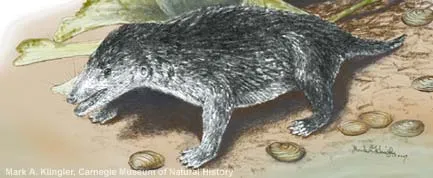
The fossils of an ancient creature resembling a small opossum and equipped with modern-looking teeth suggest our furry ancestors were far more diverse in the age of dinosaurs than previously thought.
"The story of the earliest mammals is a story of their teeth," said study team member Zhe-Xi Luo, a paleontologist at the Carnegie Museum of Natural History in Pittsburgh. "By tracing their evolution in the rich fossil record of the Mesozoic, we can understand how these cutting and grinding teeth evolved over and over again."
Dubbed Pseudotribos robustus, the creature was discovered in 165 million-year-old lakebeds corresponding to the Jurassic Period in Northern China. It measured about 5 inches (12 centimeters) in length and weighed between 20 to 30 grams (.04 to .07 pounds). The animal likely fed on worms and insects and lived above ground, although it had strong limbs and would have been capable of "power digging," scientists say.
What surprised scientists, however, were the animal's teeth. They resembled the "tribosphenic" teeth of modern mammals, which can both slice and grind. Psuedotribos had "pseudo-tribosphenic" teeth that are superficially similar to tribosphenic teeth except that the positions of the cutter and grinder are flipped.
Paleontologists previously thought tribosphenic teeth evolved once before spreading to all mammals. But a 2001 study by Luo and colleagues suggested tribosphenic molars in monotremes, whose living descendents include the platypus, evolved separately from those of marsupial and placental mammals.
The new fossil lends further support to the idea that similar dental structures for cutting and grinding evolved several times in mammalian evolution.
Under natural selection, organisms descending from different ancestors can evolve similar structures and similar adaptations to suit a common purpose. This is called convergent evolution.
Get the world’s most fascinating discoveries delivered straight to your inbox.
"The pseudo-tribosphenic teeth and the true tribosphenic teeth are great examples of convergent evolution and a great manifestation of how dental and feeding adapationa can be achieved by different lineages of mammals," Luo said.
- Ancient Furry Featherweight Mammal Discovered
- Life's Little Mysteries: Why Do We Grind Our Teeth?
- A Brief History of Dinosaurs
