















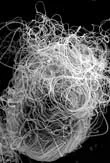
If there was a prize for biggest sperm in nature, it would go to Drosophila bifurca, a tiny fruit fly whose coiled sperm would measure more than 2 inches long if straightened out.
That's 1,000 times longer than an average human sperm.
"To put that into perspective, if humans made sperm that long and you took a six-foot man and stood him on the goal line of a football field, his sperm would stretch out to the 40-yard line," said Adam Bjork, a Ph.D. student at Syracuse University in New York.
Along with Syracuse University biologist Scott Pitnick, Bjork examined why any animal, let alone a tiny fruit fly, would evolve such lengthy sperm.
The pair's findings, detailed in the June 8 issue of the journal Nature, show that the answer lies in the body of the female fruit flies.
Post-sex hurdles
In many species, the number of sperm produced by males far outnumbers the amount of eggs produced by females. The males produce tiny but numerous sperm to increase the chances that one of them will make it to the egg.
Get the world’s most fascinating discoveries delivered straight to your inbox.
As sperm outnumbers eggs, eggs become rare and precious commodities, and male competition for access to them increases.
Sexual selection theory predicts that as sperm get bigger and the sperm to egg ratio becomes more even, male competition should decrease.
But when the researchers examined male competition in D. bifurca, they found that it wasn't weakened as expected. The reason for this, it turned out, has to do with the anatomy of the females.
Female cryptic choice
Even after a male has successfully inseminated a female, there's still a long way to go before fertilization can take place. That's because the female bodies of many species are not passive arenas within which sperm compete, but more like obstacle courses, with hurdles and defenses in place to weed out weakling sperm.
For example, the female reproductive tract might release harsh chemicals harmful to sperm, or it might evolve to become intentionally long so that the race to fertilization becomes a test of sperm endurance.
These post-sex hurdles are part of what biologists call "female cryptic choice" since they're not obvious to researchers, or to the females themselves.
In D. bifurca, the female reproductive tract is just slightly longer than the sperm that swim through it.
"It looks like a giant slinky filling her abdomen," Bjork told LiveScience.
The researchers think that it is this exceptionally long reproductive tract that drives the evolution of the giant sperm.
"These results demonstrate the often under-appreciated power that sperm competition and cryptic female choice have over the physiological and behavioral evolution of both males and females," Bjork said.