













Roman Soldier's Footprint Reveals Clues to Ancient City
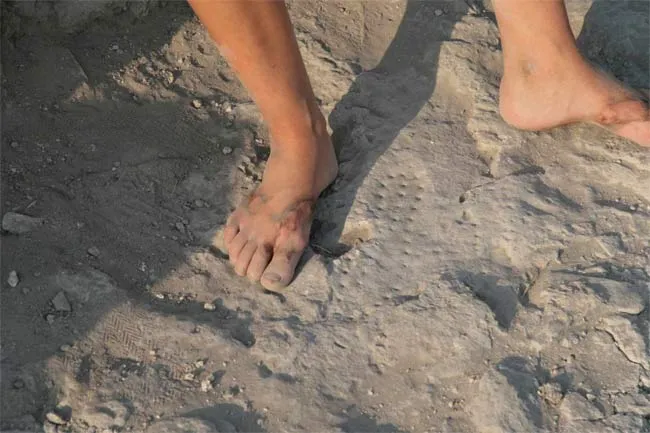
Archaeologists have uncovered a footprint made by a sandal-clad Roman soldier in a wall surrounding an ancient city in Israel that Jesus might have visited.
The print was made by a strappy, leather sandal of a type worn by the Roman military. Called caliga, the sandals of this time had iron hobnails hammered into their soles, which provided durability and traction as well as a weapon when kicking.
Other finds of the excavation project this summer at the ancient city of Hippos included the city's colonnaded street, extending 790 feet (240 meters), a marble-paneled bathhouse, a glass bottle with an embossed face and part of a statue of a Greek god. The archaeologists hope upcoming digs will reveal other pieces of the estimated 6.5-foot-high (2-meter) statue.
The sandal mark in the cement suggests the soldiers participated in the construction of the walls, the researchers say.
"This rare footprint, which is complete and well-preserved, hints at who built the walls, how and when," said researcher Michael Eisenberg of the Zinman Institute at the University of Haifa.
Hippos, also called Sussita, overlooks the Sea of Galilee. It was established in the third century B.C. and flourished as a Greco-Roman city until the seventh century A.D. The city was destroyed by an earthquake in the year 749.
Along with other cities along the Jordan River, Hippos formed the "Decapolis," which is described in the New Testament as the area in which Jesus performed miracles.
Get the world’s most fascinating discoveries delivered straight to your inbox.
"The remains of Sussita, its view of the Golan Heights and the Galilee and its historic significance in Christianity have made it one of the most attractive sites in northern Israel," said study leader Arthur Segal, also of the Zinman Institute.
About 10 years ago, when the area around Hippos was declared a national park and the army post there set up by the Israel Defense Forces was dismantled, scientists decided to embark on a large-scale international, archaeological project, now in its eighth season.
The objective is to uncover the entire city, the street network, religious and other buildings as well as to survey two necropolises, or ancient cemeteries, located to the south and southeast of the city.
- Top 10 Ancient Capitals
- Top 10 Reasons Alexander the Great Was, Well ... Great!
- Trivia: The Artifact Wars
Jeanna Bryner is managing editor of Scientific American. Previously she was editor in chief of Live Science and, prior to that, an editor at Scholastic's Science World magazine. Bryner has an English degree from Salisbury University, a master's degree in biogeochemistry and environmental sciences from the University of Maryland and a graduate science journalism degree from New York University. She has worked as a biologist in Florida, where she monitored wetlands and did field surveys for endangered species, including the gorgeous Florida Scrub Jay. She also received an ocean sciences journalism fellowship from the Woods Hole Oceanographic Institution. She is a firm believer that science is for everyone and that just about everything can be viewed through the lens of science.