Live Science Plus


New Theory of Primate Origins Sparks Controversy

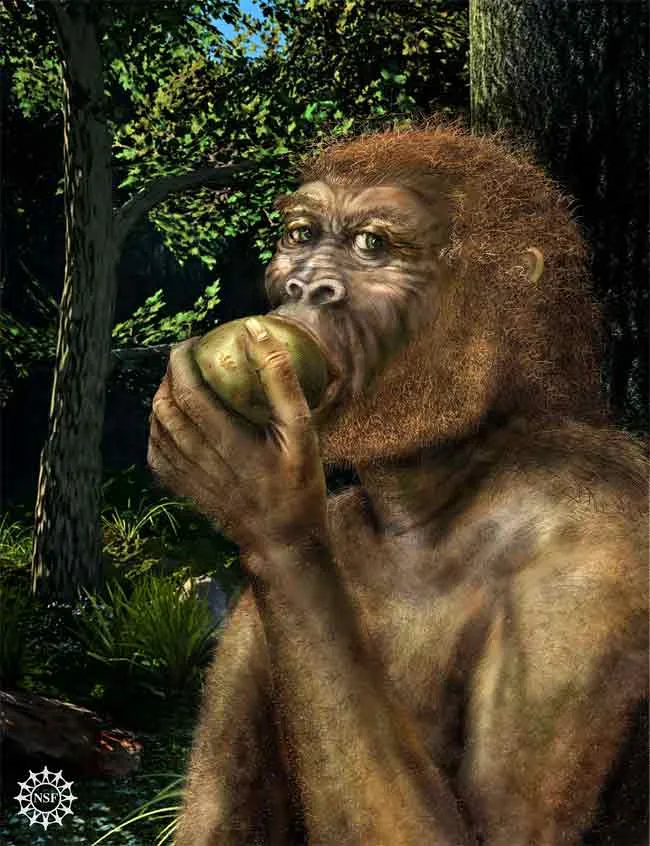
The evolution of the distant ancestors of humans and other primates may have been driven by dramatic volcanic eruptions and the parting of continents, according to a controversial new theory.
Scientists remain skeptical about the idea, however.
According to prevailing theories, primates originated in a small area. From this center of origin, they dispersed to other regions and continents.

The problem with this idea is that it has "resulted in all sorts of contradictory centers of origin," from Africa to Asia to the Americas, said researcher Michael Heads at the Buffalo Museum of Science in New York. It has also led to perhaps improbable suggestions that primates rafted across the Mozambique Channel to reach Madagascar or even across the Atlantic to reach South America, "imaginary migrations" that are "incompatible with ecological evidence," Heads noted.
Instead, Heads suggests the ancestors of primates and their nearest relatives were actually widespread across different parts of the supercontinent Pangaea some 185 million years ago, back when the lands that make up our continents nowadays were fused together. These ancestors could have evolved into the primates in central-South America, Africa, India and southeast Asia, the flying lemurs and tree shrews in southeast Asia, and extinct creatures known as plesiadapiformes in North America and Eurasia.
The big split
Dramatic geological events on Pangaea — major volcanic eruptions and the splitting up of the continent — might have then helped split the primates into different lineages.
Get the world’s most fascinating discoveries delivered straight to your inbox.
For instance, Heads suggested that at roughly the same time as intense volcanic activity in Africa about 180 million years ago, the group that includes humans, other simians, and tarsiers — altogether known as the haplorhines, or dry-nosed primates — split from the strepsirrhines or curly-nosed primates, which include the lemurs and lorises.
There are more examples he poses as well. He speculated the lemurs of Madagascar diverged from their African relatives at roughly the same time as the opening of the Mozambique Channel some 160 million years ago, while New and Old World monkeys diverged with the opening of the Atlantic about 130 million years ago.
Heads detailed his concept in the journal Zoologica Scripta.
Behind the theory
Heads reached these conclusions by incorporating spatial patterns of primate diversity and distribution as historical evidence for how they might have evolved. Prior research looked solely at the fossil record and genetic data, he said.
Still, doubts remain. Evolutionary biologist Anne Yoder at Duke University in Durham, N.C., bluntly stated, "I believe that Heads' theory is absurd."
While Heads conjectures that primates were widespread across Pangaea some 185 million years ago, the ages of the oldest primate fossils known to date suggest they emerged some 56 million years ago, while genetic data suggested they originated some 80 to 116 million years ago. Primatologist John Fleagle at Stony Brook University in New York added that Heads' findings "are inconsistent with all other evidence we have about the timing of major events in primate evolution."
Heads notes that fossils often serve as an incomplete record for what and when animals actually existed. He added that genetic data might also potentially lead scientists to underestimate ages by tens of millions of years.
Another possibility
Although Fleagle noted it was reasonable to assume that the fossil record is imprecise when it comes to what species emerged when, "the question is how far off is the fossil is record likely to be." For instance, "Why don't we find even a hint of a primate in the very rich fossil record of South America between 180 million years ago and 26 million years ago, if they there were actually there?"
Indeed, new research suggests primates could have rafted from Africa to Madagascar. Computer simulations detailed online Jan. 20 in the journal Nature suggest powerful ocean surface currents flowed eastward for a few million years from northeast Mozambique and Tanzania to the island about 50 million years ago.
These could have rapidly carried the ancestors of Madagascar's mammals outward, following storms that washed them out on natural rafts of trees or large vegetation mats.
"I was very excited to see this paper," Yoder said. This kind of dispersal had been an idea without actual data backing it up. "This takes it out of the realm of storytelling and makes it science," she added.
- Top 10 Things That Make Humans Special
- Top 10 Mysteries of the First Humans
- Human Origins: Our Crazy Family Tree