













Female Wild Horses Stick Together
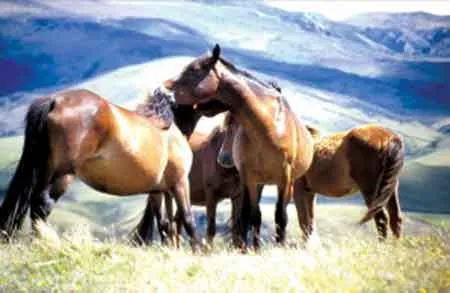
Wild mares that form strong social bonds with other mares produce more foals than those that don’t, researchers have found, in what may be the first documented link between “friendship” and reproductive success outside of primates.
The study followed bands of feral horses in the Kaimanawa Mountains of New Zealand over the course of three years. Elissa Z. Cameron, now at the University of Pretoria in South Africa, and two colleagues computed sociality scores for 56 mares, based on parameters such as the proportion of time each animal spent near other mares and the amount of social grooming she did.
The team found that the scores correlated well with foaling rate: more sociable mares had more foals. They also suffered slightly less harassment by the bands’ few males.
Such correlational studies are notoriously tricky to interpret, and they do not prove cause and effect. But Cameron’s data are certainly consistent with the idea that bonds between females—even unrelated ones, as in horse bands—help them fend off pestering males, thus reducing stress and promoting healthy pregnancies.
Other studies of various primate species (baboons, most notably) support that notion.
The research was detailed in the Proceedings of the National Academies of Science.
- Video: Horse and Rider
- Video: Wild Horses of Mongolia
- The Secret of Fast Horses
This article was provided to LiveScience by Natural History Magazine.
Get the world’s most fascinating discoveries delivered straight to your inbox.