It's quick and easy to access Live Science Plus, simply enter your email below. We'll send you a confirmation and sign you up for our daily newsletter, keeping you up to date with the latest science news.
Baleen whales, the largest creatures on Earth, can send extremely low-frequency underwater calls to one another. But little is known about how they actually process these sounds. Now, researchers have found that the whales have specialized skulls that can capture the energy of low frequencies and direct it toward their ear bones to hear.
Baleen whales, which use baleen plates in their mouths to filter out tiny organisms and other food from the ocean, have two ways of hearing sound, the researchers found. If the sound waves are short — that is, shorter than the whale's body — the sound's pressure waves can travel through the whale's soft tissue before reaching the tympanoperiotic complex (TPC), which holds the whale's rigid ear bones on its skull.
But if the sound waves are longer than the whale's body, they can vibrate its skull in a process known as bone conduction. These longer wavelengths can be amplified, or louder, when they vibrate the skull, the researchers said. [Images: Sharks & Whales from Above]
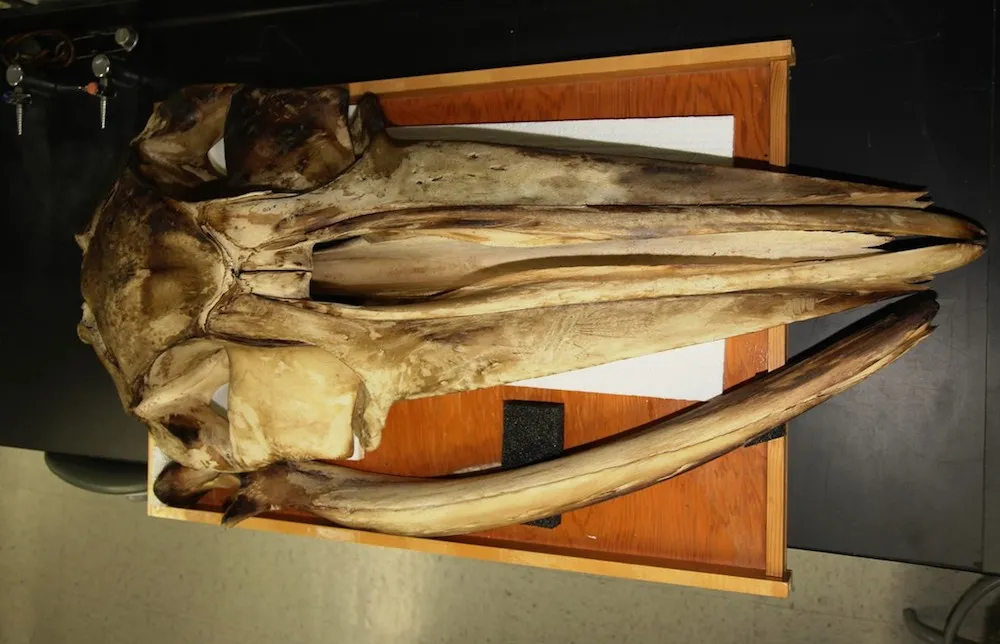
In 2003, despite rescue efforts, a young fin whale (Balaenoptera physalus)died after it beached itself on Sunset Beach in Orange County, California. The researchers saved the whale's head and used it in their study. The whale's head was placed in a CT scanner so that it could be modeled on a computer. The resulting model included the whale's skin, skull, eyes, ears, tongue, brain muscles and jaws, and allowed the researchers to simulate how sound might travel through the whale's head.
The model may only show the fin whale's anatomy, but the scientists hope to study other types of baleen whale species, including blue whales, minke whales, right whales and gray whales, the researchers said.
Before running the simulations, the researchers used a method known as finite element modeling, which breaks down the model skull into tiny pieces and tracks how they work with one another. It's almost like dividing the whale's head into Lego blocks, said San Diego State University biologist Ted Cranford, one of the study's researchers. During simulation trials, the distinct "blocks" allowed them to see how each component of bone vibrated at different frequencies.
A labeled, computer model skull of the fin whale (Balaenoptera physalus).
(Image credit: SDSU)
"At that point, computationally, it's just a simple physics problem," Cranford said in a statement. "But it's one that needs lots and lots of computational power. It can swamp most computers."
Sign up for the Live Science daily newsletter now
Get the world’s most fascinating discoveries delivered straight to your inbox.
The simulations showed that the whale's bone-conduction mechanism is about four times more sensitive to low-frequency sounds than the pressure mechanism that goes through the TPC. In fact, the lowest frequencies used by fin whales (10 hertz to 130 hertz) is up to 10 times more sensitive in cases of bone conduction, the researchers found.
"Bone conduction is likely the predominant mechanism for hearing in fin whales and other baleen whales," Cranford said. "This is, in my opinion, a grand discovery."
The new finding may help strengthen the case for laws that limit the amount of man-made noise pollution thought to interfere with the whales' underwater calls, including noise from commercial shipping, military exercises and drilling operations for oil and natural gas, the researchers said.
"What our contribution does is give us a window into how the world's largest animals hear, by an odd mechanism no less," Petr Krysl, an engineer at the University of California, San Diego, said in a statement. "This research has driven home one beautiful principle: Anatomic structure is no accident. It is functional, and often beautifully designed in unanticipated ways."
The study was published online today (Jan. 29) in the journal PLOS ONE.
Laura is the managing editor at Live Science. She also runs the archaeology section and the Life's Little Mysteries series. Her work has appeared in The New York Times, Scholastic, Popular Science and Spectrum, a site on autism research. She has won multiple awards from the Society of Professional Journalists and the Washington Newspaper Publishers Association for her reporting at a weekly newspaper near Seattle. Laura holds a bachelor's degree in English literature and psychology from Washington University in St. Louis and a master's degree in science writing from NYU.

 Live Science Plus