













Bronze Warrior Chariot Discovery Is 'Find of a Lifetime'

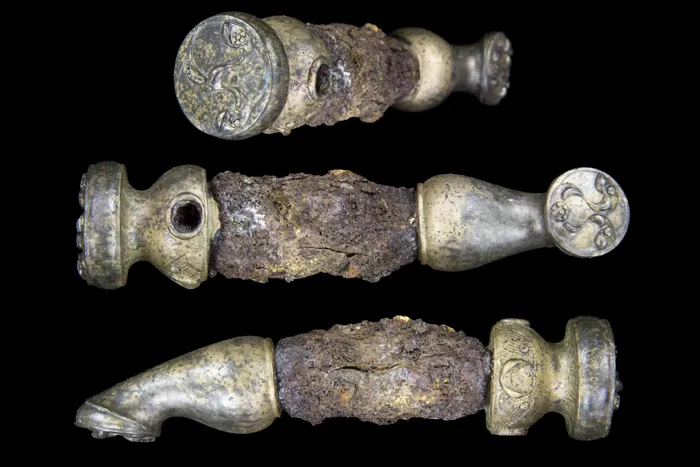
More than 2,000 years ago, pieces of an Iron Age chariot were burnt and buried, perhaps as a religious offering. Now, archaeologists have discovered the bronze remains of this sacrifice.
Digging near Melton Mowbray in Leicestershire, England, an archaeology team discovered a trove of bronze chariot fittings dating back to the second or third century B.C. The remains were discovered at the Burrough Hill Iron Age Hillfort, a fortified hilltop structure that was once surrounded by farms and settlements. Though humans lived in the area beginning around 4000 B.C., it was used most heavily between about 100 B.C. and A.D. 50, according to the University of Leicester.
"This is the most remarkable discovery of material we made at Burrough Hill in the five years we worked on the site," University of Leicester archaeologist Jeremy Taylor said in a statement. "This is a very rare discovery and a strong sign of the prestige of the site." [See Images of the Iron Age Chariot's Remains]
Burnt offering
Taylor co-directs the field project at Burrough Hill, which is used to train archaeology students. It was four of these archaeology students who first found a piece of bronze near an Iron Age house within the Burrough Hill fort. More bronze pieces were found nearby.
The pieces are the metal remains of a chariot that once belonged to a warrior or noble, according to university archaeologists. They include linchpins with decorated end caps, as well as rings and fittings that would have held harnesses. One linchpin is decorated with three wavy lines radiating from a single point, almost like the modern flag for the Isle of Man, a British dependency in the Irish Sea. The Isle of Man's flag is decorated with an odd symbol called a triskelion, or three half-bent legs converging at the thigh.
"The atmosphere at the dig on the day was a mix of 'tremendously excited' and 'slightly shell-shocked,'" Taylor said. "I have been excavating for 25 years, and I have never found one of these pieces — let alone a whole set. It is a once-in-a-career discovery."
Get the world’s most fascinating discoveries delivered straight to your inbox.
The pieces were found upon a layer of chaff, which may have provided fuel for the burning ritual. The chariot pieces were put into a box and then covered with cinder and slag after being set on fire. This may have been a ritual marking the dismantling or closing of a home at the fort, or it could have honored the change of seasons, University of Leicester archaeologists suspect.
Bronze and iron
Alongside the chariot pieces, the researchers found a set of iron tools, which were placed around the parts before they were burned.
"The function of the iron tools is a bit of a mystery, but given the equestrian nature of the hoard, it is possible that they were associated with horse grooming," Burrough Hill project co-director John Thomas said in a statement. "One piece, in particular, has characteristics of a modern curry comb, while two curved blades may have been used to maintain horses' hooves or manufacture harness parts."
The pieces will be on display temporarily at the Melton Carnegie Museum in Melton Mowbray from Oct. 18 to Dec. 13.
"Realizing that I was actually uncovering a hoard that was carefully placed there hundreds of years ago made it the find of a lifetime," University of Leicester student Nora Battermann, who was one of the four students to make the find, said in a statement. "Looking at the objects now that they have been cleaned makes me even more proud, and I can't wait for them to go on display."
Follow Stephanie Pappas on Twitter and Google+. Follow us @livescience, Facebook& Google+. Original article on Live Science.

Stephanie Pappas is a contributing writer for Live Science, covering topics ranging from geoscience to archaeology to the human brain and behavior. She was previously a senior writer for Live Science but is now a freelancer based in Denver, Colorado, and regularly contributes to Scientific American and The Monitor, the monthly magazine of the American Psychological Association. Stephanie received a bachelor's degree in psychology from the University of South Carolina and a graduate certificate in science communication from the University of California, Santa Cruz.