
 Live Science Plus


Aliens May Be Out There, But Too Distant For Contact
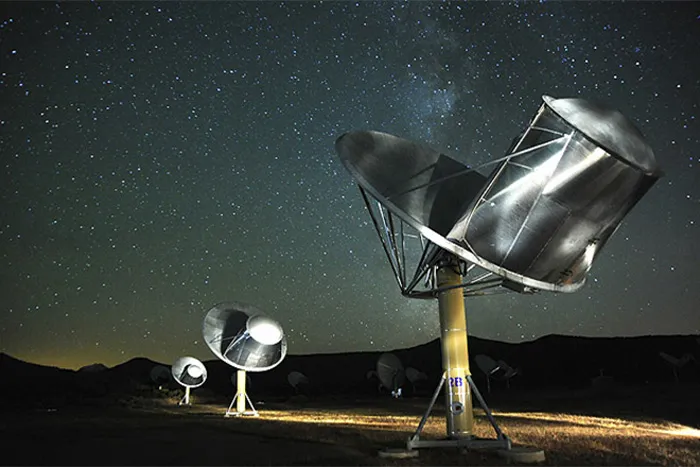
The Milky Way may be home to some 3,000 extraterrestrial civilizations but the vast distances between our galactic cousins will make contact extremely rare, a new study concludes.
Data collected by NASA’s Kepler space telescope and other observatories scouting for planets beyond the solar system indicate Earth is one of some 40 billion potentially habitable worlds in the galaxy, with about one new life-friendly planet forming every year, astronomer Michael Garrett, head of the Dutch astronomy research foundation ASTRON, said at the International Astronomical Congress in Toronto.
13 Ways to Hunt Intelligent Aliens
Article continues belowSounds promising, until you consider the sheer size of the Milky Way, which spans more than 100,000 light-years in diameter. Light travels at about 186,000 miles per second, but a signal will still take more than 4 years to reach neighboring system Alpha Centauri and 100,000 years to travel from one end of the galaxy to the other.
“On average, you’d expect the civilizations to be separated by at least 1,000 light-years in the Milky Way. That’s a large distance, and for communication purposes you need to allow for twice the travel distance, so you’re talking about civilizations that have to be around for at least a few thousand years in order to have the opportunity to talk to each other,” Garrett said.
“We don’t really know the time scales in which civilizations persist,” he added.
PHOTOS: How Aliens Can Find Us (and Vice Versa)
Get the world’s most fascinating discoveries delivered straight to your inbox.
The one example available -- Earth -- indicates that life essentially developed as soon as the conditions were right, but intelligent life arose comparatively late.
“It’s really just essentially in the last few minutes of the overall evolution of life on the planet," Garrett said. "I don’t want to be too negative about this, but ... my basic conclusion is that SETI signals will be rare in the Milky Way."
That doesn’t mean astronomers shouldn’t look, he added. Quite the contrary, given the huge technological leaps in radio astronomy and in data processing techniques compared to what was available for Search for Extraterrestrial Intelligence, or SETI, programs 60 years ago.
NEWS: Alien Life Discovery Could Happen Within 20 Years
SETI also is benefitting from sister radio astronomy projects, such as the ongoing quest to find the source of mysterious transient radio bursts.
“SETI is not easy, but it’s a pursuit that is well worth doing. The question is so important,” Garrett said. “Everyone is interested, not just scientists and space enthusiasts. People in the street are interested to know what else is out there.”
Originally published on Discovery News.