













Deadly, Rare Tropical Cyclone Hits Somalia

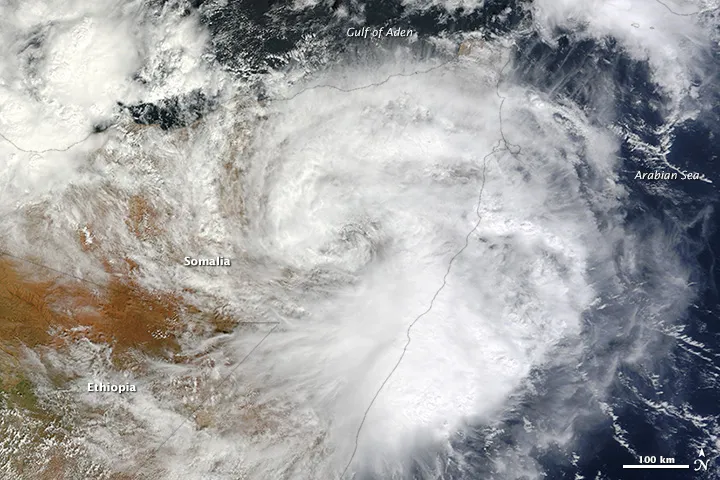
A slow-moving tropical storm pounded the Somalia coast this weekend, a rare hit for the war-torn country that killed more than 100 people and devastated coastal communities.
The unnamed tropical storm made landfall on Sunday (Nov. 10) north of Eyl in the Puntland state, a semiautonomous region that typically receives less than 10 inches (25 centimeters) of rain every year. The storm, designated Tropical Cyclone 03A, was forecast to dump a year's worth of rain on Puntland this week and hit the shore with winds of 46 mph (74 km/h).
Weak storms such as Cyclone 3A can wreak havoc along the arid African coast because they trigger flash floods, said Amato Evan, an atmospheric scientist at the Scripps Institution of Oceanography at UC San Diego.
"Even a very weak storm can cause huge damage and loss of life in this area," Evan told LiveScience. "In an area that doesn't receive a lot of rainfall in general, a storm that moves very, very slowly and dumps a lot of rain in one place for a long time can be particularly deadly."
The Puntland government said preliminary information indicates that homes, buildings, boats and entire villages have been destroyed and more than 100,000 livestock lost, endangering the livelihoods of tens of thousands of local people.
Evan said only one or two tropical cyclones strike Somalia every decade, but records only go back for about 30 years. However, the intensity of storms in the Arabian Sea appears to be increasing due to aerosol pollution. (Aerosols are very tiny particles or droplets that result from burning wood or dung, car exhaust and natural sources such as trees.)
Though the warm Arabian Sea is fertile ground for birthing tropical storms, budding weather systems rarely strengthen into powerful cyclones because of the region's prevailing wind shear conditions. During the monsoon season, strong winds blow eastward near the ocean surface and westward higher in the atmosphere, Evan explained. [Infographic: Storm Season! How, When & Where Hurricanes Form]
Get the world’s most fascinating discoveries delivered straight to your inbox.
"The wind shear makes the Arabian Sea a hostile environment for storms to form," Evan said. "That kind of change in wind direction can tear a storm apart."
But Evan and his colleagues discovered that rising aerosol pollution, which blocks incoming sunlight, has weakened the Arabian Sea's wind pattern. Without the destructive winds, cyclones are growing stronger, according to the researchers' study, published Nov. 2, 2011, in the journal Nature.
"We don't have the evidence to say the storms are becoming more frequent, but their intensity is getting stronger," Evan said.
Email Becky Oskin or follow her @beckyoskin. Follow us @livescience, Facebook & Google+. Original article on LiveScience.
