
 Live Science Plus


Antarctic Glacier Flow Controlled by Speed Bumps Below

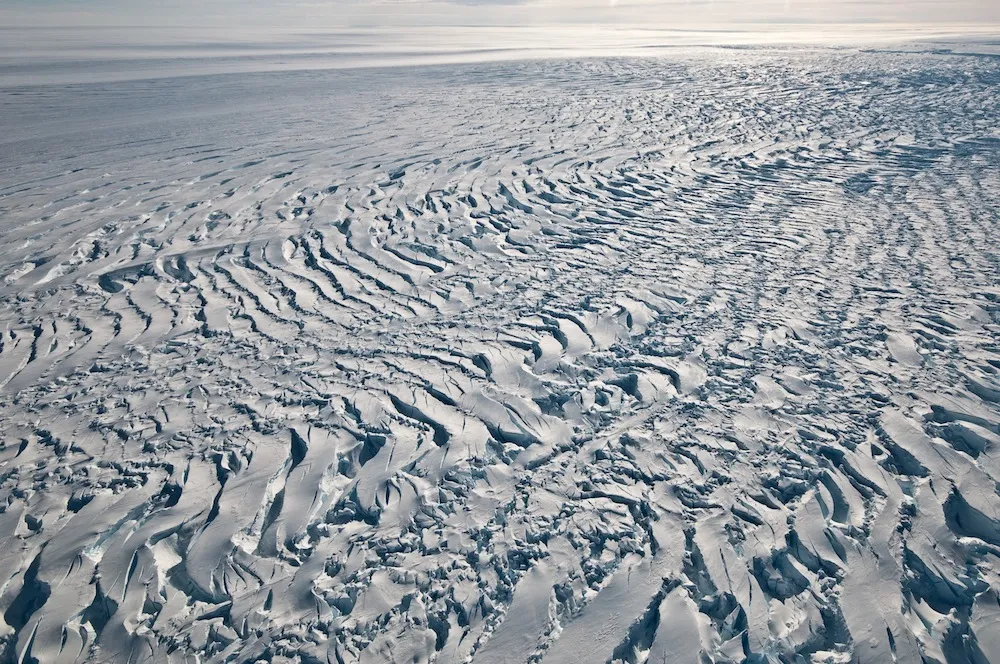
Beneath Antarctic glaciers sliding quickly toward the sea, researchers now find that stripes of extremely high friction exist that help control the rates at which giant chunks of ice flow into the ocean.
As climate is changing globally, scientists concerned about melting ice caps and subsequent rising sea levels have focused on ice streams near the margins of the Antarctic Ice Sseet, the largest mass of ice on Earth. These structures are not streams of liquid water, but parts of the ice sheet that flow quickly with respect to surrounding ice.

In a new study detailed in tomorrow's (Nov. 8) issue of the journal Science, researchers focused on two large ice streams that are major contributors to ice loss in Antarctica — the Pine Island Glacier and the Thwaites Glacier, the fastest flowing glaciers in the West Antarctic Ice Sheet. The Pine Island Glacier has thinned at a rate of 5 feet (1.5 meters) a year since the 1990s, and its flow rate has sped up 10 percent over the last decade. Scientists think Thwaites could also significantly shrink in the next 20 years, adding to global sea level rise. The whole West Antarctic Ice Sheet contributes some 0.15 to 0.30 millimeters per year to sea level rise. [Photo Gallery: Antarctica's Pine Island Glacier Cracks]
Instead of drilling into the glaciers to get a close look at how they interact with the bedrock, the team analyzed measurements of ice surface velocities and ice heights collected by aircraft and satellites during the past two decades, as well as the topography of the underlying rock. This helped them reconstruct the 3D interactions between the glaciers and bedrock.
The researchers discovered the friction or shear stress under each of these glaciers is distributed in patterns like ribs, with large slippery areas interrupted by stripes of extremely high friction.
"Hardly anyone would want to experience such shear stress on their skin — it'd be equivalent to shear stress exerted on your skin by a half-of-an-inch water layer maintaining constant temperature of 72 degrees Fahrenheit [22 degrees Celsius] and flowing at about 1,000 miles [1,600 kilometers] per second,"study lead author Olga Sergienko, a glaciologist at Princeton University, told LiveScience. "The amount of heat associated with shear in such layer would burn everything."
On average, these stripes can reach about 1 to 2miles (2.2 to 3 km) wide and 4 to 7 miles (6 to 11 km) long. The longest stretched for 30 miles (50 kilometers).
Boreholes drilled to the bedrock helped reveal that slippery areas existed where there were substantial amounts of water under the glacier. The researchers suggest that when a small bump of sediment exists on the surface a glacier is sliding on, it can dam the flow of liquid water at the base of glaciers, decreasing the lubrication this water normally provides. This can lead ribs of friction to build up.
These findings show it is important to understand what is happening at glaciers' beds in order to understand how ice sheets might respond to changing climatic conditions.
"Friction at the glacier-bed interface controls how fast the glacier flows, and impacts the rate of ice discharge to the oceans," Sergienko said. "If the friction of a band reduces — for instance, the rib is flooded by subglacial water — the glacier starts to flow faster, more ice is discharged to the ocean, and sea level would rise at a faster rate. Conversely, if a new high-friction rib is formed, the glacier slows down, less ice is discharged, and sea level change decelerates."
Follow us @livescience, Facebook & Google+. Original article on LiveScience.
