













Robot Cashier Learns to Handle Knives ... Safely

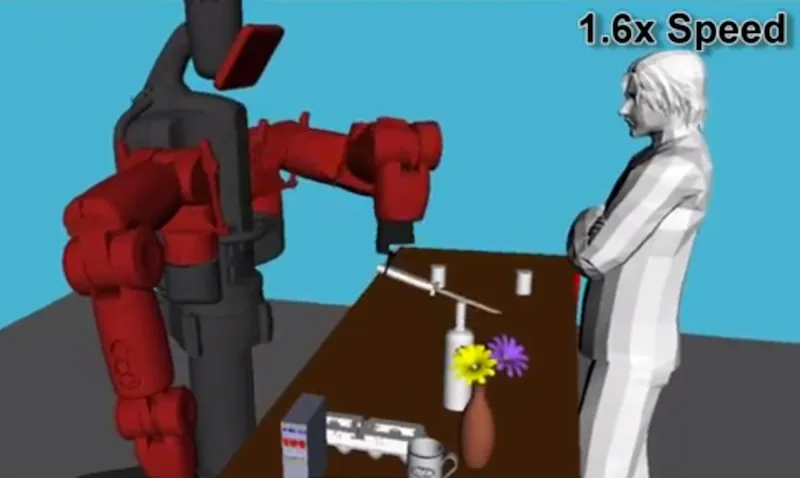
Before humans can trust robots to work as grocery store cashiers, these machines will have to prove they can do certain things — like not squishing our perfect heirloom tomatoes or stabbing us with new kitchen knives at the checkout line.
A group of researchers at Cornell University is teaching a robot dubbed Baxter how to handle, properly and safely, a variety of objects, from sharp knives to egg cartons, based on human feedback in a grocery-store scenario.
"We give the robot a lot of flexibility in learning," Ashutosh Saxena, an assistant professor of computer science at Cornell, said in a statement. "The robot can learn from corrective human feedback in order to plan its actions that are suitable to the environment and the objects present."
For their experiments, Saxena and colleagues had a Baxter robot set up as a cashier in a mock checkout line. Baxter is a cheap, flexible robot built by a Boston-based startup called Rethink Robotics. It was primarily designed to work in assembly lines alongside people, but Baxter's learning skills also make it an easy-to-teach cashier.
As this video of the knife-wielding robot shows, the researchers are teaching Baxter how to handle different items by manually correcting Baxter's arm motions.
If the robot swings a sharp kitchen knife, for example, too close to the human playing customer at the checkout, a researcher could grab Baxter's arm and guide it in the right direction.
Over time the robot learns to associate different trajectories with different objects, such as a quick flip for a cereal box or a delicate lift for a carton of eggs, the researchers say.
Get the world’s most fascinating discoveries delivered straight to your inbox.
Saxena and colleagues will present their work at the Neural Information Processing Systems conference in Lake Tahoe, Calif., next month, but an early version of their research paper is available online.
Follow Megan Gannon on Twitter and Google+. Follow us @livescience, Facebook & Google+. Original article on LiveScience.
