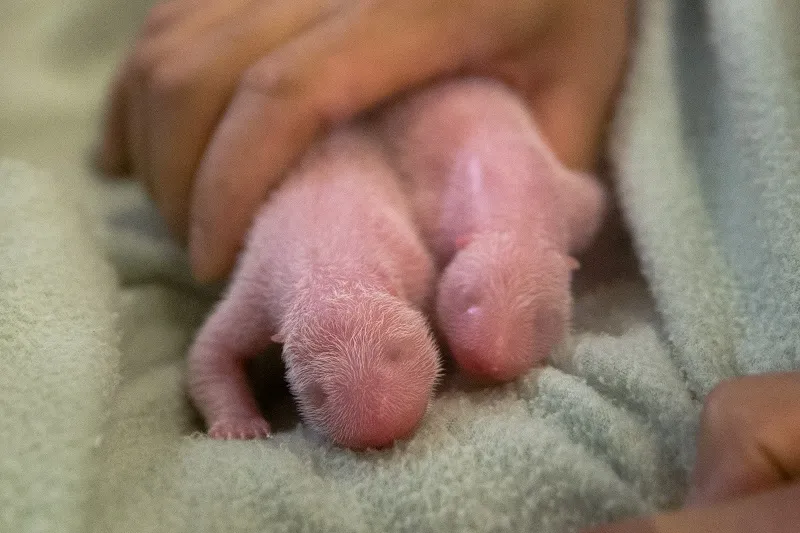
These giant panda twins were born at Zoo Atlanta on July 15. They may be tiny and hairless now, but soon enough they'll grow into black-and-white pudgy furballs.
The world may be awaiting the birth of a little royal, but in the animal kingdom, it's baby panda season. Last night (July 15), a giant panda at Zoo Atlanta gave birth to two cubs, the first panda twins to be born in the United State since 1987.
The newborns are also the first pandas to be born in the country this year. They are fourth and fifth babies for 15-year-old mom Lun Lun, according to the zoo. The female last gave birth in 2010, to a male cub named Po.
"We're thrilled to welcome Lun Lun's and Yang Yang's twins," Raymond B. King, the zoo's president and CEO, said in a statement. "This is a success we share with all of our fellow zoological organizations working to understand and protect this iconic species, and we share our joy with our local community and with our colleagues in China." [Baby Panda Pics: See A Cub Growing Up]
The twins are the fourth and fifth babies for panda mom Lun Lun, pictured here.
(Image credit: Zoo Atlanta)
Often compared to sticks of butter in size, the pink-colored newborns may look impossibly tiny compared with their parents. Marsupials aside, giant panda babies are the smallest newborns relative to their mothers among mammals. Since the panda cubs are so little, there is a high risk of mortality in the first few months, as panda fans were sadly reminded last year when the National Zoo's week-old newborn died. This risk is heightened for twins, which tend to be even smaller than single cubs, Zoo Atlanta officials said.
When panda twins are born in the wild, the mother typically cares for just one and the other baby often dies. Zookeepers can avert this choice by rotating the cubs with the mother for the first few months. One of Lun Lun's cubs is now being cared for in a nursery, zoo officials said.
"Twins are an entirely new scenario for Lun Lun, Zoo Atlanta and our animal care teams, who will no doubt be extremely busy over the next few months," King said.
Giant pandas are notoriously difficult to breed in captivity and have a very narrow mating window. Females are fertile for just one or two days per year, typically in the spring. Even if they get it on with a mate or undergo an artificial insemination during this period, zookeepers have to wait until to July or August to find out if their efforts paid off. When female pandas fail to get pregnant after ovulating, they almost always undergo a false pregnancy that mimics the real thing with lots of sleeping, nest-making and a spike in hormone levels.
Sign up for the Live Science daily newsletter now
Get the world’s most fascinating discoveries delivered straight to your inbox.
There are thought to be only 1,600 giant pandas left in the wild and their natural habitat is restricted to mountainous forests of China. Captive breeding is one way to study and conserve the endangered species.
All pandas in the United States technically belong to China, which loans the fuzzy creatures to foreign zoos. In keeping with a Chinese baby-naming tradition, the bear cubs are not named until they are 100 days old.
Megan has been writing for Live Science and Space.com since 2012. Her interests range from archaeology to space exploration, and she has a bachelor's degree in English and art history from New York University. Megan spent two years as a reporter on the national desk at NewsCore. She has watched dinosaur auctions, witnessed rocket launches, licked ancient pottery sherds in Cyprus and flown in zero gravity. Follow her on Twitter and Google+.