Earthquake Ruptures Faster Than Thought

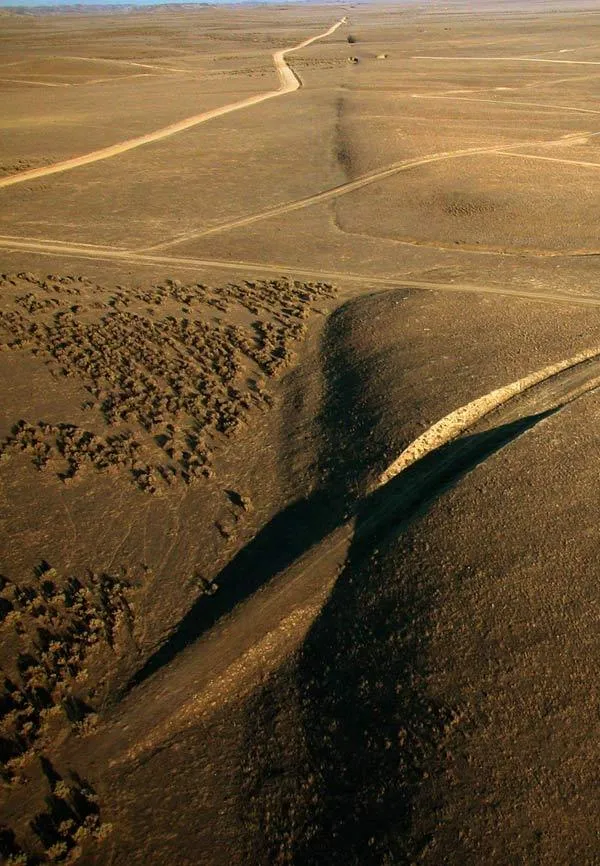
Ruptures from earthquakes could zip faster along Earth's surface than previously thought, new research detailed in the June 7 issue of the journal Science suggests.
When faults in the Earth rupture to generate earthquakes, so-called shear waves are generated deep below Earth's crust. Generally, these ruptures move along the surfaces of faults more slowly than shear waves do. (Shear waves travel at about 7,800 mph (12,600 km/h)).
However, in recent decades, seismologists have identified a handful of large quakes where the ruptures move faster than the shear waves, traveling at speeds of up to nearly 13,000 mph (20,900 km/h). The result is a sonic boom-like effect in the rock similar to that seen from supersonic jets zipping across the sky. [10 Biggest Earthquakes in History]
Scientists had investigated these supershear ruptures, as they are called, using brittle plastics. However, until now, the lack of experiments on rock samples limited the ability of investigators to understand these events in nature.
Now scientists have generated micro-earthquakes with supershear ruptures in the lab using granite, which is common in Earth's crust. A group of researchers in France and Italy pushed chunks of the rock against each other until one slipped against the other and released waves of energy, just like what happens on a larger scale with real quakes. By analyzing 200 such ruptures with acoustic sensors, they found they could recreate and measure ruptures that moved faster than shear waves.
These experiments revealed that ruptures need at most only a few centimeters of slip to reach supershear velocities. This hinted that supershears might happen more regularly than previously thought.
"We demonstrate that supershear ruptures in crustal rocks are a normal phenomenon at the scale of the laboratory," researcher François Passelègue, a geophysicist at the French National Center for Scientific Research in Paris, told LiveScience's OurAmazingPlanet.
Get the world’s most fascinating discoveries delivered straight to your inbox.
Still, only a few supershear ruptures have been seen in the real world to date. This might be due to how actual faults in the Earth's crust typically involve jagged, rough slabs of rock grinding against each other, rather than the smooth pieces of rock used in the lab, so these experiments might not reflect general earthquake conditions. The few documented cases of supershear ruptures in nature did involve relatively smooth faults. Extra factors, such as the presence of pulverized rock, might also dissipate the energy of a rupture in real life, slowing it down and preventing supershear.
The researchers suggest that supershears might still happen frequently in nature at asperities — parts of faults that do not move, where strain often builds and earthquake ruptures typically begin. As such, learning more about supershears could help shed light on how much energy is involved in earthquakes overall.
Follow OurAmazingPlanet @OAPlanet, Facebook and Google+. Original article at LiveScience's OurAmazingPlanet.