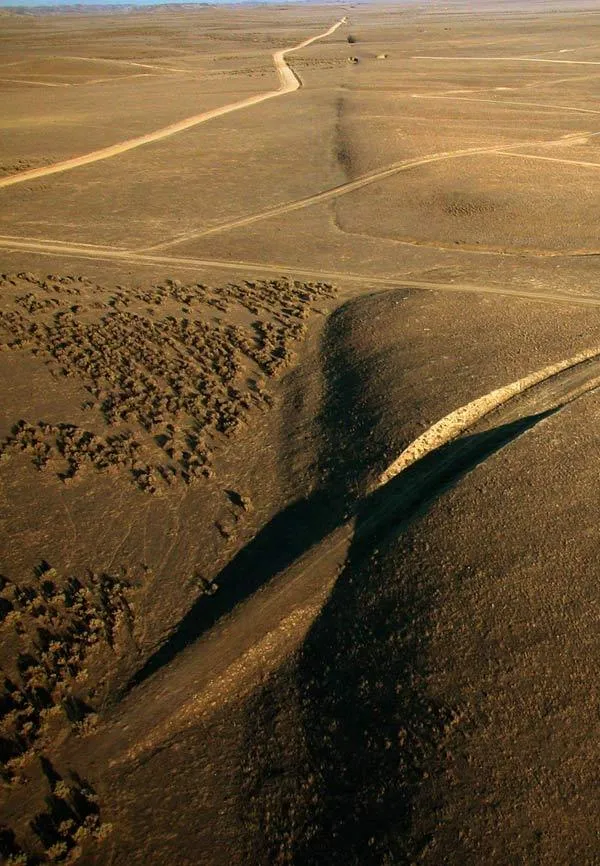
Average earthquakes may turn into mega-quakes when rock in a fault weakens much the same way ice does under ice skates, researchers say.
The finding by two researchers at the Scripps Institution of Oceanography at the University of California, San Diego, is based on past research on the friction between rocks in an earthquake fault. Their study confirmed that rock can develop weak points under pressure and suggests that the consequent drop in friction could help release energy.
Previous research suggested that during earthquakes, friction between rocks in specific areas of fault zones rapidly lessens, much the way ice skate blades reduce friction by melting icy surfaces as they glide over them. Such a phenomenon could help solve a longstanding mystery: why major fault zones such as the San Andreas Fault generate so little heat from the grinding of rocks compared with the magnitude of the earthquakes they produce.
Latest Videos From
"The process allows highly stressed areas to rapidly break down, acting like the weakest links in the chain," said researcher Kevin Brown. "Even initially stable regions of a fault can experience runaway slip by this process if they are pushed at velocities above a key tipping point."
This drop in friction also could help faults release energy. "This may be relevant for how you get from large earthquakes to giant earthquakes," Brown said.
For instance, when it came to the magnitude 9.0 earthquake that devastated Japan in 2011, "we thought that large patches of the fault were just creeping along at a constant rate. Then, all of a sudden, they were activated and slipped to produce a mega-earthquake that produced a giant tsunami."
To learn more about these locations of weakness, the researchers conducted lab experiments mimicking earthquake processes, in which they ground rock samples in a lathe and monitored the amount of friction and heating it produced. They discovered that at specific temperatures, "melt welts" — points of weakness in the rock — could indeed form, causing extreme drops in friction.
"The onset of weakening was found to be associated with formation of small but visible streaks of molten rock," said researcher Yuri Fialko, a geophysicist at Scripps. "It was surprising because previous studies have suggested just the opposite — namely, that the melt streaks begin to form when the sliding surface becomes stronger, rather than weaker.
"Understanding the mechanism of extreme weakening during high-speed sliding will advance our understanding of physics of earthquake ruptures and help design more realistic rupture models," Fialko told OurAmazingPlanet. Those models "can in turn be used for predictions of peak ground motion, shaking intensity, damage to buildings and infrastructure, and potential losses due to destructive earthquakes."
Future research can explore whether melt welt weakening applies to most materials common in fault zones, and lead to fieldwork to locate melt welts along fault zones.
Brown and Fialko detailed their findings in the Aug. 30 issue of the journal Nature.
This story was provided by OurAmazingPlanet, a sister site to LiveScience.

 Live Science Plus