













'Everything has changed since Apollo': Why landing on the moon is still incredibly difficult in 2024
More than 50 years after the Apollo era, major governments and well-funded private companies still struggle with lunar landing missions. Why is landing on the moon so hard in 2024?


On Thursday (Feb. 22), a phone booth-sized spacecraft named Odysseus made history. Landing at the moon’s south pole at 6:23 p.m. ET, Odysseus — built by the Houston-based company Intuitive Machines — became the first U.S. lander to touch down on the moon in more than 50 years, and the first private lander to ever reach the lunar surface.
But this successful landing was far from flawless. Several days after touchdown, it became clear that Odysseus broke one of its six legs upon landing, and had ended up toppled on its side. With limited power reaching the lander's solar cells, engineers powered it down, potentially for good, on Feb. 29.
Odysseus' challenges add to a trend of troubled lunar landings, with five of the previous nine attempted moon landings ending poorly for various nations and private companies.
Weeks earlier, on Jan. 19, Japan's Smart Lander for Investigating the Moon (SLIM) spacecraft successfully completed the country's first moon landing — albeit ending up upside down on the lunar surface due to an engine malfunction during descent. The lopsided lander's solar cells faced the wrong direction and failed to power its instruments and communications, forcing engineers to shut it down in fear of battery discharge. Just 10 days prior to SLIM's landing, a private U.S. moon lander named Peregrine encountered many anomalies after launch, including a propellant leak that prevented the spacecraft from landing on the moon. It was ultimately rerouted to crash into Earth's atmosphere. Other lunar landing attempts made by Japan and Russia in 2023 similarly ended in catastrophic crashes, this time on the moon itself.
Government-funded space agencies of only five countries have successfully touched down on the moon: the United States, the former Soviet Union, China, India and Japan. Just one private company (Intuitive Machines) has succeeded so far, and several high-profile missions have failed due to technical glitches that led to fatal judgments of speed, altitude and orientation — a stark reminder that even after half a century since the Apollo astronauts walked on the moon, our closest celestial neighbor remains a challenging and dangerous destination.
So, what gives? Has humanity gotten worse at lunar landings? Or are we simply grappling with a new era of technological advancements, just like the teams behind the Apollo missions did?
"We did not get 'dumber' since the Apollo landings," Csaba Palotai, a professor of physics and space sciences at the Florida Institute of Technology in Melbourne, told Live Science. Technology is significantly better today; your cellphone has more computational power than computers had in the 1970s. "But since the '70s there have been no astronauts and pilots on the landers to correct what the computers can't or won't," Palotai added.
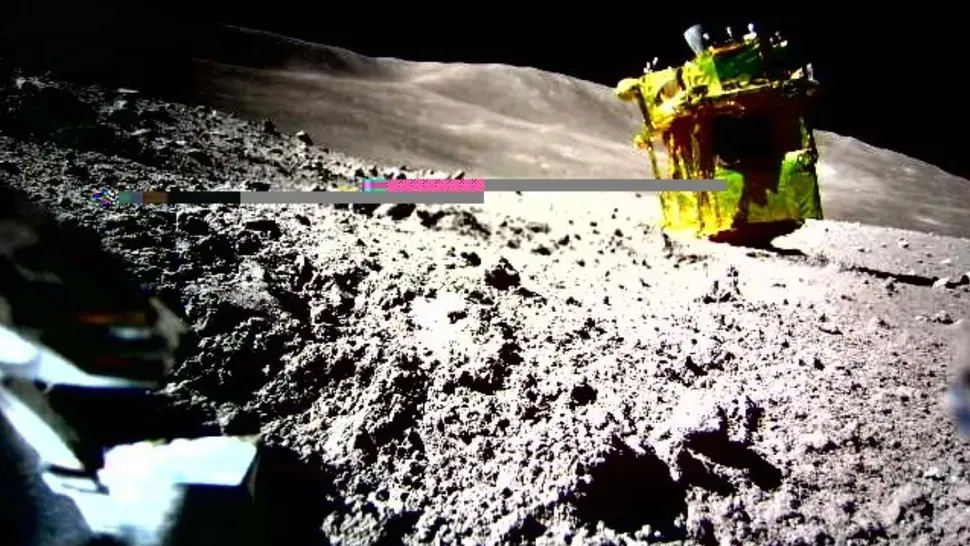
Japan’s SLIM lander made the most precise landing in lunar history — however, it landed upside down, cutting its battery life down to mere hours.
Acing the technology (again)
Landing on the moon is hard, with or without human pilots.
Get the world’s most fascinating discoveries delivered straight to your inbox.
A major hurdle is the moon's virtual lack of atmosphere. The lunar atmosphere is very thin and varies with time, preventing engineers from including parachutes to slow down spacecraft, Palotai said. Instead, missions use fuel-powered propulsion systems to descend onto the moon's surface, making it challenging to slow the spacecraft from a few kilometers per second to a perfect halt.
Yet this and other lunar exploration challenges are not new.
While the Apollo program was ultimately successful in landing humans on the moon, it was the culmination of a large program that failed many times on its way to success. Early attempts by the U.S. and the Soviet Union to fly a spacecraft to the moon were riddled with failures, including post-launch explosions, malfunctions with guidance systems, and fatal errors with solar panel deployment. Even the historic Apollo 11 mission, which landed astronauts Neil Armstrong and Buzz Aldrin on the moon, was worryingly low on fuel and faced multiple unexpected alarms just before landing on the moon.
"People tend to forget about those mission failures as being part of the learning process," said Jack Burns, director of the NASA-funded Network for Exploration and Space Science at the University of Colorado Boulder. This experiential learning perch is where moon missions, especially a growing number of privately funded ones, currently are. "It's still hard to land on the moon, but far from impossible," he said.
Burns and other experts agree that just about everything has changed since the Apollo program, including the now-antiquated technology that took humans to the moon and back in the '60s and '70s. Engineers with the Apollo program had built the first computers of their time, including sensors that have since been made more powerful in a fraction of their original sizes. Much of the software and architecture customized for the Apollo program is effectively useless for space missions today.
Moreover, "that whole generation is out of the industry at this point, and a lot of that knowledge has been lost," said John Thornton, CEO of Pittsburgh-based Astrobotic Technology, which built and operated Peregrine. "We are relearning how to do this, but we're also learning it with technology that is new and different."
Half a century after humans last walked on the moon, organizations smaller than NASA — powered by a new generation of engineers — have taken on the same challenge that only governments accomplished in the past. Palotai, Thornton and Burns view the recent moon mission failures as the natural progression of a new industry.
"Personally, I'm not worried," Burns said. "It's just part of the growing pains."
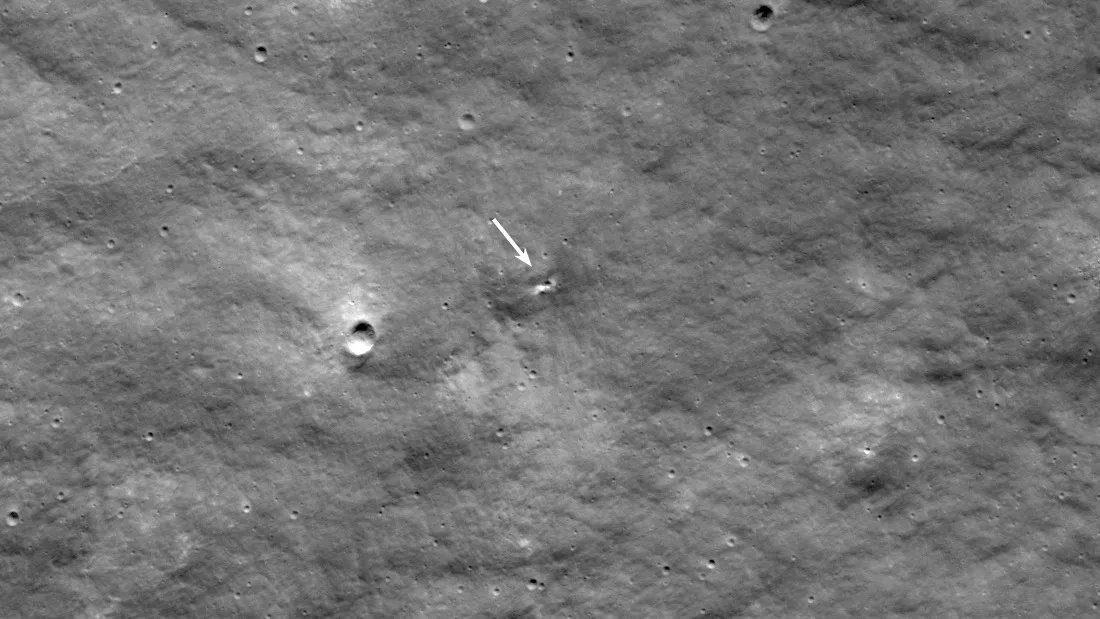
When Russia's Luna 25 probe crashed into the moon on Aug. 19, 2023, it left a 33-foot-wide (10 meters) impact crater seen here by NASA’s Lunar Reconnaissance Orbiter.
Paving the way for affordable moon missions
While technological issues influence the outcome of a mission, funding determines the extent of the software and hardware testing done in advance of launch to reduce risk.
"If we had a billion dollars to do this mission, our chances of success would go way up," Thornton said of the doomed Peregrine, whose mission failure investigation is expected to take a month or two. "But we're trying to do this at a much lower cost, which means you have to try many more times before you get to that breakthrough moment of, 'OK, now we know exactly how to do it at this price point. Let's keep doing it again and again.'"
Back in the '60s and '70s, in the heat of the space race between the U.S. and the Soviet Union, the Apollo program was the crux of NASA's work, and the space agency had 10 times its current budget to do the same thing. Between 1960 and 1973, NASA spent $25.8 billion ($257 billion when adjusted for inflation) on the Apollo program and was backed by nearly 5% of the total U.S. federal budget.
Comparatively, NASA now receives less than 0.5% of the nation's overall federal spending, and that budget also funds missions to destinations beyond the moon.
"That changes everything," Thornton said. Back then, NASA was fine with developing something that cost tens of billions of dollars. In comparison, today the industry is trying to build spacecraft for about $100 million, an affordable price that's key to routine flights. This problem is fundamentally different from those of the Apollo era. "It's going to take time to learn how to do it at that price point," Thornton said.
Lowering mission costs also increases the risk of failure, at least to start, Martin Barstow, a professor of astrophysics and space science at the University of Leicester in the U.K., told Live Science. So "we shouldn't be too surprised if some of these things don't work," Barstow added.

A fish-eye camera image of Earth taken by the Odysseus lander as it headed toward the moon in Feb. 2024.
The first commercial victory
The Odysseus spacecraft’s successful landing on Feb. 22 marked a welcome breakthrough for the commercial spaceflight industry.
RELATED STORIES
The lander (nicknamed "Odie") delivered 12 payloads to the moon, including six NASA science instruments. For these, the space agency paid Intuitive Machines $118 million through its Commercial Lunar Payload Services program (CLPS), designed to award private companies contracts to send experiments to the moon rather than NASA doing it itself. (NASA moon missions can cost up to $1 billion each.)
As part of the same CLPS program, Astrobotic plans to launch its second robotic moon lander, Griffin, and a water-hunting rover this November.
Editor's note: This article was updated on March 1 to add new information about the Odysseus lander's mission.

Sharmila Kuthunur is an independent space journalist based in Bengaluru, India. Her work has also appeared in Scientific American, Science, Astronomy and Space.com, among other publications. She holds a master's degree in journalism from Northeastern University in Boston. Follow her on BlueSky @skuthunur.bsky.social