Get the world’s most fascinating discoveries delivered straight to your inbox.
You are now subscribed
Your newsletter sign-up was successful
Want to add more newsletters?
Join the club
Get full access to premium articles, exclusive features and a growing list of member rewards.
An account already exists for this email address, please log in.
Scientists reveal 'most promising yet' signs of alien life on planet K2-18b
Scientists have discovered evidence of large quantities of biosignature chemicals — only known to be made by life on Earth — on an exoplanet more than 100 light-years away. It could be the most promising sign yet of alien life.
Astronomers have detected the most promising signs yet of a possible biosignature on the exoplanet K2-18b, which orbits its star in the so-called habitable zone.
(Image credit: A. Smith, N. Madhusudhan (University of Cambridge))
Chemical fingerprints of life have been found on a distant exoplanet by NASA's James Webb Space Telescope (JWST). It is the "most promising" evidence yet for alien life, scientists say.
These chemicals were detected in the atmosphere of an exoplanet named K2-18b, which is located 124 light-years away from Earth and orbits its star in the habitable zone — the region around a star where liquid water can exist on a planet's surface — according to a new study published in The Astrophysical Journal Letters on April 17.
On Earth, these molecules — dimethyl sulfide (DMS) and dimethyl disulfide (DMDS) — are only produced by life, such as marine algae and other microbes. Before now, DMS and DMDS hadn't been definitively detected in the atmospheres of any other planets or moons. While it is theoretically possible for these chemicals to be created without the presence of life, they are considered potential biosignatures on other worlds.
"Our findings provide new independent evidence for the possibility of a biosphere on K2-18 b" and "present an important step forward in the search for signatures of life on exoplanets," the researchers wrote in the paper.
K2-18b, which is 2.6 times the size of our planet and 8.6 times the mass, is suspected to be a "hycean world," meaning that it potentially has a planet-wide ocean and an atmosphere rich in hydrogen.
In a previous paper published in 2023, the same team of researchers detected methane (CH₄) and carbon dioxide (CO₂) in the planet's atmosphere, marking the first time that carbon-based molecules had been found in the atmosphere of an exoplanet in its star's habitable zone. The scientists also discovered potential signs of DMS. However, the levels of DMS had "low statistical significance," so the researchers couldn't be certain that it was indeed present.
Sign up for the Live Science daily newsletter now
Get the world’s most fascinating discoveries delivered straight to your inbox.
The graph shows the observed transmission spectrum of the habitable zone exoplanet K2-18 b using the JWST MIRI spectrograph.
(Image credit: A. Smith, N. Madhusudhan (University of Cambridge))
"We didn't know for sure whether the signal we saw last time was due to DMS, but just the hint of it was exciting enough for us to have another look with JWST using a different instrument," Nikku Madhusudhan, a professor of astrophysics at the University of Cambridge and lead author of both studies, said in a statement.
In the latest study, the researchers found that new measurements of the planet's atmosphere taken by JWST's Mid-InfraRed Instrument (MIRI) show specific features that can only be explained by the presence of either DMS or DMDS. Due to the similarities of these two molecules, they appear very alike in the measurements that JWST takes from the atmospheres of exoplanets, meaning it is hard to tell which molecule is present in greater quantities.
"This is an independent line of evidence, using a different instrument than we did before and a different wavelength range of light, where there is no overlap with the previous observations," Madhusudhan said. "The signal came through strong and clear."
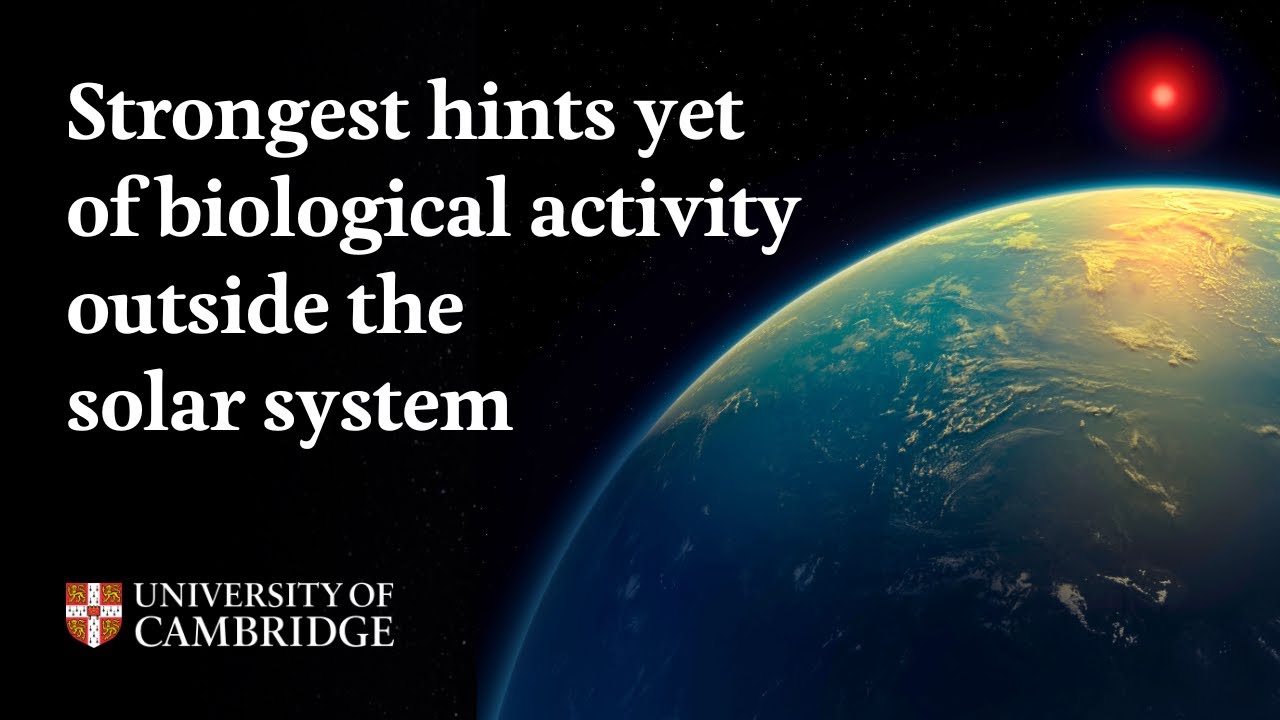
Strongest hints yet of biological activity outside the solar system - YouTube
The researchers noted that levels of DMS and/or DMDS in the atmosphere may be as high as 10 parts per million by volume, which is much higher than the levels seen here on Earth, which are below one part per billion by volume.
The researchers said that these observations have reached a "three-sigma" level of significance. This means there is just a 0.3% probability that they occurred by chance. To confirm a discovery, scientists typically require a five-sigma significance level, where there is below a 0.00006% probability of occurring by chance.
DMS and DMDS are not known to be produced in large quantities through non-biological processes on Earth, meaning that their detection in such large quantities on K2-18b is a major indicator for the potential presence of life.
"Given everything we know about this planet, a Hycean world with an ocean that is teeming with life is the scenario that best fits the data we have," Madhusudhan said.
The researchers said that more measurements need to be taken to achieve five-sigma significance and also differentiate between the presence of DMS and DMDS. They hope to take these measurements soon, whenever they can get the JWST to look at this exoplanet for a few more hours. They also noted that the presence of DMS and/or DMDS could have arisen from as-yet-unknown chemical reactions not involving any life at all, which they hope to test experimentally.
"It's important that we're deeply sceptical of our own results, because it's only by testing and testing again that we will be able to reach the point where we're confident in them," Madhusudhan said. "That's how science has to work."
Jess Thomson is a freelance journalist. She previously worked as a science reporter for Newsweek, and has also written for publications including VICE, The Guardian, The Cut, and Inverse. Jess holds a Biological Sciences degree from the University of Oxford, where she specialised in animal behavior and ecology.
You must confirm your public display name before commenting
Please logout and then login again, you will then be prompted to enter your display name.