

-
 Still frame from video footage recorded in the Kvænangen fjords, Norway, in 2024, showing the tongue-nibbling interaction between two free-ranging killer whales.
Footage captures a pair of orcas nibbling each other's tongues in the Kvænangen fjords in northern Norway. Scientists think this rarely seen behavior could play a role in social bonding.
orcas -
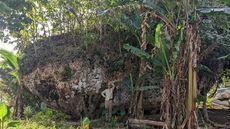 There's a humongous boulder on a cliff in Tonga. Now we know how it got there.
A massive boulder named Maka Lahi was recently found about 650 feet from the edge of a cliff in Tonga, and researchers believe that it may have been deposited by a tsunami around 7,000 years ago.
6 Commentsgeology -
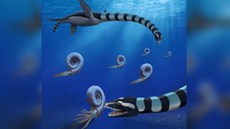 Giant 85 million-year-old mystery sea monster fossil finally identified
A brand new species of elasmosaur named Traskasaura sandrae has been identified from three specimens found on Vancouver Island.
3 Commentsextinct-species -
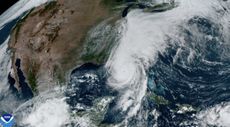 'Above normal' conditions could bring as many as 10 hurricanes to the US this summer
Hurricane Helene captured by NOAA's GOES-16 satellite as it approached Florida on September 26, 2024.
weather -
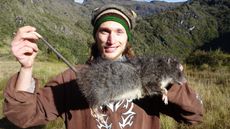 33-inch-long 'woolly' mountain rat caught on camera for first time ever
The world's second-biggest rat species — a gargantuan woolly beast — was caught on camera in the mountains of New Guinea.
5 Commentsland-mammals -
 Joe Biden diagnosed with 'aggressive' prostate cancer: What to know
Former U.S. President Joe Biden's office announced that he has been diagnosed with "aggressive" prostate cancer, which has spread to his bones. Here's what to know about the disease.
cancer -
 The sun just spat out the strongest solar flares of 2025 — and more could be headed toward Earth
The sun has released several powerful M- and X-class solar flares over the past few days, resulting in radio blackouts around the world.
3 Commentsthe-sun -
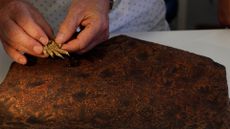 Reptiles evolved earlier than we thought, newly discovered claw-mark fossils suggest
New fossilized tracks made by an ancient reptile indicate that these animals evolved tens of millions of years sooner than scientists first thought.
reptiles -
 Your fingers 'prune' the exact same way each time, study suggests
The wrinkled, raisin-like patterns you get on your fingers after a long bath form the same patterns every time, new research suggests.
health -
 Scientists find hint of hidden liquid water ocean deep below Mars' surface
By studying seismic waves, researchers have found a layer deep beneath the surface of Mars that could contain enough liquid water to flood the planet with an ocean thousands of feet deep.
13 Commentsmars -
 Only 0.001% of deep ocean has ever been explored by humans — an area equal to the size of Rhode Island
Despite the deep ocean floor coating some 66% of our planet's surface, we haven't explored 99.999% of it, study finds.
planet-earth -
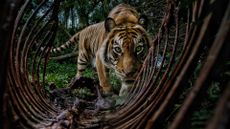 Images capturing a starving tiger, fighting bison and pit of vipers honored in environmental photography awards
Winners and runners-up of the Prince Albert II of Monaco Foundation's 2025 Environmental Photography Award revealed.
animals -
 Plants: Facts about our oxygen providers
Discover interesting facts about why plants are green, if they feel pain, and if they get cancer.
plants -
 2,000-year-old bed barricade unearthed in Pompeii house — likely a family's last attempt to escape Vesuvius' eruption
In a house in the ruins of Pompeii, archeologists have discovered evidence that a family of four attempted to barricade a door with a bed during Vesuvius's terrible eruption.
romans -
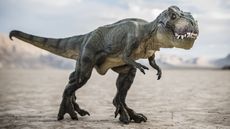 T. rex may have evolved in North America after all, scientists say
T. rex was previously suspected to have evolved in Asia and migrated to North America, but new research shows that the direct ancestors of this iconic dinosaur may have been the one to make the journey instead.
3 Commentsdinosaurs -
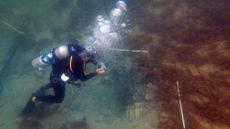 'Pirate' shipwrecks that sank in 1710 off Costa Rica are actually remains of Danish slave ships
Two shipwrecks off Costa Rica were long thought to be the remains of pirate ships, but new analyses reveal that they were actually Danish ships that took part in the transatlantic slave trade.
2 Commentsarchaeology -
 Humans heal much more slowly than chimps do. Researchers are still trying to figure out why.
Researchers have found that wounds heal three times more slowly in humans than in other primates and rodents, suggesting we may have evolved slower healing at some point in our ancestry.
primates -
 What is 'induced atmospheric vibration' and did it really cause power outages across Spain and Portugal?
Power blackouts that left millions of people across Spain and Portugal without electricity may have been caused by a bizarre atmospheric phenomenon, though the true cause is yet to be determined.
energy -
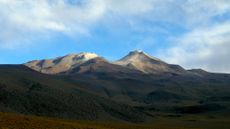 Mystery of Bolivian 'zombie' volcano finally solved
Uturuncu, a dormant volcano in Bolivia, appeared to be getting ready to erupt following earthquakes and "sombrero" shaped deformation — scientists have now worked out what's going on beneath the surface.
volcanoes -
 What are ovarian cysts?
Ovarian cysts are fluid-filled sacs that form on or inside the ovaries for a variety of reasons. Often, they disappear on their own, but sometimes, they can grow very large, burst or cause an ovary to twist.
reproductive-health -
 Deadly measles outbreaks could explode across the US if vaccinations fall, model predicts
Researchers modeled how measles might spread in the U.S. in the coming decades, showing that more than 50 million cases could occur if current vaccination rates fell by half.
viruses-infections-disease -
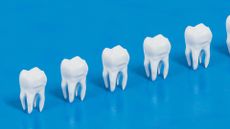 Lab-grown teeth could offer alternative to fillings and implants, scientists say
Scientists in the U.K. have developed a new material that may allow them to grow teeth in the lab, which could provide an alternative to fillings and dental implants someday.
11 Commentshealth -
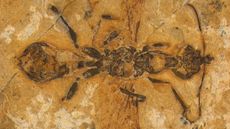 'Hell ant' with scythe-like jaws may be oldest ant fossil ever discovered
Researchers have discovered a never-before-seen species of "hell ant" that lived 113 million years ago, making it the oldest ant fossil ever found.
extinct-species -
 Curiosity rover finds largest carbon chains on Mars from 3.7 billion-year-old rock
NASA's Curiosity Rover has discovered long carbon chains on Mars. On Earth, molecules like these are overwhelmingly produced by biological processes.
mars


