













James Webb telescope discovers most distant supernova ever seen
The James Webb Space Telescope has spotted a supernova dating to just 1.8 billion years after the Big Bang, as well as 80 others in the early universe. The ancient explosions could help scientists figure out the mysteries of how the cosmos evolved.

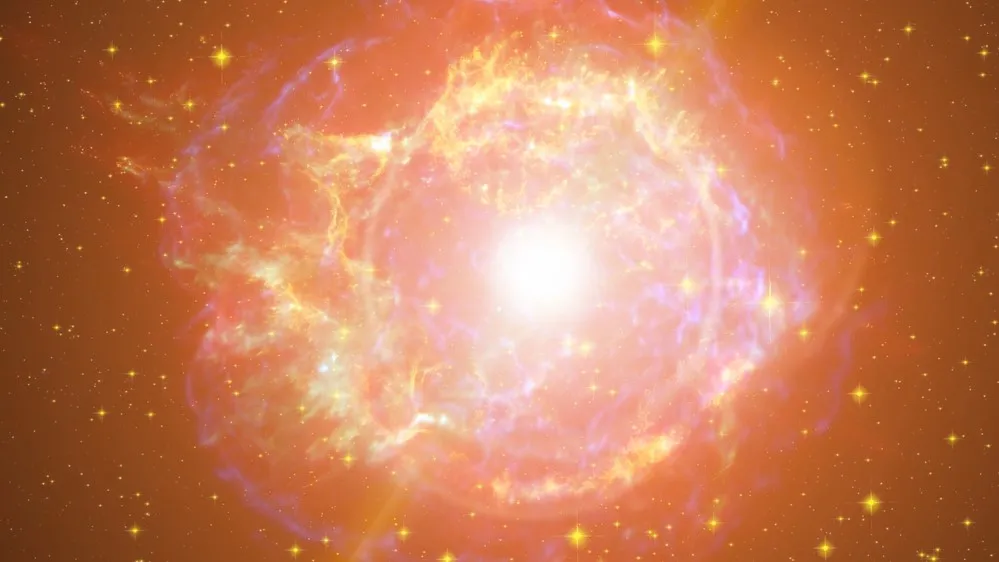
The James Webb Space Telescope has discovered the oldest and most distant supernova ever seen — a stellar explosion that took place when the universe was just 1.8 billion years old.
The ancient starburst was uncovered among 80 others in a patch of sky that, from our perspective on Earth, is about the width of a grain of rice held at arm's length.
Supernovae are transient objects, as their brightness changes over time. This makes the new batch of distant star explosions especially exciting, as studying them could provide key insights into unresolved questions of how the early universe grew. The researchers presented their findings June 10 at the 244th meeting of the American Astronomical Society in Madison, Wisconsin.
"We're essentially opening a new window on the transient universe," Matthew Siebert, an astronomer who is leading the spectroscopic analysis of the supernovas, said in a statement. "Historically, whenever we've done that, we've found extremely exciting things — things that we didn't expect."
There are two main categories of supernova: core collapse and thermonuclear runaway supernovae.
Explosions in the first category occur when stars with masses at least eight times bigger than our sun run out of fuel and collapse in on themselves, before expanding outward again in a gigantic explosion.
Related: Mysterious 'Green Monster' lurking in James Webb photo of supernova remnant is finally explained
Get the world’s most fascinating discoveries delivered straight to your inbox.
The second, known as type Ia supernovae, occur when two stars — one of which is the collapsed husk of a star called a white dwarf — spiral toward each other. This causes the white dwarf to strip hydrogen from the star it is spiraling around, creating a runaway reaction that ends in a gigantic thermonuclear explosion.
Type Ia supernovae are of particular interest to astrophysicists because their explosions are thought to always be the same brightness, making them "standard candles" from which astronomers can measure far-off distances and work out the expansion rate of the universe, known as the Hubble constant.
RELATED STORIES
But attempts to measure the Hubble constant using these standard candles and other methods have produced an alarming discrepancy — the universe appears to be expanding at different rates depending on where we look. This problem, known as the Hubble tension, has cast major doubt over the standard model of cosmology and has made finding standard candles across the universe's lifetime a major task for astronomers.
The researchers found the ancient supernovae using data from the JWST Advanced Deep Extragalactic Survey (JADES). The survey was made by taking multiple images of the same patch of the sky at year-long intervals. By looking at the new points of light that appeared or faded across successive images, the researchers identified the supernovae, some of which were type Ia blasts.
Now that they've identified the extremely distant star explosions, the researchers will study them more closely to determine their metal content and their exact distances. They say that doing so should help the scientists understand the stars the blasts came from, as well as the conditions of the "pre-teen" universe they occurred in.
"This is really our first sample of what the high-redshift [distant] universe looks like for transient science," Justin Pierel, an astronomer with the JADES team, said in the statement. "We are trying to identify whether distant supernovas are fundamentally different from or very much like what we see in the nearby universe."

Ben Turner is a U.K. based writer and editor at Live Science. He covers physics and astronomy, tech and climate change. He graduated from University College London with a degree in particle physics before training as a journalist. When he's not writing, Ben enjoys reading literature, playing the guitar and embarrassing himself with chess.