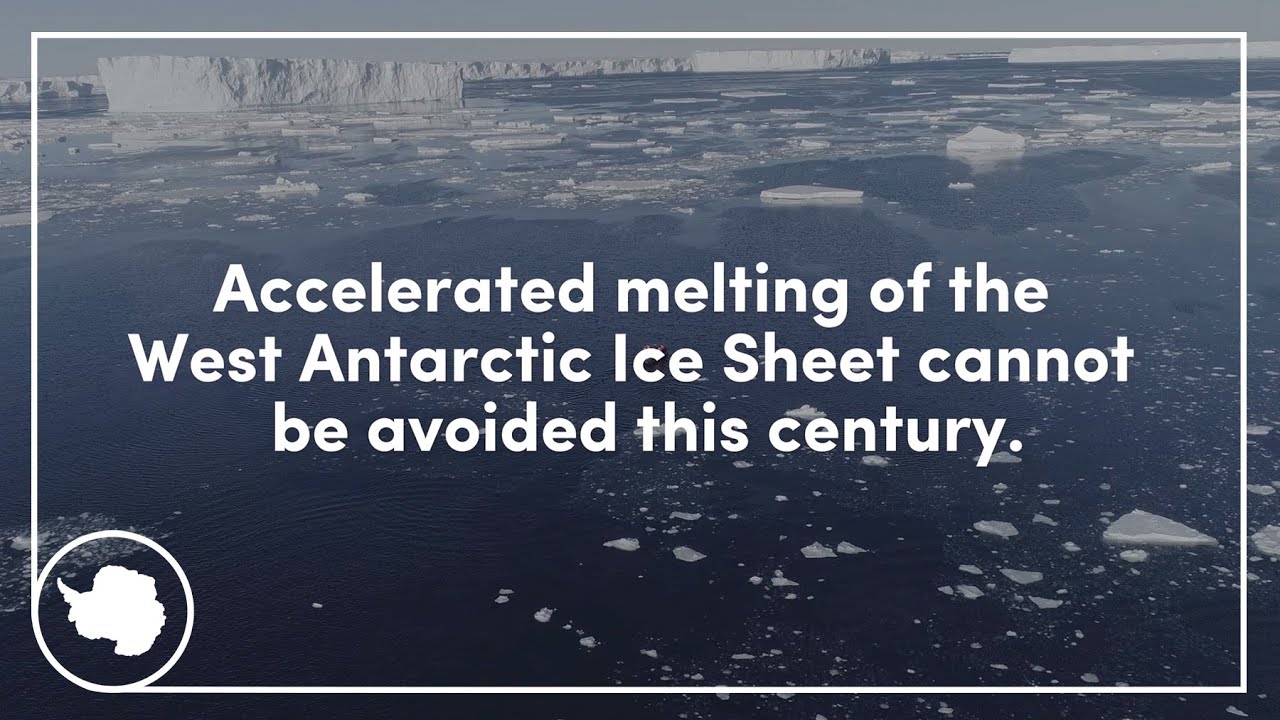
The rate at which the West Antarctic ice sheet is melting will accelerate over the coming decades and is now an "unavoidable" consequence of climate change, a new study finds.
Even if countries manage to cap greenhouse gas emissions and limit global temperature rise to 1.5 degrees Celsius (2.7 degrees Fahrenheit) above preindustrial levels — the target adopted by world leaders in the landmark 2015 Paris Agreement — melting will increase three times faster over the rest of the 21st century than it did during the 20th century.
"It looks like we've lost control of melting of the West Antarctic ice sheet," study lead author Kaitlin Naughten, a researcher at the British Antarctic Survey who specializes in ocean and ice modeling, said in a statement. "If we wanted to preserve it in its historical state, we would have needed action on climate change decades ago."
Enough water is locked up in the West Antarctic ice sheet to trigger up to 16.4 feet (5 meters) of sea level rise, according to the statement. Currently, the biggest contribution to sea level rise from this region appears to come from floating ice shelves in the Amundsen Sea, which are melting as a result of warmer temperatures in the Southern Ocean.
Related: 'Ghost' of ancient river-carved landscape discovered beneath Antarctica
Naughten and her colleagues ran simulations on a supercomputer to predict how much of this melting could still be avoided by reducing greenhouse gas emissions. Taking into account climate events and variability, such as the global effects induced by El Niño, the researchers found little change in the rate of ice loss among four different scenarios outlined in the Paris Agreement.
The three scenarios predicting the lowest rise in mean global temperature — 1.5 C above preindustrial levels, 2 C (3.6 F) above preindustrial levels, and between 2 and 3 C (2.6 and 5.4 F) above preindustrial levels — had nearly identical effects on the rate of melting in the Amundsen Sea, according to the statement.
The scenario foreseeing the highest rise in mean global temperature — which is deemed unlikely to occur, but would lead to 4.3 C (7.7 F) above preindustrial levels — diverged from the lower three, but only after 2045, when it projected more ice melting than the other scenarios. Until then, estimated melting was comparable for the four scenarios, according to the study, published Monday (Oct. 23) in the journal Nature Climate Change.
The findings are bleak, but predicting the consequences of climate change may help us prepare for them. "The bright side is that by recognizing this situation in advance, the world will have more time to adapt to the sea level rise that's coming," Naughten said.
Our actions to limit greenhouse gas emissions may not come in time to prevent "the collapse of the West Antarctic ice sheet," according to the study, but slowing the rate of sea level rise is still a vital pursuit.
"We must not stop working to reduce our dependence on fossil fuels," Naughten said. "The slower the sea level changes, the easier it will be for governments and society to adapt to, even if it can't be stopped."