














How Can a Star Be Older Than the Universe?
Space Mysteries: If the universe is 13.8 billion years old, how can a star be more than 14 billion years old?


For more than 100 years, astronomers have been observing a curious star located some 190 light years away from Earth in the constellation Libra. It rapidly journeys across the sky at 800,000 mph (1.3 million kilometers per hour). But more interesting than that, HD 140283 — or Methuselah as it's commonly known — is also one of the universe's oldest known stars.
In 2000, scientists sought to date the star using observations via the European Space Agency's (ESA) Hipparcos satellite, which estimated an age of 16 billion years old. Such a figure was rather mind-blowing and also pretty baffling. As astronomer Howard Bond of Pennsylvania State University pointed out, the age of the universe — determined from observations of the cosmic microwave background — is 13.8 billion years old. "It was a serious discrepancy," he said.
Related: The Methuselah Star: Oldest Known Star Revealed (Gallery)
Taken at face value, the star's predicted age raised a major problem. How could a star be older than the universe? Or, conversely, how could the universe be younger? It was certainly clear that Methuselah — named in reference to a biblical patriarch who is said to have died aged 969, making him the longest lived of all the figures in the Bible — was old, since the metal-poor subgiant is predominantly made of hydrogen and helium and contains very little iron. It's composition meant the star must have come into being before iron became commonplace.
But more than two billion years older than its environment? Surely that is just not possible.
Taking a closer look at the age of Methuselah
Bond and his colleagues set themselves to the task of figuring out whether or not that initial figure of 16 billion was accurate. They pored over 11 sets of observations that had been recorded between 2003 and 2011 by the Fine Guidance Sensors of the Hubble Space Telescope, which make a note of the positions, distances and energy output of stars. In acquiring parallax, spectroscopy and photometry measurements, a better sense of age could be determined.
"One of the uncertainties with the age of HD 140283 was the precise distance of the star," Bond told All About Space. "It was important to get this right because we can better determine its luminosity, and from that its age — the brighter the intrinsic luminosity, the younger the star. We were looking for the parallax effect, which meant we were viewing the star six months apart to look for the shift in its position due to the orbital motion of the Earth, which tells us the distance."
Get the world’s most fascinating discoveries delivered straight to your inbox.
There were also uncertainties in the theoretical modelling of the stars, such as the exact rates of nuclear reactions in the core and the importance of elements diffusing downwards in the outer layers, he said. They worked on the idea that leftover helium diffuses deeper into the core, leaving less hydrogen to burn via nuclear fusion. With fuel used faster, the age is lowered.

This is a backyard view of the sky surrounding the ancient star, cataloged as HD 140283, which lies 190.1 light-years from Earth. The star is the oldest known to astronomers to date. Image released March 7, 2013.
"Another factor that was important was, of all things, the amount of oxygen in the star," Bond said. HD 140283 had a higher than predicted oxygen-to-iron ratio and, since oxygen was not abundant in the universe for a few million years, it pointed again to a lower age for the star.
Bond and his collaborators estimated HD 140283's age to be 14.46 billion years — a significant reduction on the 16 billion previously claimed. That was, however, still more than the age of the universe itself, but the scientists posed a residual uncertainty of 800 million years, which Bond said made the star's age compatible with the age of the universe, even though it wasn't entirely perfect.
Related: Star Quiz: Test Your Stellar Smarts
"Like all measured estimates, it is subject to both random and systematic error," said physicist Robert Matthews of Aston University in Birmingham, UK, who was not involved in the study. "The overlap in the error bars gives some indication of the probability of a clash with cosmological age determinations," Matthews said. "In other words, the best supported age of the star is in conflict with that for the derived age of the universe [as determined by the cosmic microwave background], and the conflict can only be resolved by pushing the error bars to their extreme limits."
Further refinements saw the age of HD 140283 fall a bit more. A 2014 follow-up study updated the star's age to 14.27 billion years. "The conclusion reached was that the age is about 14 billion years and, again, if one includes all sources of uncertainty — both in the observational measurements and the theoretical modelling — the error is about 700 or 800 million years, so there is no conflict because 13.8 billion years lies within the star's error bar," Bond said.

Scientists have been keen to discover when the universe began — that is, when the Big Bang occurred and left its imprint on the fabric of the cosmos.
Taking a closer look at the age of the universe
For Bond, the similarities between the age of the universe and that of this old nearby star — both of which have been determined by different methods of analysis — is "an amazing scientific achievement which provides very strong evidence for the Big Bang picture of the universe". He said the problem with the age of the oldest stars is far less severe than it was in the 1990s when the stellar ages were approaching 18 billion years or, in one case, 20 billion years. "With the uncertainties of the determinations, the ages are now agreeing," Bond said.
Yet Matthews believes the problem has not yet been resolved. Astronomers at an international conference of top cosmologists at the Kavli Institute for Theoretical Physics in Santa Barbara, California, in July 2019 were puzzling over studies that suggested different ages for the universe. They were looking at measurements of galaxies that are relatively nearby which suggest the universe is younger by hundreds of millions of years compared to the age determined by the cosmic microwave background.
Related: Big Bang to Civilization: 10 Amazing Origin Events
In fact, far from being 13.8 billion years old, as estimated by the European Planck space telescope's detailed measurements of cosmic radiation in 2013, the universe may be as young as 11.4 billion years. One of those behind the studies is Nobel laureate Adam Riess of the Space Telescope Science Institute in Baltimore, Maryland.
The conclusions are based on the idea of an expanding universe, as shown in 1929 by Edwin Hubble. This is fundamental to the Big Bang — the understanding that there was once a state of hot denseness that exploded out, stretching space. It indicates a starting point that should be measurable, but fresh findings are suggesting that the expansion rate is actually around 10% higher than the one suggested by Planck.
Indeed, the Planck team determined that the expansion rate was 67.4 km per second per megaparsec, but more recent measurements taken of the expansion rate of the universe point to values of 73 or 74. That means there is a difference between the measurement of how fast the universe is expanding today and the predictions of how fast it should be expanding based on the physics of the early universe, Riess said. It's leading to a reassessment of accepted theories while also showing there is still much to learn about dark matter and dark energy, which are thought to be behind this conundrum.
Related: The 11 Biggest Unanswered Questions About Dark Matter
A higher value for the Hubble Constant indicates a shorter age for the universe. A constant of 67.74 km per second per megaparsec would lead to an age of 13.8 billion years, whereas one of 73, or even as high as 77 as some studies have shown, would indicate a universe age no greater than 12.7 billion years. It's a mismatch that suggests, once again, that HD 140283 is older than the universe. It has also since been superseded by a 2019 study published in the journal Science that proposed a Hubble Constant of 82.4 — suggesting that the universe's age is only 11.4 billion years.
Matthews believes the answers lie in greater cosmological refinement. "I suspect that the observational cosmologists have missed something that creates this paradox, rather than the stellar astrophysicists," he said, pointing to the measurements of the stars being perhaps more accurate. "That's not because the cosmologists are in any way sloppier, but because age determination of the universe is subject to more and arguably trickier observational and theoretical uncertainties than that of stars."
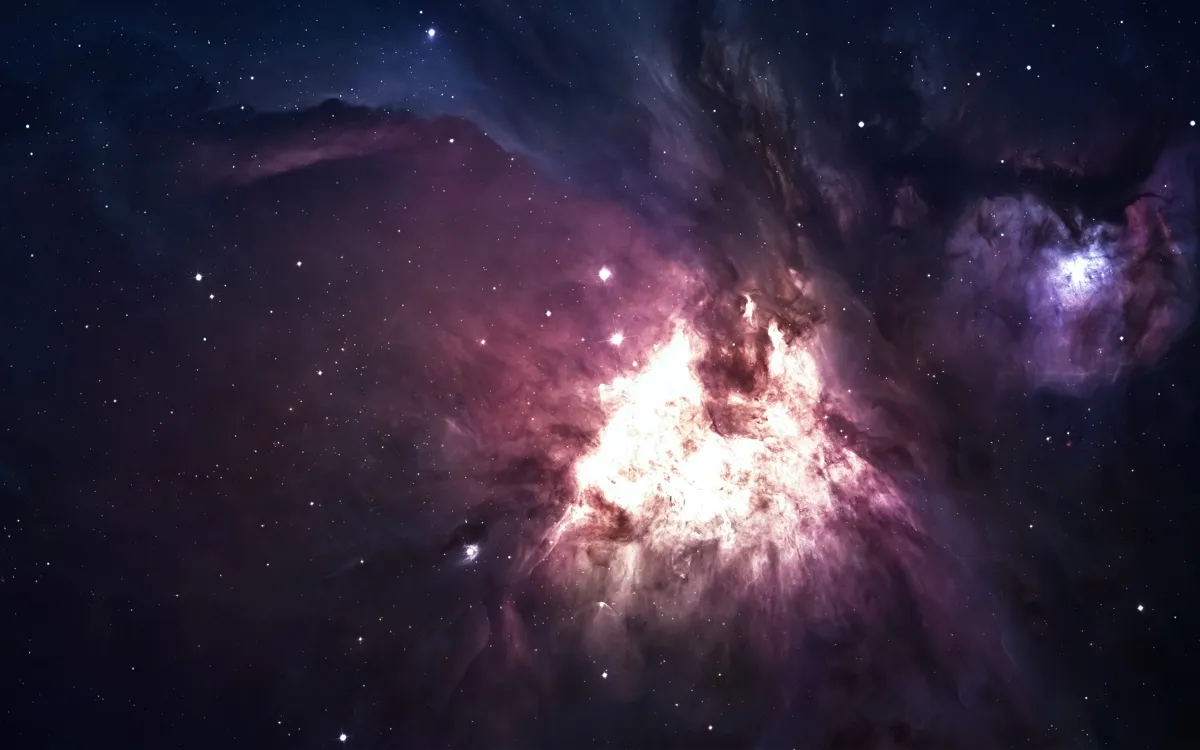
Nebula and stars in deep space.
So, how will scientists figure this out?
What could be making the universe potentially appear younger than this particular star?
"There are two options, and the history of science suggests that in such cases the reality is a mix of both," Matthews said. "In this case that would be sources of observational error that haven't been fully understood, plus some gaps in the theory of the dynamics of the universe, such as the strength of dark energy, which has been the prime driver of the cosmic expansion for many billions of years now."
Related: Dark Matter and Dark Energy: The Mystery Explained (Infographic)
He suggests the possibility that the current "age paradox" reflects time variation in dark energy, and thus a change in the rate of acceleration — a possibility theorists have found might be compatible with ideas about the fundamental nature of gravity, such as so-called causal set theory. New research into gravitational waves could help to resolve the paradox, Matthews said.
To do this, scientists would look at the ripples in the fabric of space and time created by pairs of dead stars, rather than relying on the cosmic microwave background or the monitoring of nearby objects such as Cepheid variables and supernovae to measure the Hubble Constant — the former resulting in the speed of 67 km per second per megaparsec and the latter in 73.
Trouble is, measuring gravitational waves is no easy task, given they were only directly detected for the first time in 2015. But according to Stephen Feeney, an astrophysicist at the Flatiron Institute in New York, a breakthrough could be made over the course of the next decade. The idea is to collect data from collisions between pairs of neutron stars using the visible light these events emit to figure out the speed they are moving relative to Earth. It also entails analyzing the resulting gravitational waves for an idea of distance — both of which can combine to give a measurement of the Hubble Constant that should be the most accurate yet.
The mystery of the age of HD 140283 is leading to something bigger and more scientifically complex, altering the understanding of how the universe works.
"The most likely explanations for the paradox are some overlooked observational effect and/or something big missing from our understanding of the dynamics of the cosmic expansion," Matthews said. Precisely what that "something" is, is sure to keep astronomers challenged for some time.
Additional resources:
- Beyond Higgs: 5 Elusive Particles That May Lurk in the Universe
- Cosmic Record Holders: The 12 Biggest Objects in the Universe
- 7 Everyday Things That Happen Strangely in Space


David Crookes is a UK-based science and technology journalist who has been writing professionally for more than two decades. Having studied at the University of Durham in England, he has written for dozens of newspapers, magazines and websites including The Independent, The i Paper, London Evening Standard, BBC Earth, How It Works and LiveScience. He has been a regular contributor to Space.com's sister publication, All About Space magazine since 2014.