















Author Lise Barnéoud on the bizarre and provoking world of microchimerism — when cells from one person live in another, genetically distinct individual
Journalist and author Lise Barnéoud talks to Live Science about her book "Hidden Guests," which dives into the field of microchimerism and how it's transforming our knowledge of genetics, immunology and evolution.


Over a century ago, German pathologist Georg Schmorl documented a strange phenomenon: cells from fetuses that had moved into the mother during pregnancy. He had discovered microchimerism — where the cells from one individual move into another and set up shop.
In the past few decades, scientists' understanding of microchimerism has grown, thanks to technological advances. And the implications are wild.
Cells transferred during pregnancy could mean you have cells from your grandmother living inside you. A twin can be "absorbed" within the womb, leaving a genetic trace of the lost sibling. And after a bone marrow transplant, a man ended up with the donor's DNA in his blood and semen. These are just a few examples of how microchimerism opens a new way to understand immunology, genetics and evolution.
In her book "Hidden Guests: Migrating Cells and How the New Science of Microchimerism Is Redefining Human Identity" (Greystone Books, 2025), author and journalist Lise Barnéoud explores how the field emerged and developed as scientists grappled with understanding what was going on, and why — as well as the far-reaching implications of these minuscule interlopers.
"Hidden Guests" has been short-listed for the 2026 Royal Society Trivedi Science Book Prize.
Excerpt from "Hidden Guests": 'It doesn't lie. So who are you?': What happens when DNA tests show a woman is not the mother of the child she gave birth to?

Lise Barnéoud is a freelance science journalist who regularly contributes to Mediapart, Science et Vie, Le Monde. In addition to Hidden Guests, she is the author of two books about vaccines (not yet translated). In 2017 she won French Science Writer of the Year and was nominated for European Science Writer of the Year. Lise lives in France.
Live Science spoke with Barnéoud about the book, why the idea of microchimerism resonates so deeply, and where the field could be headed next. "Hidden Guests" has been short-listed for the 2026 Royal Society Trivedi Science Book Prize.
Hannah Osborne: What first got you interested in microchimerism? How did your personal understanding change over the course of writing "Hidden Guests"?
Lise Barnéoud: The first time I heard about it, I was writing my previous book on vaccinations, and I had a chapter on our immunity, how our immune system works. I wanted to explain what we got wrong about how our immunity works. We are still learning — [we used to have this idea] that our immune system is kind of an army patrolling in our body and expelling any foreign elements. That's the image we have of our immune system. I wanted to tell another story, which is more accurate because we know now that it's not working like that.
I was looking for counterexamples, and, of course, one very famous counterexample is pregnancy. We tolerate the fetus that is half different than us. Another well-known counterexample is microbiota. Inside our body, we carry microbial cells as well as human cells — so cells coming from bacteria, viruses, fungi. We don't expel them; we need them. The third example I found was microchimerism.
The more I read about it, the more I was interested in it. It was challenging so many things. I've learned that the placenta is not that watertight barrier that we often think of, that the immune system is not as intolerant as we often think, and we can inherit cells from our kids like an inverted inheritance. All those elements popped up within my first reading, and I thought, "OK, I really need to dig more."
For your second question, I think the biggest change is that I realized those cells are not only kind of inactive tourists, just homeless drifters passively traveling in our body. They are really active. They can multiply, they can produce protein, they communicate with other cells, and they really influence our physiology, for better or for worse.
HO: We see how microchimerism is a relatively new field of research that has had lots of stops and starts. What was the biggest hindrance to the development of the field, and what changed?
LB: Maybe before speaking about the hindrances, just saying that the first time we discovered cells from other individuals within individuals was a century ago. The first one was in 1893, and it was a German pathologist who discovered cells from fetal origin in lungs from women who had died during pregnancy. Then it took a century to understand that this phenomenon happened to everyone and that it is of importance.
I think there are several hindrances. There's never one big one. The first one we can think of is the technology, because you need to study these microchimeric cells; you need tools that are able to study a tissue at the cellular level. This is quite new, so now we have these tools and we can make some progress. The second big hindrance is that this research field calls into question the traditional view of the immune system. If you see the immune system as a purely defensive and intolerant army, then you can't think of these foreign cells staying forever in your body, and that was a big hindrance, I think.
Maybe a third hindrance is that at the beginning of this field — I mean the new beginning in the '90s — they were mostly women working in this field. They told me that male colleagues often said, "Well, that's woman's stuff, you know; you're looking for some connection with your babies, but it's not really relevant," which is wrong, of course, because even men are affected by this phenomenon. They stayed nine months in the womb like us.
That might have, at least, challenged some of the first pioneers of the field. Now there are more and more men working in the field. In April, there was an international conference on microchimerism, and I think it was half women.
It's because it's such a new field and you have such open questions, there's room for many interpretations, many hypotheses.
HO: The book includes many anecdotes about people directly affected by microchimerism. Which story were you most affected by, and why?
LB: I guess it'd be the story of Lydia Fairchild because she nearly lost custody of her children because of microchimerism. She was 26 and living in the U.S., and she applied for a welfare benefit to help her raise her kids. In the U.S., you need to undergo a maternity test for that, and her DNA test ends up showing that she could not be the mother of her kids. Of course she tried to argue; she had photos; she had testimonies. But she was always told, "DNA is 100% foolproof; DNA doesn't lie," which implied that she was lying. But she was not, so she called several lawyers. But at the beginning, they were all saying, "No, DNA doesn't lie."
At that time, she was pregnant with her third child, and they decided to do a test immediately after birth. Again, the impossible happened. This third child that just emerged from her womb was not her son — genetically speaking, at least.
In fact, she was harboring cells from her vanished sister inside her. Most of her eggs carried her sister's genetic signature, which means that the mother of her kids never lived. Isn't it amazing? That's maybe one of the stories that blew my mind.
HO: The section on DNA and how microchimerism complicates things is fascinating. How much of an impact do you think hidden cells have on the reliability of DNA evidence?
LB: The truth is that I think we don't really know. If you have only some microchimeric cells, among thousands of your own cells, then it won't change the reliability of the DNA test. But in some cases, these microchimeric cells can make up a significant part of an organ and sometimes even an entire organ. This proportion might depend on when you received those microchimeric cells. For instance, if you received those cells like Lydia Fairchild at the very, very beginning of your development, they might end up making up the entire organ where they landed first. But probably, we don't know which percentage of us start our in utero life with an evanescent embryo.

An illustration of a human embryo
I looked for this number because I didn't really know about evanescent twins, so I wanted to know how many pregnancies started with several embryos and suddenly one disappeared. And I couldn't find any good number because, of course, it's quite difficult to put any imaging there at the beginning of the condition. Some articles say that up to 30% of pregnancies will start with several embryos, which means a lot of us are affected by evanescent twins. But let's say it might be rare that we have so many microchimeric cells in one organ that it completely changed a DNA test.
But there's another example in my book that took place in Alaska in 2004. After a rape, the forensic investigators collected the semen from the scene, and they discovered that the DNA in this semen matched with a man who was already in the database. But this guy was behind bars. He was in jail, the day of the rape, so he couldn't be the rapist.
Finally, investigators discovered that this guy, the prisoner, received a bone marrow transplant a few years ago from his brother, and the cells from the bone marrow of his brother didn't stay quietly in the bone marrow and blood. They go outside the marrow, and some end up in the semen. And the true rapist was the brother, the one who donated the bone marrow, and not the receiver. Without the alibi of the prison, the brother who received the transplant would have been charged, and the true rapist would have been left free.
I guess there are some cases where microchimeric cells can really change the result of a DNA test. But for now, it's not really studied. I've been contacted by some forensic investigators to learn more about microchimerism, so maybe things will change.
HO: You point out that microchimerism is used for both pro- and anti-abortion arguments, and it's used by "manosphere" influencers to promote ideologies. Why do you think microchimerism research is so open to interpretation and used in this way?
LB: Next time you're at a dinner, just try to explain microchimerism. You're a science journalist, right? Well, usually when you tell the story you're working on, people are saying, "Oh, yeah, OK." And they just turn to another conversation. If you try mentioning microchimerism in your next dinner, then you'll see. Everyone will try to make some hypothesis, some connection; some will be moved that it's possible to keep some cells from an unborn child or a lost child. Some will be disgusted by the idea that they keep cells from their mother, like having their mother on their shoulder all the time. It's really the first time as a science journalist I experienced such resonance with a story I was working on among people around me, people who are really not into science.
As soon as the door opened, it revealed the fears and the desires of people. So yes, some conservatives use microchimerism to fight against abortion because they say the cells from those aborted will haunt the women for the rest of their life. [But] I've met scientists explaining that if you receive a shot of cells of fetal origin, it can also help you to regenerate your organs. It can be used also by some other people to rejuvenate, to try to stay young.
It's because it's such a new field and you have such open questions, there's room for many interpretations, many hypotheses. I mean, that's fine; that's how science works. You should always have hypotheses and try to answer your hypothesis with new experiments. But it's true that sometimes I didn't know how to handle all those ideas at the beginning. Then I realized it was like a window open on the intimate — their fears and their desires — and it reveals what they really think about their connection to the world they are in. From a sociological point of view, it would be really interesting to study that.
HO: In the book, biologist and evolutionary theorist Amy Boddy warns that microchimerism researchers love to hypothesize. When the implications of the field are so far-reaching, how do we get past this? Which hypothesis do you find most intriguing?
LB: Many scientists told me that until 2021 or something like that, there was this hypothesis that those cells could come from another generation than the mother. We knew that the mother would give cells to the fetus and the fetus could give cells to the mother, but then people ask, because the mother can still carry cells from her mother, maybe she could pass those cells to the fetus. Until the 2020s, scientists were thinking, "Well that's a crazy hypothesis; that can't happen." There could be only a few cells that won't go through the placenta and integrate with the new fetus — until one scientist proved that a newborn can carry cells from the grandma.
In this field, you always have crazy hypotheses, and I guess until we haven't proved that this hypothesis is wrong, you can still leave the hypothesis on the table. One of the craziest hypotheses, the first time I encountered it, I thought, "OK, they've gone really too far."
This hypothesis is that we could inherit cells from our sexual partner. I thought it was not possible because I thought the semen was full of spermatozoa, that they are only like half cells having only half chromosomes, so they cannot survive. But actually in semen, you have a lot more cells than spermatozoids — you have immune cells, for example.
There are many cells in the semen, and we can think that if you have some, there could be some path for those cells to escape and go into your blood. It's not completely crazy. For now, there's no formal proof of this new source of microchimerism, but I recently heard that some scientists are working on the topic on mice.
We should be careful about those interpretations. But I think scientists are not the ones who should care about this interpretation; otherwise, they would prevent themselves from doing their research. They should open all the doors with all kinds of hypotheses. If we do it in a scientific way, meaning if we try to answer a hypothesis with good experiments, then I think everything is fine. You will never prevent people around you from using this information to distort the facts and tell another story. That's how life goes.
Related stories
HO: What do you think the most promising use for microchimerism research will be over the next 10 to 20 years? How do you see it unfolding?
LB: I guess it will be in the regeneration field. We have discovered that those cells can participate to regenerate tissue. Some scientists around the world are doing clinical studies to see whether we could use these cells as a therapy either after an infarctus [heart attack], but also a vascular accident [stroke] or when you have a wound on your skin. The hope is that by either attracting microchimeric cells that are within our bodies, or injected, these microchimeric cells maybe can help this kind of tissue to repair. I think that might be one of the promising uses of these cells in the future.
Maybe also in the transplantation field; maybe we can think about using the knowledge of how microchimeric cells can induce tolerance to avoid [immunosuppressive] drugs. When you receive the transplant, you need to take drugs [that suppress the immune system] for the rest of your life, and those drugs are like really strong drugs. If we can use microchimeric cells before the transplant to allow better tolerance, then we could either not use any drugs or maybe use less drugs. That would be really interesting, too.
This interview has been condensed and edited lightly for clarity.
Help us improve Live Science Pro: We're always trying to make our content better. Leave us feedback about Pro here.
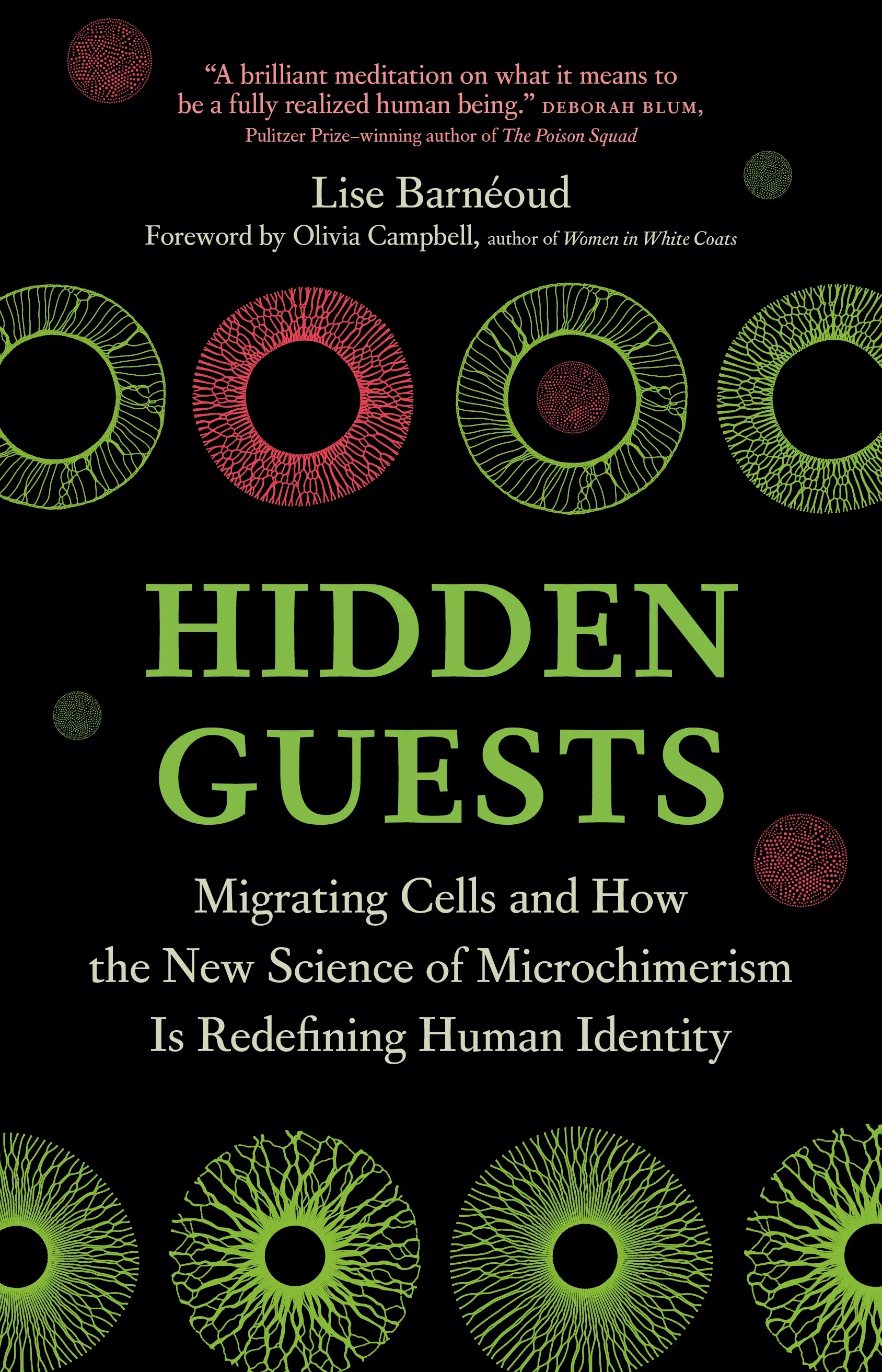
What if some of your cells were not your own? What if they once belonged to someone else?
Part mind-bending medical mystery — part cutting-edge science — Hidden Guests uncovers the astonishing phenomenon of microchimerism: the presence of foreign cells inside our own bodies. The incredible story of how those cells got there — and what they do once they arrive — might change everything we know about the immune system, lineage, and identity.

Hannah Osborne is the planet Earth and animals editor at Live Science. Prior to Live Science, she worked for several years at Newsweek as the science editor. Before this she was science editor at International Business Times U.K. Hannah holds a master's in journalism from Goldsmith's, University of London.
You must confirm your public display name before commenting
Please logout and then login again, you will then be prompted to enter your display name.