


-
 Only 1% of chemicals in the universe have been discovered. Here's how scientists are hunting for the rest.
Most chemical compouds are still unknown to science. How many new ones can we make by combining elements from the periodic table?
chemistry -
 Can foxgloves really give you a heart attack?
Foxgloves contain digoxin, a drug used to treat cardiac arrhythmia and heart failure that can also be toxic. But can ingesting it cause a heart attack?
chemistry -
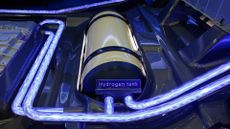 Is hydrogen a metal?
Hydrogen is not a metal on Earth, but scientists keep trying to create metallic hydrogen under high pressure to unlock a new superconductor.
chemistry -
 States of matter: Definition and phases of change
Reference The four fundamental states of matter are solid, liquid, gas and plasma, but there others, such as Bose-Einstein condensates and time crystals, that are man-made.
Reference -
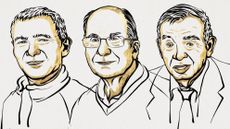 Nobel Prize in chemistry awarded to trio who discovered bizarre quantum dots
Moungi Bawendi, Louis Brus and Alexei Ekimov will share the Nobel Prize in Chemistry for their discovery of strange nanoparticles that change color according to their size.
chemistry -
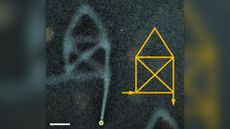 For 1st time, scientists write words in liquid water
Scientists used a process called 'diffusioosmosis' to write words that lingered in liquid water.
chemistry -
 What's the highest temperature water can freeze, and the lowest it can boil on Earth?
Ice can form on Earth at temperatures above 32 degrees Fahrenheit (0 degrees Celsius), and water can boil below 212 F (100 C). Here's how.
chemistry -
 Is glass a liquid or a solid?
Glass has unique properties, but is it a solid or a liquid, or does it fall into its own scientific category?
chemistry -
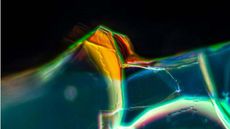 Roman glass keeps turning into photonic crystals. Scientists finally know why
Analysis of the microscopic structure of an ancient shard of Roman glass has revealed how photonic crystals form, and might enable them to be grown.
chemistry


