

-
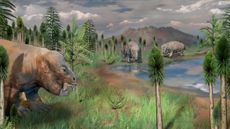 Refuge from the worst mass extinction in Earth's history discovered fossilized in China
The End-Permian mass extinction killed an estimated 80% of life on Earth, but new research suggests that plants might have done okay.
10 Comments -
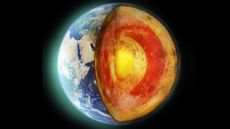 Scientists discover giant blobs deep inside Earth are 'evolving by themselves' — and we may finally know where they come from
Giant regions of the mantle where seismic waves slow down may have formed from subducted ocean crust, a new study finds.
-
 What counts as a phobia?
Specific phobias are out-of-proportion fears to objects, animals or situations, and fortunately, they can be treated.
-
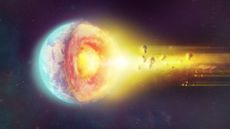 'Primordial' helium from the birth of the solar system may be stuck in Earth's core
The discovery that helium and iron can mix at the temperatures and pressures found at the center of Earth could settle a long-standing debate over how our planet formed.
3 Comments -
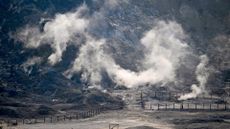 Italy's Campi Flegrei volcano may unleash devastating eruptions more often than we thought, ancient outburst suggests
A new look at an ancient eruption at Campi Flegrei raises new questions about the propensity of the still-active volcano, located near Naples, to produce major eruptions in the future.
-
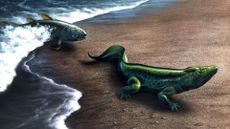 Evolution itself can evolve, new study argues
A new computer model suggests that the process of evolution can get better at evolving in the face of environmental change.
24 Comments -
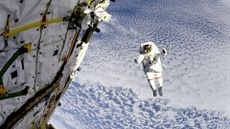 'Stranded' Starliner astronauts finally have a return date — and it's sooner than expected
NASA will send astronauts Butch Wilmore and Suni Williams home from the International Space Station early on a previously used SpaceX Dragon space capsule, not on a brand-new one, the agency announced.
6 Comments -
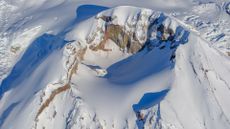 Earthquakes at massive Alaska volcano Mount Spurr ramp up again — and there's now a 50-50 chance of an eruption
Ten months of unrest at Mount Spurr could be a sign of an upcoming eruption from a side vent or, less likely, from the main crater.
-
 Hims & Hers Super Bowl controversy: What the ad left out about its 'alternative' weight-loss drugs
The telehealth company Hims & Hers put out a Super Bowl ad that skimped on clarifying that its compounded semaglutide medications aren't FDA-approved.
7 Comments -
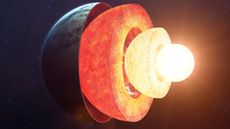 Scientists discover Earth's inner core isn't just slowing down — it's also changing shape
The surface of Earth's inner core appears to be dynamic, changing shape as it rotates, earthquake waves reveal.
-
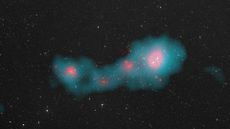 Astronomers discover 'Quipu', the single largest structure in the known universe
Newly discovered Quipu, a superstructure in which galaxies group together in clusters and clusters of clusters, is the largest known structure in the universe in terms of length, scientists claim.
3 Comments -
 Scientists find giant magma reservoirs hidden beneath dormant volcanoes in the Cascades
The magma system beneath volcanoes may persist even after recent eruptions, a new study finds.
-
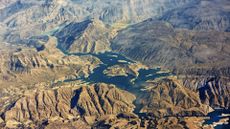 Ocean plate from time of Pangaea is now being torn apart under Iraq and Iran
What was once the floor of an ancient ocean is still shaping the landscape between Arabia and Eurasia.
-
 Earth's crust is peeling away under California
A section of the upper mantle and crust under the Sierra Nevada mountains is peeling away, in a process that may mimic how the continents were formed.
7 Comments -
 Santorini is having a swarm of tiny earthquakes. Is the Greek isle about to erupt?
An uptick in seismic activity on the volcanic island of Santorini has raised concerns about a potential eruption.
-
 Doomsday Clock is now 89 seconds to midnight, the closest yet to catastrophe
The Bulletin of the Atomic Scientists has moved its Doomsday Clock closer to Armageddon than ever before.
3 Comments -
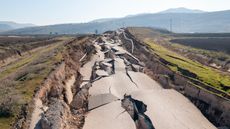 Scientists find hidden mechanism that could explain how earthquakes 'ignite'
How does creeping stress ignite a cataclysmic earthquake? A new study has answers.
-
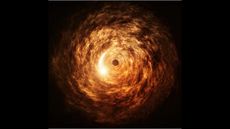 James Webb telescope captures 1st 'mid-infrared' flare from Milky Way's supermassive black hole
The James Webb Space Telescope has captured a mid-infrared picture of Sagittarius A*, filling in a long-standing gap in observations..
-
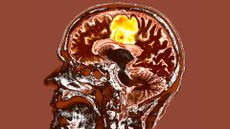 New treatment for most aggressive brain cancer may help patients live longer
Glioblastoma often kills within months. A new targeted radiation therapy may help patients live longer.
-
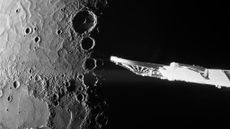 See Mercury's frigid north pole in extraordinary new images from the BepiColombo spacecraft
A joint Japanese-European mission to Mercury just made its sixth flyby of the planet, revealing stunning close-ups of the permanently shadowed craters at Mercury's north pole.
-
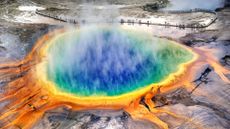 We finally know where the Yellowstone volcano will erupt next
A detailed look at Yellowstone's magma storage system finds that only one region is likely to host liquid magma in the long term.
-
 Scientists find hidden 'hotspot' that helped create the Great Lakes before North America even existed
A hotspot that now lies in the middle of the Atlantic Ocean was once under the Great Lakes, and may explain why they formed where they did.
-
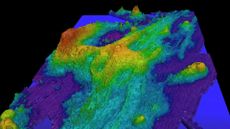 Undersea volcano off Oregon coast could erupt this year, geologists predict
Axial, an undersea volcano off the coast of Oregon is probably going to erupt in 2025.
-
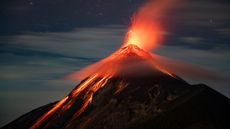 What's the difference between an active, dormant and extinct volcano?
To be considered active, a volcano must have erupted at some point during the Holocene, but dormant and extinct are a little harder to define.


