Get the world’s most fascinating discoveries delivered straight to your inbox.
You are now subscribed
Your newsletter sign-up was successful
Want to add more newsletters?
Join the club
Get full access to premium articles, exclusive features and a growing list of member rewards.
An account already exists for this email address, please log in.
1,000-year-old altar and human sacrifices from Toltec Empire discovered in Mexico
Archaeologists found the altar and human bones during a construction project near Tula, an ancient city that was the capital of the pre-Hispanic Toltec Empire.
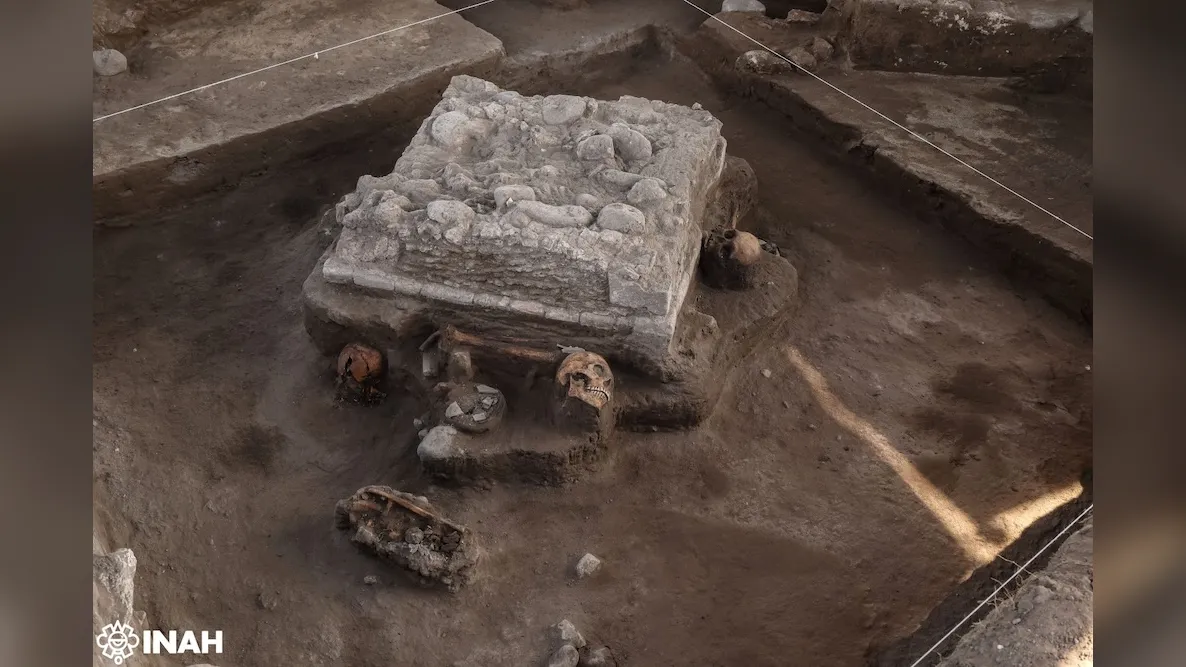
Archaeologists in Mexico have unearthed a square stone altar used for human sacrifices during the Toltec Empire more than 1,000 years ago.
The altar, human bones, obsidian knives and ceramic vessels were discovered during excavation for a transportation project near the archaeological site of Tula, about 55 miles (88 kilometers) north of Mexico City.
In a translated statement posted Tuesday (March 24) by Mexico's National Institute of Anthropology and History (INAH), archaeologists described the altar — also called a momoztli in Nahuatl — as a three-layer construction of stones that measures about 10 square feet (1 square meter). Four human skulls and several human leg bones were recovered from three sides of the altar, likely from people who were sacrificed.
"We know that they are offerings because they are located specifically in certain sections of the feature, but we don't know if they have any other remains underground that cannot be physically seen," Víctor Francisco Heredia Guillén, the archaeologist who's coordinating the project, said in a translated video.
Archaeologists discovered the remains of walls around the altar, suggesting it was located in a courtyard. Additional rooms flanked the courtyard and may have been part of a palace or other residential structure housing ancient Tula's elite, Heredia said.
Between the fall of Teotihuacán around A.D. 550 and the rise of Tenochtitlán in 1325, Tula was an important Mesoamerican urban center and the capital of the Toltec Empire, which lasted from 950 to 1150. Located in Mexico's Hidalgo state, Tula was contemporary with the Maya site of Chichén Itzá in the Yucatán Peninsula. Tula boasts a large pyramid dedicated to the feathered serpent god Quetzalcoatl that is topped with four massive statues of Toltec warriors.
Skulls and other human body parts were discovered around the ancient altar.
(Image credit: Gerardo Peña/INAH)
The newly discovered altar likely dates to the imperial period of Tula's occupation, according to the archaeologists. By that time, the Toltec had gained a reputation as fierce warriors, and the human sacrifices may have been enemies offered after the Toltec defeated them.
Sign up for the Live Science daily newsletter now
Get the world’s most fascinating discoveries delivered straight to your inbox.
One of the skulls appears to still be attached to part of the spine, suggesting decapitation was part of the sacrificial ritual.
"In this case, although metal was already being worked in the postclassic period, we know that decapitations were still done here with obsidian or flint knives, and they left cut marks on the bones," Heredia said.
But additional research will be required to learn more about the sacrificial victims. Anthropological analysis should reveal whether the bones came from men or women, and chemical analysis may show whether the victims were local or came to Tula from afar, Heredia said.
"Each discovery like this expands our knowledge of one of the great civilizations of Mesoamerica," Claudia Curiel de Icaza, the Mexican secretary of culture, said in the statement.
First Americans quiz: How much do you know about the first people to reach the Americas?
Kristina Killgrove is a staff writer at Live Science with a focus on archaeology and paleoanthropology news. Her articles have also appeared in venues such as Forbes, Smithsonian, and Mental Floss. Kristina holds a Ph.D. in biological anthropology and an M.A. in classical archaeology from the University of North Carolina, as well as a B.A. in Latin from the University of Virginia, and she was formerly a university professor and researcher. She has received awards from the Society for American Archaeology and the American Anthropological Association for her science writing.
You must confirm your public display name before commenting
Please logout and then login again, you will then be prompted to enter your display name.