














China's 8.5-Ton Space Lab Expected to Fall to Earth Over Easter Weekend

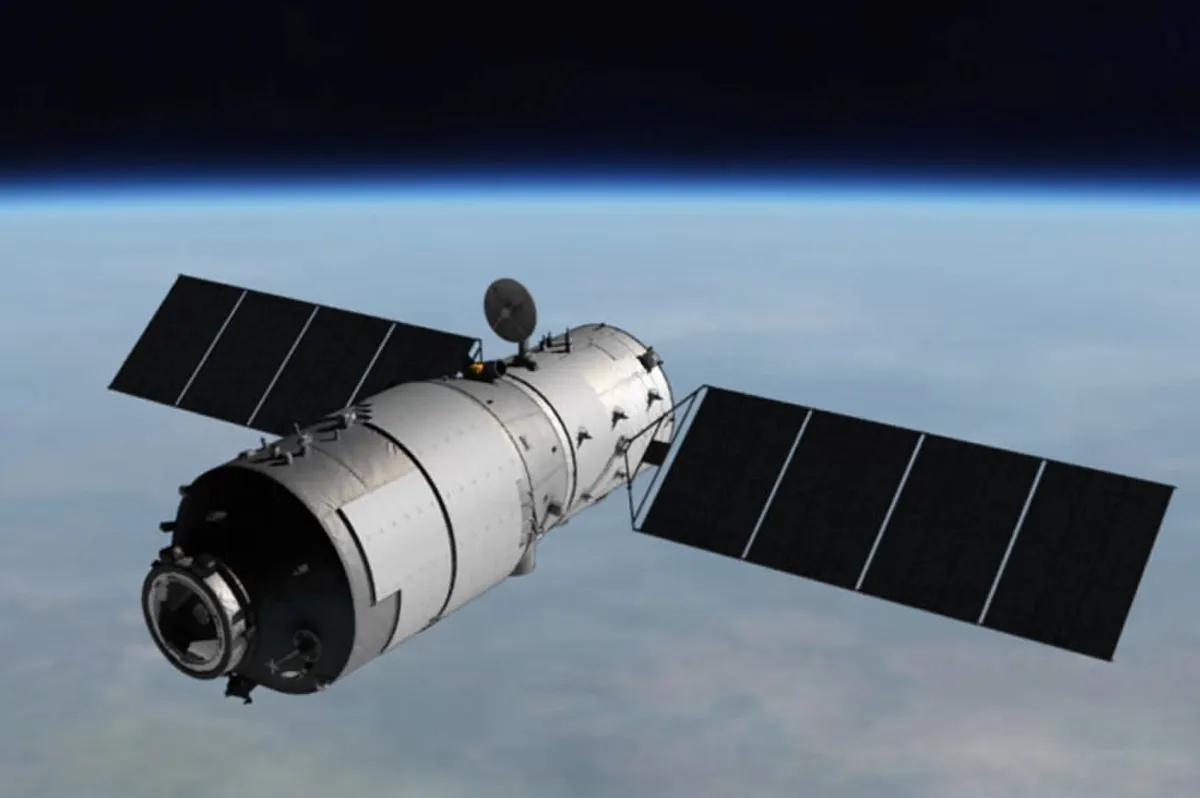
China's Tiangong-1 space lab will likely fall to Earth between March 30 and April 2, according to the latest prediction by the European Space Agency's (ESA) Space Debris Office in Darmstadt, Germany.
This window is "highly variable," not ironclad, Space Debris Office representatives stressed in the updated forecast, which was issued yesterday (March 21).
Tiangong-1 was lofted in late September 2011, to help test the docking and rendezvous technologies required to build a bona fide space station, which China aims to do by the mid-2020s. [China's Tiangong-1 Space Lab in Pictures]
The first Chinese orbital docking occurred between Tiangong-1 and an unpiloted Shenzhou spacecraft on Nov. 2, 2011. Two piloted missions were subsequently completed to visit Tiangong-1: Shenzhou-9 and Shenzhou-10, in June 2012 and June 2013, respectively.
Test campaign
Meanwhile, ESA will serve as host and administrator of a test campaign regarding the re-entry of Tiangong-1, conducted by the Inter Agency Space Debris Coordination Committee (IADC).
IADC comprises space-debris experts and other researchers from 13 space agencies and other organizations, including NASA, ESA, European national space agencies, the Japan Aerospace Exploration Agency, the Indian Space Research Organisation, the Korea Aerospace Research Institute, Russia's Roscosmos and the China National Space Administration.
IADC members will use the fall of Tiangong-1 to conduct their annual re-entry test campaign, during which participants will pool their predictions of the time window, as well as their respective tracking datasets obtained from radar and other sources. The aim is to cross-verify, cross-analyze and improve the prediction accuracy for all members.
Get the world’s most fascinating discoveries delivered straight to your inbox.
Where on Earth?
It's unknown where exactly Tiangong-1 will fall back to Earth. But given the spacecraft's inclination, it will re-enter somewhere between 43 degrees north and 43 degrees south latitudes.
Owing to the Chinese station's mass and construction materials, there is a distinct possibility that some portions of Tiangong-1 will survive the fiery journey through Earth's atmosphere and reach the surface, experts say.
Leonard David is author of "Mars: Our Future on the Red Planet," published by National Geographic. The book is a companion to the National Geographic Channel series "Mars." A longtime writer for Space.com, David has been reporting on the space industry for more than five decades. Follow us @Spacedotcom, Facebook or Google+. This version of the story published on Space.com.

Leonard David is an award-winning space journalist who has been reporting on space activities for more than 50 years.