














NASA, France Team Up for 2016 Mars Lander Mission

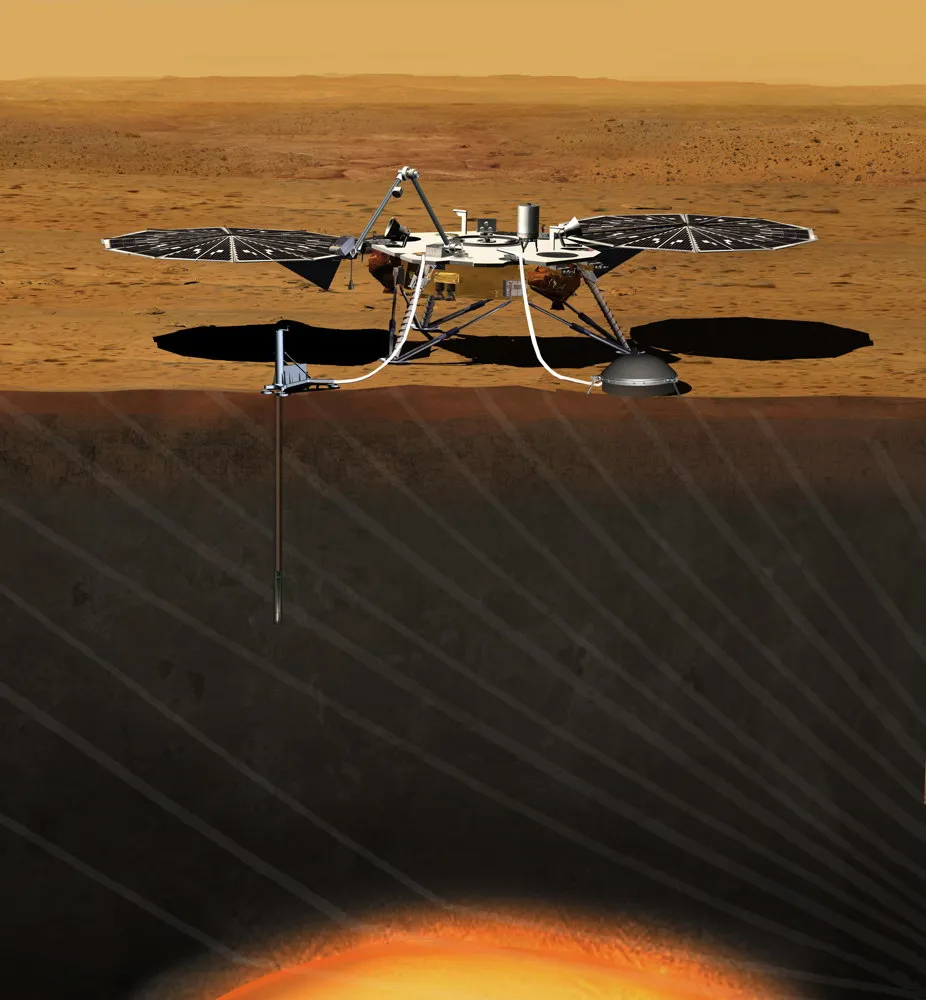
Space officials from the United States and France signed an agreement this week to work together on a NASA's next Mars lander mission set to launch in 2016 to peer deep into the core of the Red Planet.
The InSight Mars lander — the name is short for Interior Exploration Using Seismic Investigations, Geodesy, and Heat Transport — is currently scheduled to take flight in March 2016 and touch down on Mars six months later.
The spacecraft will spend two years study the Mars' interior makeup, which could help scientists understand the building blocks of terrestrial planets like Earth. [NASA's Mars InSight Lander Mission in Pictures]
NASA Administrator Charles Bolden and Jean-Yves Le Gall, president of the National Center of Space Studies of France (CNES), signed an implementing deal Monday (Feb. 10) pledging their cooperation on the project.
"This new agreement strengthens the partnership between NASA and CNES in planetary science research, and builds on more than 20 years of cooperation with CNES on Mars exploration," Bolden said in a statement from NASA. "The research generated by this collaborative mission will give our agencies more information about the early formation of Mars, which will help us understand more about how Earth evolved."
Spacecraft now studying the Red Planet like NASA's Mars Rover Curiosity have largely focused on surface features like rocks and soil to piece together a history of Mars. But NASA officials say InSight will probe much deeper, with geophysical instruments that can study the properties of the Red Planet's core, mantle and crust as well as heat flow from the interior.
The spacecraft could help scientists determine whether Mars has a liquid or solid core and why its crust doesn't seem to have drifting tectonic plates like those on Earth.
Get the world’s most fascinating discoveries delivered straight to your inbox.
NASA's Jet Propulsion Laboratory in Pasadena, Calif., will lead the InSight mission under principal investigator principal investigator, Bruce Banerdt. CNES is building one of the lander's key tools: the Seismic Experiment for Interior Structure instrument, or SEIS, which will explore Martian tectonic activity and meteorite impacts.
The InSight mission was selected in 2012 as part of NASA's Discovery Program, an initiative established in 1992 to explore the solar system on a low budget. (InSight's funds are capped at $425 million, not including launch vehicle funding, according to NASA.)
InSight is just one of several missions in NASA's Mars program. The space agency launched its Mars Atmosphere and Volatile EvolutioN mission (MAVEN for short) last November to study the upper atmosphere of the Red Planet. NASA is also developing its next Mars rover, set to launch in 2020, to search for life.
Follow Megan Gannon on Twitter and Google+. Follow us@SPACEdotcom, Facebook or Google+. Originally published on Space.com.
