













Beaks Helped Dinosaurs Chomp on Food

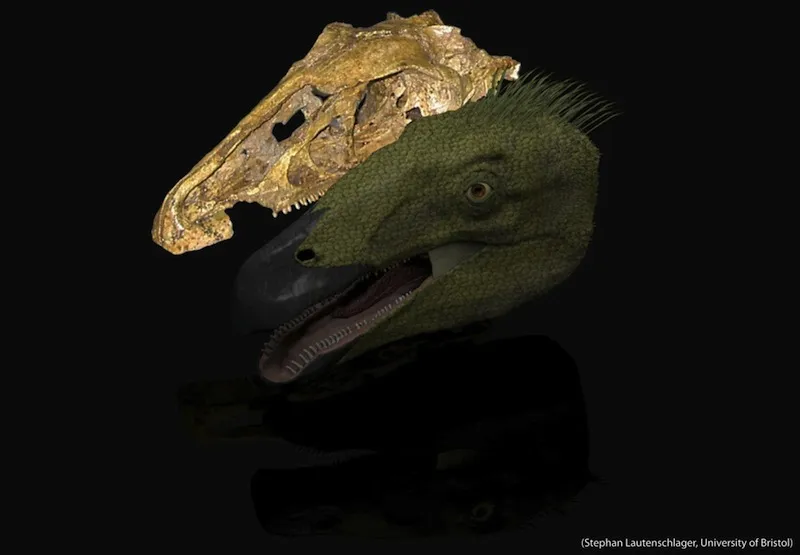
Millions of years ago, several groups of dinosaurs evolved beaks much like the bills on their bird cousins today, and a new study could explain why.
Using X-ray scans and computer models, researchers found that beaks likely helped stabilize the skulls of the dinosaurs as they chomped down on their food.
"It has classically been assumed that beaks evolved to replace teeth and thus save weight, as a requirement for the evolution of flight," study researcher Stephan Lautenschlager, of the University of Bristol, explained in a statement. "Our results, however, indicate that keratin beaks were in fact beneficial to enhance the stability of the skull during biting and feeding." [Avian Ancestors: Dinosaurs That Learned to Fly]
For their research, Lautenschlager and colleagues turned to therizinosaurs. With long necks, tiny heads, wide bodies and huge claws, these bizarre-looking herbivores walked on two legs and perhaps were coated in feathers.
Skeletal remains of the therizinosaur Erlikosaurus andrewsi, which was up to 13 feet (4 meters) long and lived in Mongolia more than 90 million years ago, suggest that part of its snout was sheathed in a keratin beak. Researchers think this beast was just one of several dinosaurs in the maniraptoriformes clade to evolve beaks during the Cretaceous Period (including the group that gave rise to modern birds).
Keratin is the material that also makes up fingernails and claws, and it is not typically preserved in the fossil record. Without actual beaks to examine, the researchers used computer simulations to reconstruct how bite and muscle forces would have affected the skull of E. andrewsi while it was eating.
The researchers found that most of this dinosaur's biting and food processing would have taken place at the toothless tip of the snout. (They say this is also evidenced by the lack of wear on the dinosaur's back teeth, as well as the low replacement rate of these chompers.) A beak, the scientists say, would have helped dissipate the stress of biting and eating, making the dinosaur's skull less susceptible to bending and deformation.
Get the world’s most fascinating discoveries delivered straight to your inbox.
"Beaks evolved several times during the transitions from dinosaurs to modern birds, usually accompanied by the partial or complete loss of teeth and our study now shows that keratin-covered beaks represent a functional innovation during dinosaur evolution," study researcher, Lawrence Witmer, of the Ohio University Heritage College of Osteopathic Medicine, said in a statement.
The research was detailed on Monday (Dec. 2) in the Proceedings of the National Academy of Sciences.
Follow Megan Gannon on Twitter and Google+. Follow us @livescience, Facebook & Google+. Original article on LiveScience.
